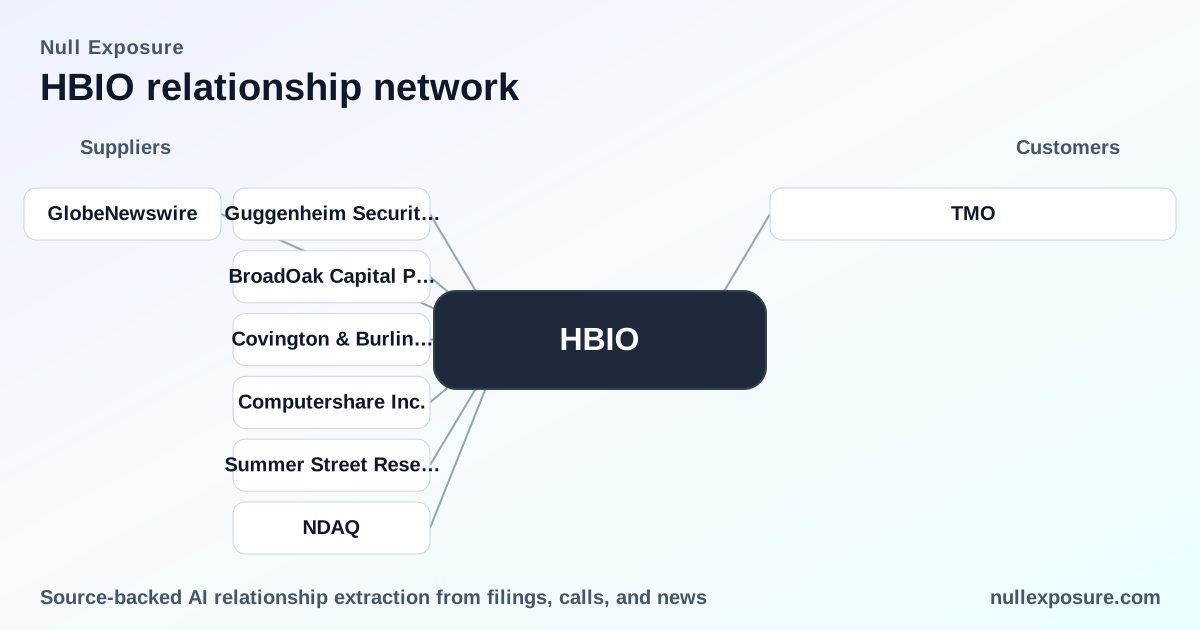
Harvard Bioscience (HBIO) — Distribution expansion with Thermo Fisher sharpens go‑to‑market; core preclinical franchise remains the revenue engine
Harvard Bioscience designs, manufactures and sells life‑science instruments, software and post‑sales services to academic labs, biotechs, CROs and government research centers, monetizing through direct equipment sales, distributor relationships and recurring service/consumable revenue. Its commercial model is a hybrid of direct selling and distribution, with hardware and consumables driving near‑term revenue and software/services adding margin and recurring cash flow. For investors, the recent expansion of distribution with Fisher Scientific (Thermo Fisher) is a high‑leverage commercial event layered on a business that is operationally short‑cycle and geographically diversified. Learn more at https://nullexposure.com/.
Why the Fisher Scientific (Thermo Fisher) expansion matters to the P&L
Harvard announced an expanded distribution agreement with Fisher Scientific that now places Harvard pumps, spectrophotometers and BTX electroporation systems into Thermo Fisher’s US Fisher Scientific channel, complementing an existing European arrangement. According to a GlobeNewswire press release dated September 16, 2025, this broadened access should accelerate North American penetration for core instrument lines. An earnings call transcript for Q3 2025 also confirmed management’s view that the expanded Fisher relationship significantly broadens access to Harvard’s products across North America (InsiderMonkey, Q3 2025 transcript).
Fisher Scientific — distribution reach in the United States
Harvard’s press release (GlobeNewswire, 16 Sep 2025) describes an explicit expansion: Fisher Scientific will now offer pumps, spectrophotometers and BTX electroporation systems across the United States, augmenting the company’s existing European distribution footprint. This converts channel access into potential incremental sales volume across both academic and industrial end markets.
TMO / Thermo Fisher Scientific — strategic channel partner at scale
Management reiterated in the company’s Q3 2025 earnings remarks (earnings call transcript published on InsiderMonkey) that the Fisher Scientific expansion materially broadens North American distribution for Harvard’s product families, implying a strategic alignment with a very large enterprise channel partner that can scale commercial coverage and inventory availability.
Operating model constraints that shape revenue predictability and risk
Harvard’s commercial model is defined by a set of company‑level operational constraints that govern contract economics, counterparty mix, geographic exposure and product maturity.
- Contracting posture — short duration, transactional sales dominate. Company disclosures indicate payment terms of zero to sixty days and that the majority of contracts run for less than one year; contract liabilities are generally recognized within one year. That results in rapid revenue recognition but higher sensitivity to quarter‑to‑quarter demand swings.
- Some long‑term elements coexist. Amortization of definite‑lived intangibles over four to fifteen years shows pockets of longer‑lived value (acquisitions, customer contracts), but these do not replace the overall short‑term nature of most customer orders.
- Customer concentration and counterparty mix. Harvard sells globally to academic institutions, CROs, pharma/biotech and government labs; no single customer accounted for more than 10% of revenue in 2024. This provides diversification while retaining dependence on R&D and government funding cycles.
- Geographic diversification is material. The company operates across North America, EMEA and APAC with significant international revenue exposure and related FX and geopolitical risks.
- Product mix and materiality. Preclinical products comprised approximately 51% of global revenues in both 2023 and 2024, making that franchise critical to overall performance even as other lines (CMT product family ~49%) remain material.
- Distribution dependency. Roughly 37% of revenues flow through distributors, which amplifies the importance of relationships like Fisher/Thermo Fisher for scale and channel velocity.
- Segments and revenue drivers. Harvard’s revenue streams are a blend of hardware (instruments/equipment), software (licenses/enhancements) and services (installation, training, data analysis, maintenance); services contributed several million dollars annually and offer margin stability.
- Operational maturity signals. The company has identified historical internal control weaknesses in order‑to‑cash processes and inventory counts; remediation progress is an execution metric investors should watch.
Investment implications — how the relationships translate to valuation
- Distribution expansion is a near‑term revenue multiplier. Partnering with Fisher Scientific in the US converts Harvard’s reach into potential incremental orders for its core hardware lines; the distribution channel can accelerate adoption cycles for preclinical and CMT products.
- Economics remain short‑cycle and demand‑sensitive. Given short payment terms and prevalent <1 year contracts, revenue growth requires consistent order flow rather than long backlog visibility.
- Preclinical franchise concentration is both a strength and a risk. With ~51% of revenues concentrated in preclinical, acceleration in CRO and pharma R&D spending will disproportionately benefit HBIO margins and EBITDA.
- Service and software are margin stabilizers. Recurring services and software enhancements increase lifetime customer value and reduce top‑line volatility versus pure equipment sales.
For deeper operational coverage and relationship mapping visit https://nullexposure.com/.
Risks investors should monitor closely
- Distributor demand volatility. Revenues fell $18.2M (16.1%) in 2024 due primarily to softening demand from distributors, CROs and academic institutions; distribution channels amplify downstream demand cycles.
- Budget dependency of core customers. Universities, government labs and some biotech customers rely on external funding (NIH, grants); government budget shifts translate into reduced procurement windows.
- Export and regulatory controls. Certain equipment sales may require export licenses; regulatory friction can delay or restrict international orders.
- Internal controls and order‑to‑cash weakness. Historical control gaps increase the chance of billing, collection and revenue recognition issues until fully remediated.
- Foreign exchange and geopolitical exposure. Substantial international operations mean FX swings and regional tensions (China, APAC, EMEA) will affect reported results.
Bottom line
Harvard Bioscience is a focused life‑science instrument and services company that monetizes through direct sales, distributor networks and recurring services; the Fisher/Thermo Fisher expansion materially upgrades US channel access for key instrument lines. The company’s short‑cycle contracts, high distributor mix and concentration in the preclinical franchise create a profile that offers meaningful upside from improved channel execution but remains sensitive to funding cycles, distributor demand and operational controls. Monitor execution on the Fisher rollout, remediation of order‑to‑cash controls, and trends in CRO/pharma R&D spend for the clearest read on whether expanded distribution converts into sustained margin‑accretive growth.
Sources: GlobeNewswire press release (September 16, 2025) announcing the Fisher Scientific distribution expansion; Q3 2025 earnings call transcript published on InsiderMonkey confirming management commentary; Harvard Bioscience FY2023–FY2024 disclosures and 2024 financial statements for contract, geographic and segment details.