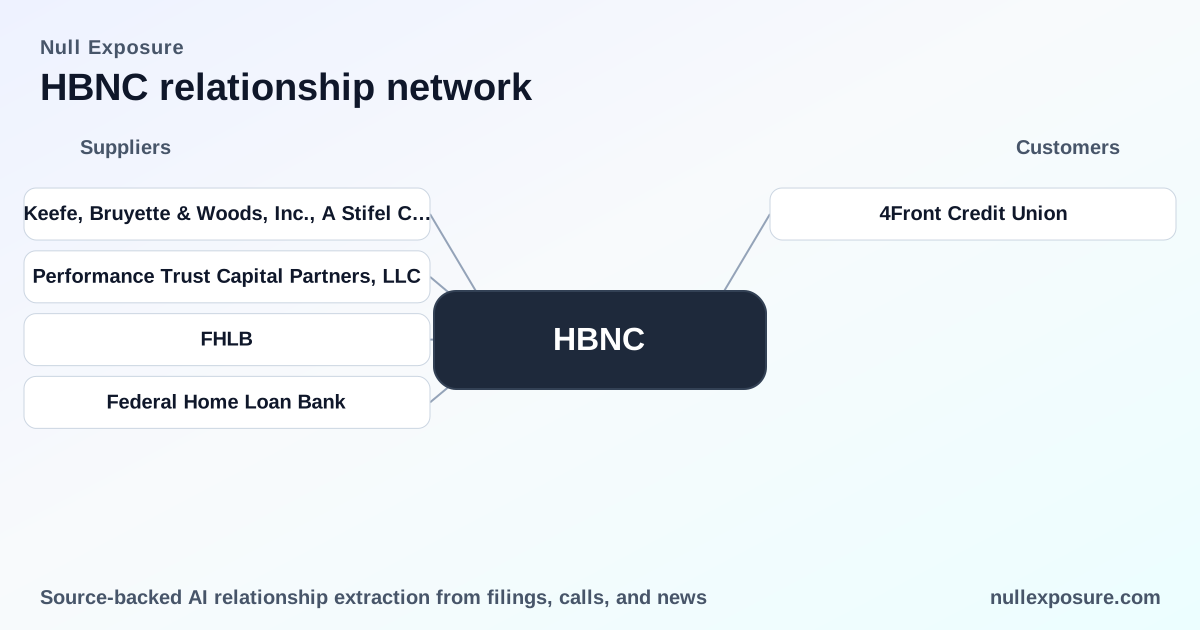
Horizon Bancorp (HBNC) — Customer Relationships and Strategic Signals for Investors
Horizon Bancorp operates as a regional bank holding company that earns most of its revenue from interest on a large loan portfolio and recurring deposit balances, supplemented by fee income from payment activity, mortgage banking and fiduciary services. The company monetizes through net interest margin on loans (commercial and consumer), transaction and interchange fees, mortgage loan sales and servicing, and wealth-management/fiduciary fees. For direct diligence on client dynamics and competitive positioning, see more at https://nullexposure.com/.
4Front Credit Union: a discrete, material customer event
4Front Credit Union acquired Horizon Bank from Horizon Bancorp, a transaction covered in March 2026 press reports. MarketScreener reported the acquisition in articles published March 10, 2026 that identify 4Front Credit Union as the acquirer of Horizon Bank from Horizon Bancorp (NasdaqGS: HBNC). This is a corporate-level disposition with clear implications for the bank’s operating footprint and deposit/loan servicing relationships. (Sources: MarketScreener, March 10, 2026 news items.)
What the relationships dataset tells investors about how Horizon serves customers
Horizon’s customer base and counterparty interactions reflect the classic regional-bank model: highly deposit-funded, loan-driven, and fee-supported.
- Individuals and consumer portfolios are substantial: consumer loans represented roughly $966 million of the loan book and consumer products (installment, indirect auto, home equity) are important sources of stability and fee income (company filings as of December 31, 2024).
- Commercial lending is dominant: commercial loans totaled $3.08 billion or about 64% of loans, making commercial borrowers the primary revenue engine (2024 filings).
- Public and municipal relationships are present and material: the company holds $1.0 billion of public deposits insured through Indiana’s Public Deposit Insurance Fund (December 31, 2024 disclosure).
- Mortgage banking and servicing relationships are meaningful: Horizon serviced approximately $1.44 billion of loans for others and operates mortgage warehouse lending to mortgage companies (Note 7 and mortgage warehouse disclosures, 2024 filings).
These customer roles position Horizon as both a lender and a financial service provider: the bank originates, warehouses and frequently sells mortgage loans, retains servicing in many cases, and provides deposit and payment services that generate transaction fees.
Contracting posture and revenue character
Horizon’s contract and revenue structure combines long-dated liabilities, short-term funding and transaction-driven fee streams — a mix that shapes liquidity and margin dynamics:
- Long-term obligations are present: junior subordinated debentures and trust preferred securities with maturities into the mid-2030s indicate long-dated capital structure items that influence interest expense and regulatory capital treatment (2024 filing excerpts).
- Short-term funding predominates operationally: a large portion of time deposits is short-dated — time deposits due within one year totaled roughly $1.0 billion, and many transactional products (deposits, repo-like securities transfers) are daily or monthly in nature (December 31, 2024 disclosures).
- Usage-based revenue is meaningful: interchange, wire and service charges are explicit transaction drivers — interchange fees and service charges increased with higher debit card volumes and transaction activity in 2024 (2024 income-note excerpts).
- Subscription-style components exist: account maintenance and fiduciary fees generate recurring monthly revenue streams, although they are smaller than loan interest income (ASC 606/fee recognition statements).
Collectively, these contract types create sensitivity to interest rate moves, deposit flows and payment volumes, while also producing recurring fee revenue that cushions margin variability.
Concentration, criticality and maturity signals investors must weigh
Horizon’s operating model shows both scale and concentration in core banking assets:
- Loans are the principal earning asset: total loans held for investment were approximately $4.85 billion at year-end 2024; this is the bank’s primary balance-sheet lever.
- Funding criticality is high: deposits are the principal source of liquidity, and time-deposit roll-off of ~$1.0 billion in the one-year band is a short-term funding risk if customers redeploy funds.
- Allowance for credit losses (ACL) is a governance focal point: the company identified the ACL’s economic forecast adjustments as a critical audit matter — signaling management and auditors treat credit forecasting as material to reported results.
- Large exposure bands exist: multiple indicators point to high-dollar relationships and activities (aggregate mortgages for sale/sale proceeds of hundreds of millions, mortgage servicing balances over $1 billion, commercial loan balances in the billions) — a spend profile consistent with a 100m+ tier customer base for certain product lines (2024 disclosures).
At the same time, the firm states that no single customer or small group of customers is expected to materially impair the business, reflecting a diversified retail and local business deposit base (filing excerpts).
How Horizon acts across customer roles and stages
Horizon fills multiple roles for its customers and counterparties:
- As a service provider, Horizon operates mortgage warehouse lending to mortgage companies, services loans for others (unpaid principal balances ~ $1.438 billion) and delivers fiduciary/wealth management services that generate fee income (Note 7, 2024).
- As a seller, Horizon regularly sells a substantial portion of the mortgage loans it originates, recognizing gain-on-sale income and transferring servicing rights in many cases (mortgage banking notes).
- As a buyer, contractual mechanics allow reacquisition of individual mortgage loans under certain mortgage-company agreements, and the bank takes positions in securities and deposits as part of asset-liability management (mortgage contract and asset transfer notes).
Relationship life-cycle signals are present: a predominance of active relationships (ongoing loan portfolios, mortgage warehouse activity), some mature and long-standing deposit relationships, examples of terminated services (ESOP trustee business sold in 2021), and pockets where portfolios are ramping (commercial growth) or winding down (planned runoff of indirect auto).
Risks that matter to an investor due to customer exposures
- Interest-rate sensitivity: Net interest income and loan demand are materially affected by rate moves; deposit beta assumptions and large short-term time-deposit maturities amplify this.
- Funding concentration timing: ~$1.0 billion of near-term time deposits puts rollover risk on the front burner for liquidity planning.
- Credit and ACL volatility: Commercial exposure is large and the ACL process is a critical audit matter; downturns in local markets would translate quickly into provisioning pressure.
- Geographic concentration: Primary markets are northern/central Indiana and southern/central Michigan, so regional economic shocks have an outsized earnings effect.
- Operational/regulatory complexity: Mortgage servicing, warehouse lending and custodial/fiduciary activities require ongoing compliance and data controls; failure to maintain programs risks regulatory and reputational costs.
Bottom line: what investors should take away
Horizon Bancorp is a traditional regional bank whose customer relationships are anchored by a commercial-loan-heavy balance sheet, deposit-funded liquidity and recurring fee streams from payments and mortgage servicing. The 4Front Credit Union acquisition of Horizon Bank is a discrete corporate event reported in March 2026 that changes the downstream servicing and branch footprint calculus for the holding company. Investors should prioritize the impact of deposit roll-off, ACL sensitivity and mortgage servicing economics when forecasting earnings and capital outcomes.
For a deeper, relationship-level view and ongoing signals about HBNC counterparties, visit https://nullexposure.com/.