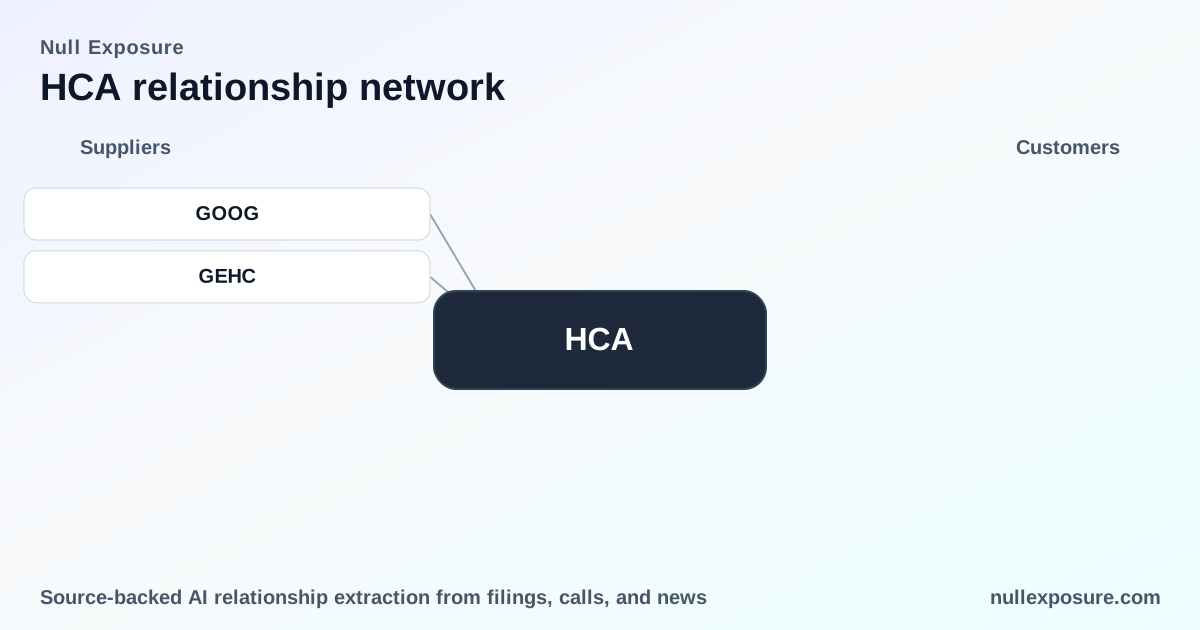
HCA Healthcare — Customer Relationships, Contracting Posture and Investor Implications
HCA Healthcare operates and monetizes a national network of hospitals and outpatient sites by selling clinical services to patients and third‑party payers, with reimbursements collected under a mix of prospective payment systems, negotiated managed‑care contracts and direct patient payments. Revenue is largely usage‑based (per diagnosis, per diem or fee‑for‑service), concentrated in U.S. markets (notably Florida and Texas) and materially exposed to government payors (Medicare and Medicaid account for roughly 45% of revenue) — a profile that shapes negotiation leverage, cash‑flow dynamics and regulatory risk for investors. For a concise, commercially oriented view of HCA’s customer footprint and payer relationships, visit https://nullexposure.com/.
How HCA gets paid: the commercial mechanics investors must understand
HCA’s operating model is fundamentally service‑sale driven: hospitals and outpatient centers deliver care and record revenue when services are provided. Reimbursement is dominated by three mechanisms:
- Usage‑based payments — Medicare’s MS‑DRG inpatient PPS and various per‑diem or procedure rates underpin a large portion of revenue, meaning volume and case mix directly drive top line. This is documented throughout HCA’s filings covering FY2025–FY2026.
- Short‑term negotiated contracts — managed care agreements typically run one to three years, creating cyclical renegotiation points that affect rates and network access.
- Longer‑lived government frameworks — Medicaid and Medicare program structures produce enduring payment rules (PPS, supplemental payments and state waiver programs), but the specific contract terms with managed plans are often shorter and renegotiated frequently.
According to HCA’s recent annual filings (2025/2026), reimbursement is predominantly usage‑based and periodically adjusted by payer policy, and the company recognizes outpatient services over short service intervals while inpatient obligations resolve over days. This mixed tenure — short‑term commercial contracts overlaying persistent government payment frameworks — drives both revenue volatility and predictability in different pockets of the business.
Concentration, criticality and what those constraints imply for investors
HCA’s footprint is large but concentrated. At year‑end 2025 the company operated roughly 190 hospitals, with Florida and Texas accounting for over half of consolidated revenues; that geographic concentration increases sensitivity to state‑level Medicaid changes and regional shocks. Government programs are not incidental — Medicare and Medicaid together comprised ~45.4% of revenues in 2025, per HCA’s filings — so policy shifts, CMS rules and state supplemental payment designs are direct revenue levers.
Key company‑level signals drawn from HCA filings:
- High counterparty concentration with government payors (very high confidence): government reimbursement rules, audits and program changes materially influence cash collection and margins.
- Receivables collection is critical (critical materiality): collection from Medicare/Medicaid/managed care and patients is HCA’s principal source of cash.
- Large scale uncompensated care and supplemental payments (100m+ spend band): state Medicaid supplemental and SDP arrangements contributed billions (reported ~$6.2bn in 2025), meaning policy or CMS decisions on those programs shift earnings materially.
These constraints produce a corporate posture that combines active commercial negotiation (frequent managed care renewals) with dependence on stable government reimbursement frameworks that are subject to regulatory risk.
The payer ecosystem: patients, large insurers and government as distinct dynamics
HCA functions simultaneously as a seller, buyer and service provider across different relationships:
- As a seller of inpatient and outpatient services, HCA is paid by Medicare/Medicaid, managed care plans and patients; this is the company’s primary revenue role.
- As a buyer, HCA negotiates with group purchasers, provider networks and vendors, and is affected by payer rules that can reduce admissions or shift services to lower‑acuity settings.
- As a service provider and operator, HCA runs hospitals, ASCs and a broad outpatient footprint — the company’s operational scale creates bargaining relationships with payers and physician groups.
HCA also serves individuals directly (self‑pay and insured patients) where collection risk is higher and large enterprise payers where negotiated discounts can compress margins. These distinctions are documented across HCA’s FY2025/2026 filings and explain why both reimbursement mix and payer mix must be active monitoring points for investors.
Active commercial relationship disclosed: Cigna expands Medicare Advantage access (CI)
Cigna has expanded its Medicare Advantage plans in Central Florida and the Treasure Coast to include HCA Healthcare’s facilities, giving Cigna MA customers network access to HCA hospitals, primary care and specialists in those markets. This expansion is live and was announced in Cigna’s newsroom on March 9, 2026 (Cigna newsroom, March 9, 2026: https://newsroom.cigna.com/Cigna-expands-medicare-advantage-plans-to-more-FL-counties).
Implication: greater MA network penetration in HCA’s Florida footprint can increase insured patient volumes from managed Medicare plans and improve revenue predictability where reimbursement rates and utilization trends are favorable.
What the Cigna expansion signals for HCA’s customer strategy
The Cigna move illustrates two practical takeaways:
- Network access matters for volume: inclusion in MA networks tends to steer beneficiaries toward in‑network hospitals, especially in concentrated markets like Florida where HCA already has scale (HCA filings, 2025).
- Managed Medicare growth is strategic: as Medicare Advantage enrollment rises, payers that secure robust hospital networks can influence utilization patterns and margins; HCA’s ability to win and renew these contracts is a revenue driver.
Investment implications and risk signals investors should price
- Revenue sensitivity to payer policy is high. With ~45% of revenue from government programs and large SDP exposure, macro policy moves (FBA implementation, CMS payment rules) can swing margins. (HCA filings, 2025/2026)
- Contract cadence creates recurring renegotiation risk. Short‑term managed care contracts (1–3 years) produce periodic rate resets and potential network shifts.
- Geographic concentration is a double‑edged sword. Florida/Texas scale drives operating leverage but concentrates regulatory and reimbursement risk in a few states (HCA filings, 2025).
- Cash generation depends on effective receivables management. Collection from payers and patients is critical to liquidity and is flagged as a core operational dependency.
For a deeper read on HCA’s customer and payer relationships and to track similar commercial disclosures across healthcare providers, visit https://nullexposure.com/.
Bottom line
HCA’s business model is scale‑driven, usage‑based and highly interdependent with government payors and large managed plans. The Cigna expansion in Florida is a concrete example of how payer relationships translate to patient flow and revenue mix — a dynamic investors must measure alongside policy shifts, contract renewal cycles and regional exposure when forming an investment view.