HCI Group — customer relationships and operating constraints investors should price in
HCI Group operates as a Florida‑centric property & casualty insurance holding company that also runs insurance management/technology services and owns a modest portfolio of real estate assets. The company monetizes through net premiums written and earned, investment income on insurance float, fees for attorney‑in‑fact/TPA services and rental income from owned properties; insurance operations accounted for the vast majority of revenue in FY2024. For investors, the business combines high recurring cash generation from premiums with concentrated geographic and product exposure that amplifies regulatory and catastrophe risk. Explore a concise register of HCI’s customer and tenant relationships and how they feed the firm’s risk/reward profile at https://nullexposure.com/.
One‑page read: what the relationship data actually says about HCI
HCI’s customer footprint is a hybrid of insurance policyholders and real‑estate tenants, plus outsourced service engagements. Key operating characteristics distilled from the company filing:
- Contracting posture is mixed. The Form 10‑K shows long‑duration commercial leases (in‑place leases average 17.7 years) alongside very short insurance‑policy tenors and one‑year leases used in certain property acquisitions, producing both stable cash from real estate and high renewal churn in insurance. (HCI Form 10‑K, FY2024)
- Revenue concentration is high and insurance‑centric. Insurance operations represented 82.3% of revenues for the year ended December 31, 2024, making policy performance the primary financial driver. (HCI Form 10‑K, FY2024)
- Criticality: insurance operations are critical. The filing classifies insurance revenues as material to consolidated results; fluctuations in underwriting, catastrophe loss, or regulatory assessment recovery will change cash flows materially. (HCI Form 10‑K, FY2024)
- Maturity profile is mixed by segment. Long‑term retail leases provide stable rental receipts, while policy books and certain short‑term operating leases create near‑term renewal and liquidity dynamics. (HCI Form 10‑K, FY2024)
- Revenue capture mechanics vary. The company earns per‑claim fees recognized over claim processing periods (usage‑based fees), fixed rental income, and premium flows that fund investing and operations. (HCI Form 10‑K, FY2024)
If you want a deeper dataset of HCI’s customer relationships and excerpted evidence from filings, visit https://nullexposure.com/ for structured coverage and primary‑source links.
Relationship register drawn from HCI’s FY2024 10‑K
Below are every counterparty relationship listed in the relationship results, summarized in plain English with source attribution.
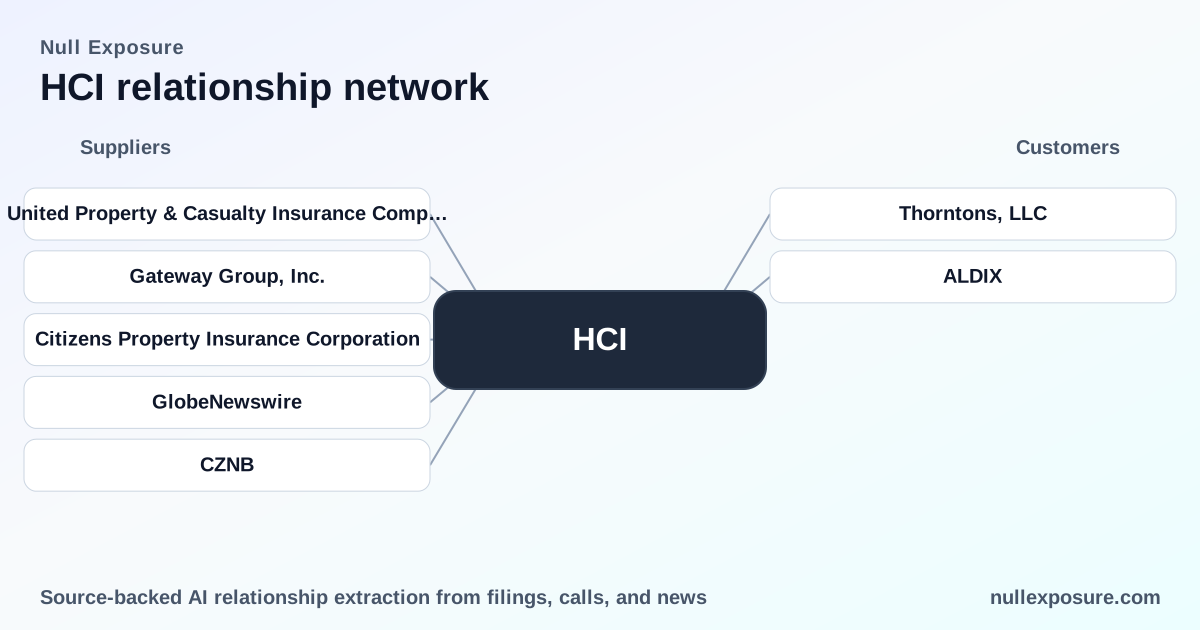
Thorntons, LLC
HCI’s filing discloses that 1.27 acres of owned property is leased to Thorntons, LLC, a gasoline/convenience‑store operator, representing a standard tenant lease in the company’s real‑estate portfolio. Source: HCI Form 10‑K (Investments/Leases note, FY2024).
ALDI
The 10‑K reports that approximately 59% of the rentable space (at a retail center) is leased to an ALDI supermarket, identifying ALDI as the anchor tenant responsible for the majority of leasable square footage in that asset. Source: HCI Form 10‑K (Real Estate Investments/Leasing, FY2024).
ALDIX (inferred symbol for ALDI)
The filing contains an identical reference under the inferred ticker ALDIX: approximately 59% of rentable space is leased to an ALDI supermarket, confirming the anchor‑tenant concentration in the retail center. Source: HCI Form 10‑K (Real Estate Investments/Leasing, FY2024).
How these relationships map to HCI’s business model and risk profile
The two tenant relationships above are straightforward: HCI uses leased investment property to diversify income and support corporate cash flow, and ALDI functions as an anchor tenant, driving foot traffic and underpinning rental economics for that retail center. Thorntons represents a small, single‑asset retail lease. These real‑estate tenants are supplementary to HCI’s core monetization engine—insurance underwriting and claims management—where the company generates the overwhelming majority of revenue and net cash flow. (HCI Form 10‑K, FY2024)
Operating constraints that shape partner economics and investor risk
The 10‑K evidences a set of company‑level constraints and characteristics investors must price into valuations:
- Contract mix: HCI runs a dual contracting model—long‑term leases for real estate (in‑place leases 17.7 years) alongside short‑term insurance contracts and renewals (policy renewal rights cited at ~1.3 years and explicit short one‑year operating leases). This creates a stable rental base but a high‑turnover core business that is sensitive to pricing cycles and retention. (HCI Form 10‑K, FY2024)
- Usage pricing for some services: Claims handling and related fees are recognized on a per‑claim, usage‑based revenue basis, so some revenue scales directly with claims volume and processing intensity. (HCI Form 10‑K, FY2024)
- Geographic concentration: HCI remains primarily exposed to Florida, with large policyholder concentrations in the southeast and northeast U.S., elevating weather and regulatory concentration risk. (HCI Form 10‑K, FY2024)
- Materiality and criticality: Insurance operations are material and critical to consolidated revenue and cash generation—any adverse regulatory, rating, or loss‑reserve event would be financially consequential. (HCI Form 10‑K, FY2024)
- Relationship maturity and lifecycle: The filing documents both active customer books (hundreds of thousands of policies in force) and terminated service relationships (reinsurance/TPA work with United was ceased in 2023), indicating ongoing portfolio turnover in both policies and third‑party engagements. (HCI Form 10‑K, FY2024)
Investment implications — a short checklist for analysts
- Top‑line sensitivity: Gross premiums earned exceeded $1.08bn in 2024, making premium volume trends and retention metrics the primary valuation levers. (HCI Form 10‑K, FY2024)
- Catastrophe and regulatory risk: Florida hurricane exposure and state regulatory frameworks are dominant risk vectors given geographic concentration. (HCI Form 10‑K, FY2024)
- Real‑estate diversification is modest: Anchor tenancy (ALDI) stabilizes a single retail center, but real estate is a secondary revenue source relative to insurance. (HCI Form 10‑K, FY2024)
- Service and management income is strategic: Attorney‑in‑fact and TPA activities provide fee income and downstream control over underwriting/claims but are cyclic and, in the case of some third‑party arrangements, have been terminated historically. (HCI Form 10‑K, FY2024)
What to watch next (quarterly and near‑term catalysts)
- Policy in‑force trends and policy count growth versus lapse/renewal rates.
- Reinsurance program renewals and pricing, plus any change in ratings or regulatory action in Florida that could affect underwriting capacity.
- Tenant occupancy and lease renewals at retail assets where ALDI is the anchor; a tenant transfer or vacancy would have outsized local cash‑flow impact.
- Continued monetization of claims‑processing technology and attorney‑in‑fact services, which influence fee income and operating leverage.
For a focused, sourced view of HCI’s customer relationships and the primary filing excerpts that support them, visit https://nullexposure.com/ — the portal hosts the citation trail and allows you to cross‑check the exact 10‑K notes used in this analysis.
Bottom line: HCI is an insurance‑first business with a concentrated geographic footprint and a mix of stable real‑estate leases and high‑turnover insurance contracts; anchor tenants like ALDI support limited diversification but do not materially change the company’s reliance on premium flows and underwriting performance.