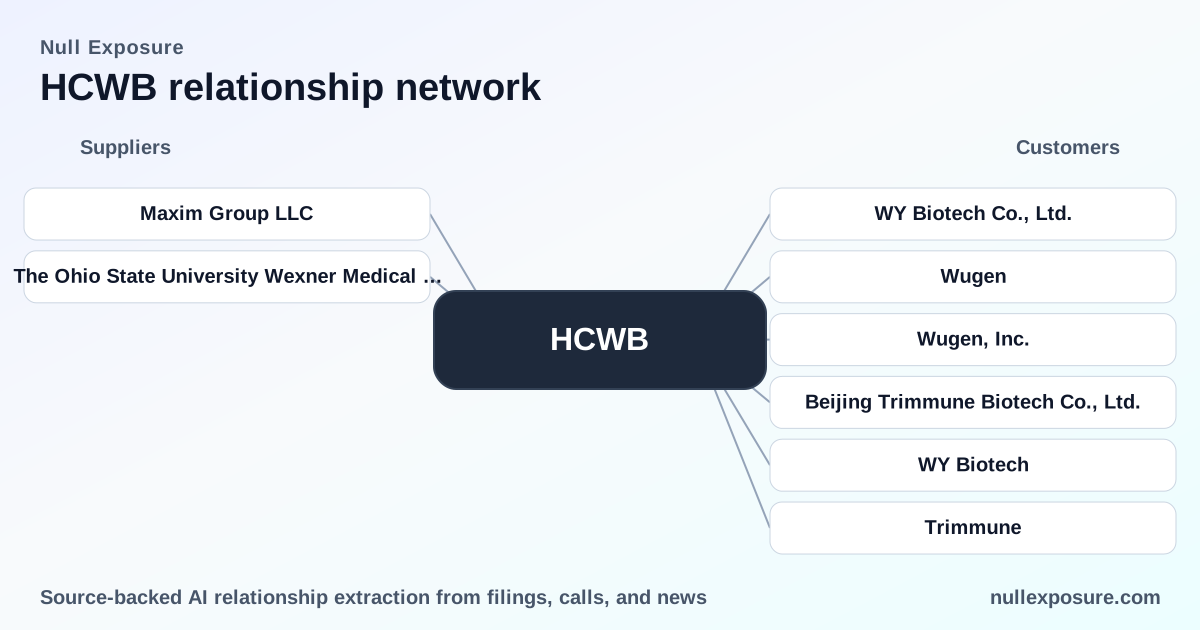
HCW Biologics (HCWB) — Customer relationships, revenue mechanics, and what investors should price in
HCW Biologics builds value by discovering immunotherapeutic fusion proteins and monetizing them primarily through out‑licensing deals and the supply of clinical‑grade materials to licensees. Historically HCW generated almost all revenue by selling clinical materials under a framework supply agreement; more recently the company shifted to license deals that deliver upfront cash, milestone upside and royalties, while retaining selective manufacturing and opt‑in rights that preserve optionality for North and South America. For an operational deep dive and comparative deal detail visit https://nullexposure.com/.
How HCW makes money — concise operating thesis and model signals
HCW operates as a small, pipeline‑stage biotech that licenses intellectual property and supplies clinical materials, rather than selling commercial products directly. Key company‑level operating signals drawn from filings and releases:
- Licensing is the primary contract form: HCW recognizes nonrefundable upfront fees, milestone payments and royalties for licensed molecules; this is the dominant revenue generator per the company’s FY2024 10‑K.
- Revenue concentration and short maturity: To date the firm’s revenues derive largely from a single licensee relationship and supply agreement; this creates earnings volatility and single‑counterparty concentration risk.
- Long‑term economic strings attached: License terms are structured on a product‑by‑product, country‑by‑country basis with multi‑year patent and exclusivity horizons; the contracts include milestones and royalties that convert development success into recurring economics.
- Manufacturing / supply role retained: HCW provides clinical and research‑grade materials to its licensees under master agreements, storing a margin on manufactured supply while transferring downstream development risk.
- Deal economics are in the $1m–$10m band for upfronts: The WY/Trimmune transactions are structured around a $7.0M upfront figure; historical supply revenues are in the low‑single millions annually.
- Regulatory & payor risk is systemic: As with all biologics, reimbursement, regulatory approvals and government pricing programs are material determinants of ultimate commercial value.
These characteristics make HCW a licensor‑centric biotech with near‑term cash inflows tied to discrete transactions and longer‑term upside tied to milestones and royalties.
Counterparty map — every customer relationship investors must know
Wugen / Wugen, Inc.
HCW’s fiscal 2024 revenues were derived exclusively from the supply of clinical‑grade material to Wugen under a master supply arrangement contemplated by the Wugen license, with HCW reporting $2.6 million of revenue for the year. The Wugen license and supply agreement have been the company’s principal historical revenue source and a critical contributor to its development‑stage cash flow. (HCW 2024 Form 10‑K, FY2024; HCW press commentary FY2025)
WY Biotech Co., Ltd. (WY Biotech)
HCW entered an exclusive worldwide license with WY Biotech for HCW11‑006 that contemplates a $7.0 million upfront payment, plus development, regulatory and commercial milestones and royalties; the agreement includes an Opt‑In Right for HCW to assume development and commercialization responsibilities in the Americas. This deal signals HCW’s deliberate shift toward out‑licensing for molecules it does not plan to fully commercialize in‑house. (HCW 2024 Form 10‑K; SEC exhibit disclosure, FY2025)
Beijing Trimmune Biotech Co., Ltd. / Trimmune (joint vehicle)
HCW closed an exclusive worldwide license for HCW11‑006 with Beijing Trimmune/Trimmune and received full payment of the upfront license fee reported at $7.0 million in March 2026, with earlier reporting of staged cash payments during the first quarter of 2026. Trimmune’s funding and the upfront payment convert HCW’s preclinical asset into near‑term non‑dilutive cash and transfer development execution to the licensee. (GlobeNewswire press release, March 17, 2026; HCW earnings release, March 31, 2026; Sahm Capital news, Feb 13, 2026)
Note on duplicates in public reporting: HCW’s press and SEC disclosures reference WY Biotech, Trimmune and Wugen across multiple releases; the substance is consistent — Wugen as longstanding supply/license partner, WY Biotech/Trimmune as the counterparty for HCW11‑006 licensing and upfront consideration.
How the constraints in filings shape the commercial story
The company’s filings and investor communications communicate constraints that are better read as business model characteristics rather than isolated data points:
- Contracting posture: HCW acts primarily as licensor and seller/manufacturer of clinical materials, retaining selective regional opt‑ins. The firm structures deals to capture upfront nonrefundable cash while preserving royalty streams. (Company 10‑K disclosures)
- Concentration and criticality: Historical reliance on Wugen for nearly all revenue is classified as a company‑level criticality issue; investors must price the transition risk as HCW replaces or augments that single source with WY/Trimmune deals. (HCW 10‑K, FY2024)
- Maturity and term structure: Licenses are long‑dated on a product‑by‑product basis with patent‑driven expiration mechanics; the economic value of each contract is therefore tied to clinical/regulatory success over years, not quarters.
- Deal size and timing: Spend bands centered in the $1m–$10m range for upfronts mean HCW’s near‑term cash profile is driven by a handful of discrete payments rather than steady recurring revenue. (Company disclosures and press releases)
Investment implications — what to price and where the upside lies
- Near‑term cash is improved: The $7.0M upfront reported from Trimmune materially reduces immediate liquidity pressure and validates HCW’s out‑licensing strategy. (GlobeNewswire, March 2026)
- Concentration risk persists: Even with the new deals, HCW’s revenue model remains counterparty‑dependent; a single licensing or supply setback will have outsized P&L impact.
- Optionality via opt‑in rights: The WY/Trimmune agreements preserve HCW’s option to assume Americas development — a latent asset that can be exercised if economics and capital markets improve. (SEC exhibit, FY2025)
- Milestone and royalty upside conditional: Long‑term value depends on downstream clinical and regulatory success at licensees; investors should discount HCW’s near‑term valuation accordingly and model milestone probability rather than assumed conversion.
- Balance‑sheet & financing constraints: The company’s capital plan has included secured notes and private placements; maturity of debt (notably senior secured notes with near‑term maturities disclosed in filings) is a liquidity risk that investors should monitor. (HCW 10‑K, FY2024)
Key investor checklist:
- Monitor milestone receipts and the schedule of any deferred license payments.
- Track Wugen’s clinical progress for downstream supply demand and residual royalty potential.
- Watch for HCW’s exercise/non‑exercise of Opt‑In Rights for Americas markets.
Bottom line
HCW Biologics has converted its discovery platform into licensable assets that generate discrete upfront cash and preserve upside via milestones and royalties. The company’s licensor + manufacturer posture reduces near‑term capital burn but leaves earnings concentrated and binary on licensee development success. For investors, the near‑term question is whether the recent $7.0M proceeds and licensing traction provide sufficient runway and proof of commercial relevance to materially re‑rate the equity.
For a concise data pack and further due diligence materials, visit https://nullexposure.com/.
Bold takeaway: HCW’s path to value is clear — execute out‑licenses, collect upfronts, and monetize milestones — but valuation must reflect high concentration risk and binary development outcomes.