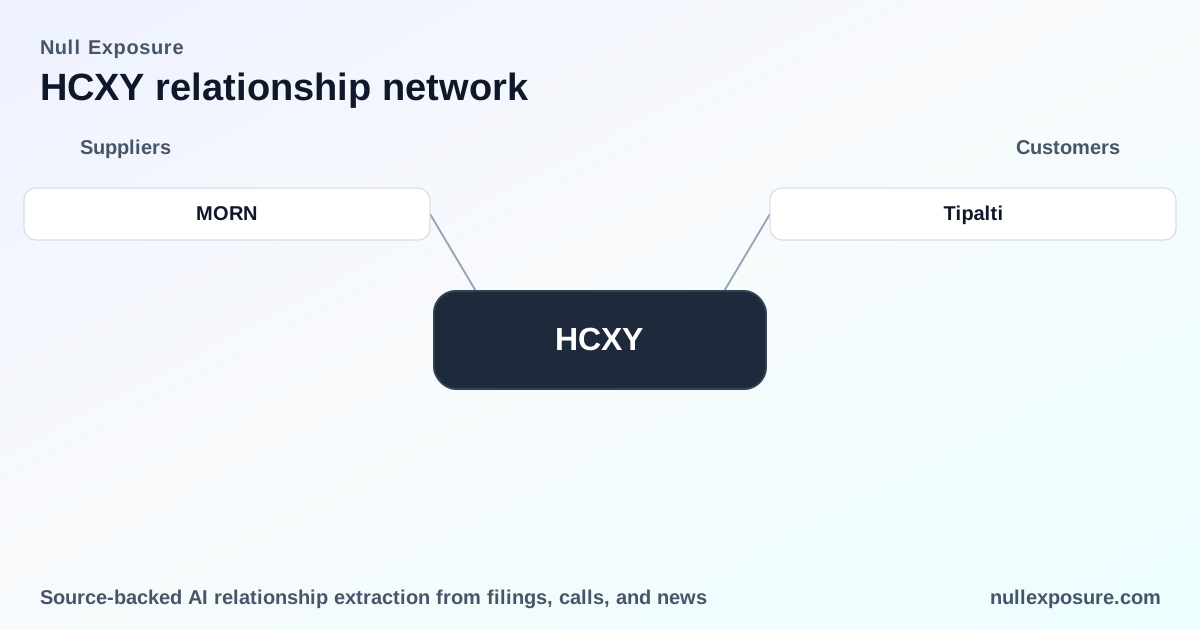
Hercules Capital (HCXY) — customer relationships that define credit exposure and growth optionality
Hercules Capital, Inc. (HCXY) is a specialty finance Business Development Company that originates senior secured debt and structured equity to growth-stage technology and life sciences companies and monetizes through interest income, arrangement and monitoring fees, and management income from subsidiary-managed funds. The firm's underwriting profile is concentrated on mid-market, venture- and sponsor-backed companies with typical financings between $25–100 million and contract tenors clustered in the 2–5 year range, producing a portfolio with high industry concentration in software and drug discovery & development. For a quick overview of the platform, visit the firm homepage: https://nullexposure.com/.
Why customers matter: financing relationships drive both yield and concentration risk
Hercules underwrites credit exposure to businesses that need growth capital rather than commodity lending. That positioning generates higher yield potential through coupon spreads (reported ranges roughly 7%–14% on debt investments) and fee income for structuring and syndication, but it also concentrates exposure in a handful of sectors and counterparty types. Company filings through December 31, 2025 show that ~87% of fair value sits in five industries, led by Application Software and Drug Discovery & Development, indicating that customer mix is a primary driver of portfolio volatility and upside.
- Contracting posture is multi-modal. The firm’s loan products are predominantly medium-term (2–5 years) with interest-only periods and amortization schedules, but Hercules also operates equity distribution frameworks and transactional (spot) sales through market facilities. This gives the company flexibility to support growth capital while retaining liquidity channels.
- Counterparty concentration is intentional. Hercules targets mid-market and select small businesses via SBIC vehicles; this focus increases idiosyncratic credit risk but also enables higher contractual yields and structural seniority in deal documentation.
- Geographic bias is U.S.-centric with selective global reach. Regulatory requirements for qualifying assets and the 1940 Act orientation keep holdings largely domestic, but the firm selectively underwrites cross-border opportunities in technology sub-sectors.
Deal-by-deal: public coverage of customer relationships
Below are the customer relationships surfaced in public reporting and news coverage. Each relationship is summarized in plain English with the citation noted.
Tipalti — a large growth loan to scale AI and international expansion
Hercules provided $200 million in growth financing to Tipalti to accelerate investment in artificial intelligence and expand its global reach; the transaction was reported in March 2026. This is a sizeable single-customer credit that aligns with Hercules’ stated loan size bands and software industry focus. According to a Ynet News report (Mar 10, 2026), Tipalti secured the financing from Hercules to fund AI and global expansion initiatives. (Source: Ynet News, March 2026)
Savara (SVRA) — servicing clinical-stage pharma with a debt facility
Savara’s near-term outlook was described as dependent on FDA decisions, distribution execution, and management of cash burn against its Hercules debt facility and prior equity raises; the relationship is discussed in coverage of the company’s regulatory newsflow in early 2026. Simply Wall St commentary (Mar 2026) highlighted Savara’s need to manage cash with the support of Hercules’ debt facility as part of its capital structure and near-term execution plan. (Source: Simply Wall St commentary, March 2026)
What the constraints tell investors about Hercules’ operating model
The public constraint signals derived from company disclosures offer a clear picture of Hercules’ operating model and contract architecture:
- Maturity and contracting posture are medium-term and framework-driven. Filings state structured debt maturities generally run between two and five years, and the company has standing equity distribution agreements with sales agents for incremental capital. This mix gives Hercules predictable cash flows from term lending while maintaining flexibility to raise capital through frameworks.
- Relationship roles span lender, arranger, and service provider. The firm acts as a senior secured lender, provides working capital lines tied to benchmarks such as SOFR or Prime, and operates shared services agreements through its adviser subsidiary — indicating integrated servicing capacity and fee-derived revenue beyond pure interest income.
- Concentration is a feature, not an accident. With a portfolio skewed heavily toward software and drug discovery, sector concentration materially influences portfolio volatility and recovery assumptions in stressed scenarios.
- Customer scale is mid-market to lower-middle market with targeted ticket sizes. Investment sizes typically range from $25 million up to $100 million, validating the observed Tipalti transaction and consistent with the firm’s underwriting strategy.
- Regulatory and structural constraints shape capital allocation. As a BDC, Hercules must maintain qualifying asset thresholds (generally 70% in qualifying U.S. assets), which enforces a U.S.-heavy portfolio bias and affects cross-border underwriting.
These characteristics combine into a business model that is credit-centric, yield-driven, and operationally integrated — attractive for investors seeking exposure to growth-driven credit income but requiring active monitoring of sector cycles and single-name exposure.
Investment and operational implications for investors and operators
Hercules’ customer book delivers high contractual yields with concentrated sector exposure and active portfolio management requirements. Key implications:
- Credit monitoring is essential. Active monitoring of borrowers’ milestones and liquidity is baked into the business model; filings stress ongoing portfolio surveillance and unfunded commitments available to portfolio companies as of year-end 2025.
- Single-name ticket sizes can be material. A $200 million facility to a software scale-up is consistent with the firm’s stated ticket range and underscores potential portfolio concentration risk if multiple large loans align with the same sector cycle.
- Servicing and fee streams diversify revenue, but governance of adviser subsidiaries and shared-services agreements is a critical oversight area for investors. Filings disclose expense allocation and management-fee dynamics that affect net yield.
- Regulatory posture constrains global ambitions but preserves a U.S.-focused risk profile. Investors should factor in the BDC compliance regime when modeling geographic and asset-class tilts.
Key takeaways for investor due diligence
- Hercules monetizes through interest, fees, and adviser-related income, with loan tenors largely between two and five years.
- Portfolio concentration in Application Software and Drug Discovery materially shapes return volatility and recovery profiles.
- Typical deal size aligns with a $25–100 million band; single transactions such as the Tipalti $200M facility are within the firm’s stated flexibility and increase single-name exposure.
- The firm operates both as lender and service provider through adviser subsidiary arrangements, which supports fee diversification but requires governance scrutiny.
- Regulatory constraints (qualifying asset thresholds) keep the portfolio U.S.-centric, limiting scale in some international opportunities.
For institutional investors and operators evaluating counterparty exposure to Hercules, focus diligence on covenant strength, sector concentration stress tests, and the firm’s unfunded commitment utilization. If you want deeper relationship mapping or transaction-level analysis, start your review at our hub: https://nullexposure.com/.
Hercules’ public customer signals — from Tipalti’s growth loan to Savara’s debt facility — validate a repeatable mid-market financing model that drives yield but concentrates exposure, making active credit supervision and sector analysis the decisive inputs for investors evaluating HCXY.