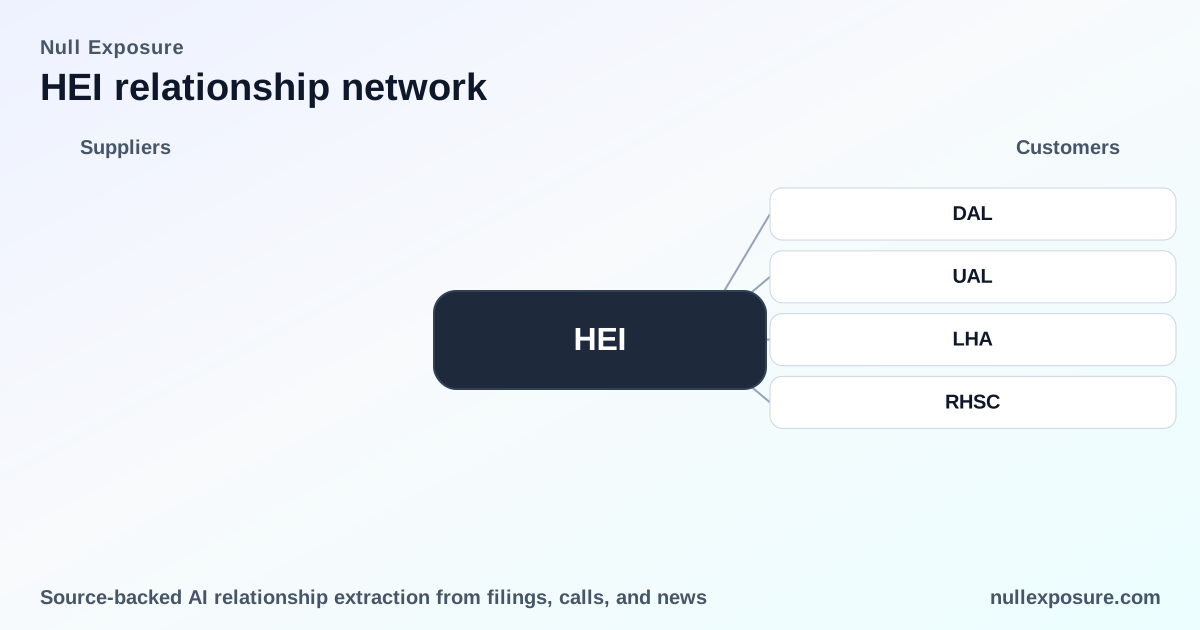
HEICO Corporation — customer relationships, revenue drivers, and contract posture
HEICO is a diversified aerospace and defense components company that monetizes through three core engines: (1) aftermarket replacement parts and distribution and overhaul services (Flight Support Group, FSG), (2) engineered electronic and electromechanical hardware for defense, space and aviation (Electronic Technologies Group, ETG), and (3) services tied to those products such as repair, overhaul and certification. Revenue comes from point‑of‑sale product shipments, long‑term contract performance and recurring repair/overhaul contracts, supported by regulatory approvals (PMA/DER) that create barriers to entry and pricing leverage. Learn more at https://nullexposure.com/.
Why HEICO’s customer map matters for valuation and risk
HEICO’s customer relationships are the practical expression of its strategy: convert engineering and certification capability into recurring aftermarket sales and high‑margin niche hardware sales. Several structural features matter for investors:
- Low customer concentration but high industry concentration: no single customer represents more than 10% of consolidated sales, which reduces single‑counterparty risk, while HEICO remains exposed to cyclical aviation demand.
- Significant government exposure: a material portion of ETG revenue derives from U.S. and allied military agencies and defense primes, which increases program durability but also subjects HEICO to procurement cycles, export controls and regulatory compliance.
- Revenue visibility from backlog and long‑term contracts: the company reports substantial remaining performance obligations and advance long‑term customer deposits, creating a base of predictable revenue alongside transactional parts sales.
- A dual product/services business model that combines manufacturing, distribution and repair/overhaul services—this mixes capital intensity with recurring service economics and inventory risk.
These operating traits inform valuation multiples and scenario analysis: premium multiples reflect durable aftermarket margins and recurring service revenue, while downside scenarios hinge on airline demand cycles, defense budget shifts and regulatory constraints.
How HEICO contracts and sells — operating model signals
The company disclosures and reported excerpts point to clear business model characteristics investors should internalize:
- Contracting posture: predominantly long‑term contractual relationships with measurable remaining performance obligations, but a material volume of point‑in‑time product sales where payment and revenue recognition are immediate.
- Counterparty mix: a broad base including U.S. and foreign governments, defense prime contractors, major commercial airlines, OEMs and independent MROs; government sales are an important, stable revenue stream.
- Geography: truly global reach—HEICO markets to ~130 countries with both U.S. and international facilities.
- Roles and segments: the company operates as manufacturer, distributor, service provider and seller across hardware, distribution and services segments.
- Maturity and stage: relationships are largely active and mature, supported by FAA approvals, PMAs and long track records; backlog supports near‑term revenue recognition.
- Spend and balance sheet signals: large accounts receivable and contract assets/liabilities indicate multi‑million dollar exposures and meaningful working capital tied to customer contracts.
These signals justify a hybrid valuation approach: treat a meaningful portion of cash flows as recurring (services / contracted backlog) and another portion as volume‑sensitive (core aftermarket shipments).
Documented customer relationships (what we found)
Below are every relationship cited in the source results, each with a plain‑English take and a source note.
EPR-P-E (Kartrite operator)
An article reported that the Kartrite indoor water park reopened under a new operator identified as HEI, described as a Connecticut‑based hotel and resort manager, indicating non‑aerospace commercial operator activity connected to HEI’s hospitality/real‑estate interests. Source: Record Online news report on the Kartrite reopening (June 2021): https://www.recordonline.com/story/news/2021/06/11/kartrite-indoor-water-park-sullivan-county-reopen-aug-1/7623678002/.
United (UAL)
HEICO’s Flight Support Group lists United among the largest established customers for PMA and repair solutions, highlighting that major network carriers are direct buyers of HEICO’s aftermarket parts and repair services. Source: Q4 FY2025 earnings call transcript summarized online (InsiderMonkey, FY2025): https://www.insidermonkey.com/blog/heico-corporation-nysehei-q4-2025-earnings-call-transcript-1664848/.
DAL (Delta)
Delta is named alongside United and Lufthansa as one of the largest, established customers for HEICO’s PMA products and repair solutions, underscoring direct airline demand for lower‑cost non‑OEM replacement parts. Source: InsiderMonkey Q4 FY2025 earnings call transcript (FY2025): https://www.insidermonkey.com/blog/heico-corporation-nysehei-q4-2025-earnings-call-transcript-1664848/.
Delta (duplicate entry)
The same transcript references Delta again in context of major customers for HEICO’s FSG PMA and repair business; this duplicate citation reinforces that multiple major carriers are core commercial customers. Source: InsiderMonkey Q4 FY2025 earnings call transcript (FY2025): https://www.insidermonkey.com/blog/heico-corporation-nysehei-q4-2025-earnings-call-transcript-1664848/.
Lufthansa (LHA)
Lufthansa is cited as another anchor commercial airline customer for HEICO’s aftermarket and repair offerings, reflecting HEICO’s penetration into large European carrier fleets. Source: InsiderMonkey Q4 FY2025 earnings call transcript (FY2025): https://www.insidermonkey.com/blog/heico-corporation-nysehei-q4-2025-earnings-call-transcript-1664848/.
RHSC (Robertson)
The transcript notes that a business unit is separate from Robertson and that Robertson has been a customer, implying supplier–customer ties between HEICO’s acquired businesses and Robertson (a component/repair customer). Source: InsiderMonkey Q4 FY2025 earnings call transcript (FY2025): https://www.insidermonkey.com/blog/heico-corporation-nysehei-q4-2025-earnings-call-transcript-1664848/.
Robertson (duplicate entry)
The same text reiterates Robertson’s role as a customer of the separate business, confirming legacy commercial relationships in HEICO’s portfolio companies. Source: InsiderMonkey Q4 FY2025 earnings call transcript (FY2025): https://www.insidermonkey.com/blog/heico-corporation-nysehei-q4-2025-earnings-call-transcript-1664848/.
What investors should take away
- Revenue durability: HEICO’s mix of long‑term contracts, PMA‑backed replacement parts and recurring repair/overhaul services provides high revenue visibility and margin resilience relative to pure OEM suppliers.
- Cyclicality and concentration risk: airline demand cycles and defense budget shifts are the primary macro risks; no single customer drives >10% of revenue, limiting counterparty concentration but not removing industry cyclicality.
- Regulatory and export exposure: HEICO’s defense and space businesses expose it to export controls, DoD cybersecurity requirements and licensing regimes that can materially affect addressable markets.
- Balance sheet and working capital: meaningful accounts receivable, contract assets and backlog imply working capital sensitivity to sales timing and collections; investors should monitor days sales outstanding and contract liability trends.
For a practitioner or analyst building a thesis, the combination of global customer reach, diversified counterparty types (commercial carriers and governments), and a durable aftermarket/service franchise justifies a premium valuation, conditioned on monitoring cyclical airline demand and regulatory headwinds.
If you want a compact briefing tailored to a specific valuation scenario or counterparty stress test, see our coverage at https://nullexposure.com/ — we can help turn these relationship signals into a financial sensitivity analysis.