HEICO (HEI-A): Customer Relationships Drive Durable Aftermarket Margins and Defense Exposure
HEICO monetizes through a dual-engine aftermarket model: high-margin, non‑OEM replacement parts, repair & overhaul services for commercial aviation (Flight Support Group) and specialized electronic and mission‑critical hardware for defense, space and industrial customers (Electronic Technologies Group). The company converts engineering and FAA/defense certifications into repeatable sales, backlog and attractive margins — supported by a substantial remaining performance obligation book and global distribution. For deeper entity-level customer intelligence, visit https://nullexposure.com/.
Why HEICO’s customers matter to investors
HEICO earns revenue from three complementary commercial vectors: manufacturing replacement parts, distributing FAA‑approved components, and providing repair/overhaul and niche electronics. This creates a revenue mix that is both recurring (aftermarket repairs and parts) and contract‑backed (longer‑dated performance obligations and defense procurement). According to HEICO’s public filings covering fiscal 2025, the company reported $2,107.6 million of remaining performance obligations associated with firm contracts, of which $1,358.7 million is expected to be recognized in the following fiscal year and the remainder thereafter — a structural source of visibility into near‑term revenue.
Key operating model characteristics distilled from company disclosures:
- Contracting posture: mixed short‑ and long‑term. HEICO accrues customer rebates tied to mostly one‑year rebate periods while also reporting significant long‑term contract liabilities and backlog that amortize over multi‑year horizons. (HEICO FY2025 disclosures.)
- Counterparty profile: government and large enterprise customers are material. Multiple segments explicitly serve the U.S. Department of Defense, defense prime contractors and large airlines, with ETG reporting roughly half of its sales to military and defense customers. (HEICO FY2025 filings.)
- Global footprint with North American concentration. HEICO sells into roughly 130 countries and recorded approximately 38% of consolidated net sales from foreign customers in fiscal 2025, while reporting dominant domestic income by dollar amounts. (HEICO FY2025 results.)
- Materiality nuance: sector concentration, not single‑customer concentration. No single customer accounted for 10% or more of consolidated net sales in the last three fiscal years, but 31% of net sales derive from defense & space and 58% from commercial aviation — a sectoral concentration that links HEICO to aviation cyclicality and defense spending trends.
- Roles and delivery model: integrated manufacturer, distributor and service provider. HEICO acts as seller, manufacturer, distributor and repair service provider across its two operating groups, supporting capture of aftermarket economics and recurring revenues.
The customer list on the record — two relationships to note
HEICO’s scraped customer relationships returned two items in the current scope. Each is summarized below with source context.
Mirandy Products, LLC — related‑party commercial purchases
Mirandy Products, LLC purchased $1,421,953 from one of HEICO’s subsidiaries during fiscal 2023; the proxy disclosure notes that Lindsey Mendelson, daughter of Victor H. Mendelson, is President and part‑owner of Mirandy. This is a small, disclosed related‑party customer transaction recorded in the company’s FY2026 proxy filing. (Source: HEICO DEF 14A proxy filing, FY2026 — SEC filing.)
Department of Defense (DoD) — strategic market counterparty
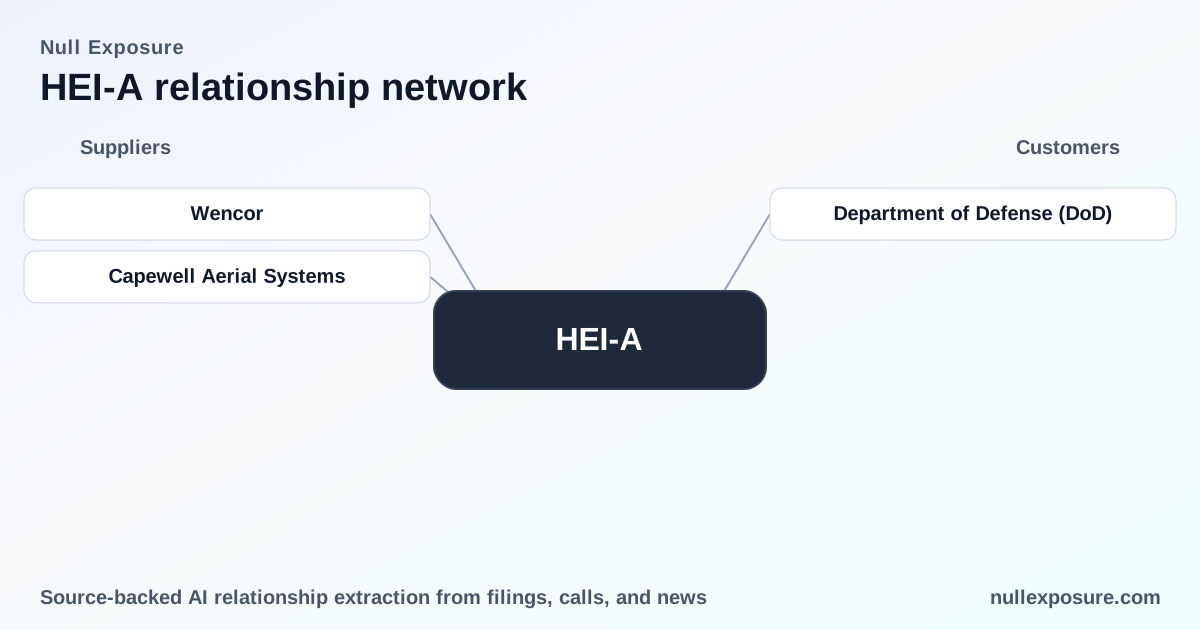
HEICO’s executive commentary and segment disclosures identify the U.S. Department of Defense and defense prime contractors as recurring customers for repair services, parts and mission‑critical electronics; management highlighted increased opportunities to provide cost‑effective solutions to the DoD in public comments during the company’s Q4 earnings commentary. This underpins HEICO’s meaningful defense revenue exposure and ETG sales concentration to military agencies. (Source: Yahoo Finance recap of HEICO Q4 results, March 10, 2026; HEICO FY2025 segment disclosures.)
How these relationships map to risk and upside
HEICO’s customer base and contract profile translate directly into both structural advantages and definable risks for investors.
-
Upside drivers:
- Backlog and long‑dated obligations provide near‑term revenue visibility. The $2.1 billion of remaining performance obligations gives investors a runway to validate organic growth assumptions and margin expansion targets. (HEICO FY2025 Form 10‑K.)
- Aftermarket and certification moat. HEICO leverages PMAs, DER approvals and specialized manufacturing capabilities to capture aftermarket share at lower cost than OEMs, supporting durable margins and pricing power.
- Defense exposure cushions commercial cycles. With roughly half of ETG sales going to military/defense customers, defense procurement cycles and prime contractor relationships provide counter‑cyclical stability when commercial aviation softens.
-
Risk factors:
- Aviation cyclicality and sector concentration. While no single customer exceeds 10% of revenue, 58% commercial aviation exposure subjects HEICO to airline fleet decisions and passenger traffic cycles that can depress aftermarket demand.
- Certification, compliance and supply‑chain risks. Repair and overhaul operations require FAA and other regulatory approvals; defense work brings cybersecurity and compliance requirements such as CMMC for certain contracts.
- Contract variability. HEICO recognizes revenue both at a point in time (majority of sales) and over time for certain contracts, creating periodic timing noise driven by unbilled receivables, contract assets and variable consideration like rebates and volume discounts.
- Integration and quality liability exposure. Manufacturing and servicing safety‑critical parts creates reputational and litigation risk if a part fails, and HEICO discloses potential material impact from uninsured claims.
Practical takeaways for investors and operators
- HEICO’s model captures aftermarket economics and defense program arbitrage — the business generates resilient gross margins through engineering, certification and a mix of distributed and manufactured products.
- Visibility is real but mixed: a large backlog provides revenue runway, balanced by short‑term rebate programs and variable consideration that require careful monitoring of working capital flows and contract liabilities.
- Counterparty diversification is sectoral rather than single‑customer: investors should track airline demand cycles and defense budget trajectories rather than individual customer credit risk, although disclosed related‑party purchases (e.g., Mirandy) warrant governance review.
For a structured, entity‑level view of HEICO’s customer relationships and to monitor changes in counterparties and contract exposure, visit https://nullexposure.com/ for ongoing coverage and alerts.
Bottom line: HEICO combines engineered product differentiation, certification‑driven barriers to entry and a balanced mix of commercial and defense customers to produce durable aftermarket revenue and attractive margins, while remaining exposed to aviation cyclicality and contract complexity that require active monitoring in any investment thesis.