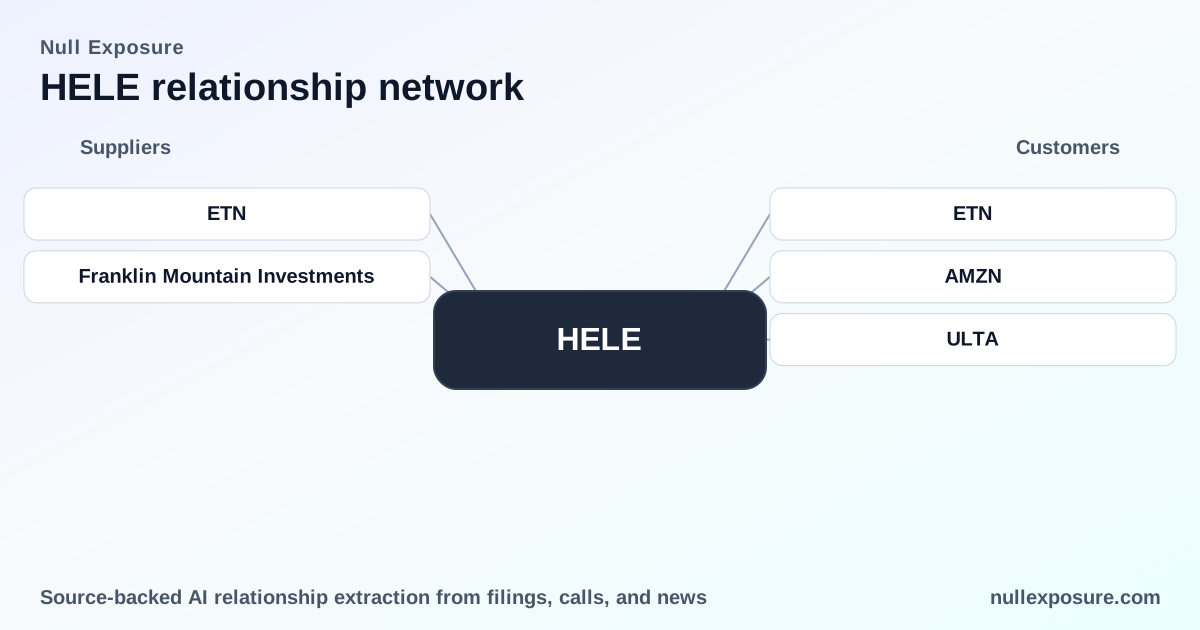
Helen of Troy (HELE): Customer Relationships that Drive Revenues and Operational Risk
Helen of Troy designs, sources and distributes consumer products across Home & Outdoor and Beauty & Wellness categories, monetizing primarily through product sales to retailers, distributors and direct-to-consumer channels, supplemented by royalty income from licensed trademarks. The company operates a short-order, high-turnover commercial model with significant revenue concentration among a handful of large retail partners—most notably Amazon—making customer relationships both a growth lever and a material risk to cash flow and valuation. For further detail or comparative relationship analytics, visit https://nullexposure.com/.
How Helen of Troy contracts and where value is created
Helen of Troy sells non-customized consumer goods under owned and licensed brands, and recognizes revenue at the point of sale, which produces short payment and order cycles and limited contractual lock-ins. The company’s public filings describe standard payment terms of 30 to 90 days and note that long-term purchase commitments from major customers are not required, which creates revenue volatility tied to retail ordering patterns. The company also licenses trademarks both as inbound inputs and outbound income streams, introducing a mixed monetization profile of product margin plus recurring royalty contributions.
- Contracting posture: Predominantly short-term and spot transactions with limited backlog; product shipments and performance obligations are generally satisfied at a single point in time.
- Counterparty mix: High exposure to both individual consumers (via DTC and retailer channels) and a small set of large enterprise buyers; the top five customers represent roughly half of consolidated revenue.
- Geographic footprint: Global distribution but heavily weighted to North America, with roughly 71% of net sales shipped from the U.S. in fiscal 2025; EMEA, APAC and LATAM are meaningful but secondary.
- Operational concentration: Distribution is centralized across a small number of facilities, which improves scale but increases disruption risk from facility outages or automation startup issues.
- Commercial maturity: Relationships with major retailers are long-standing but not contractually guaranteed, so loss of a major buyer would have a material operating impact.
Customer mentions in the news — what investors need to know
The dataset of media hits and company disclosures yields three customer relationships referenced in recent reporting. Each relationship below is summarized in plain English with the cited source.
Eaton — real estate sale and facility change
Helen of Troy sold its former El Paso headquarters and adjacent warehouse to Eaton for $50.6 million, a transaction that reflects the company’s shift in real estate footprint and distribution strategy. This is a corporate property sale rather than a product-supply relationship, but it affects Helen of Troy’s operating asset base and working capital deployment (El Paso Times, March 1, 2024; link: https://www.elpasotimes.com/story/money/business/2024/03/01/helen-of-troy-moving-headquarters-to-downtown-el-paso-office-building/72806557007/).
Amazon — large, exclusive e-commerce outlet for new Revlon Hair Tools SKU
Helen of Troy’s Revlon Hair Tools introduced the Revlon One‑Step Multi‑Styler as an exclusive offering on Amazon, reflecting direct channel concentration with a principal online retail partner that accounts for a material share of company sales. Amazon’s role as a primary e-commerce distribution partner both amplifies reach and concentrates receivable and revenue risk (Barchart news and Yahoo Finance coverage, March 2026; links: https://www.barchart.com/story/news/35406579/revlon-unveils-new-3-in-one-one-step-multi-styler-for-salon-quality-hair-at-home and https://finance.yahoo.com/news/recent-changes-rewriting-story-helen-150849457.html).
Ulta — retail retail distribution ramp
Helen of Troy reported that shipments to retail partners, including Ulta, began in the second quarter, signaling ongoing distribution expansion in specialty beauty retail and the activation of new channel placements. Ulta is cited as a named retail partner in the company’s earnings call transcript and reflects incremental brick-and-mortar distribution for Beauty & Wellness SKUs (earnings call transcript, InsiderMonkey, Q2 FY2026; link: https://www.insidermonkey.com/blog/helen-of-troy-limited-nasdaqhele-q2-2026-earnings-call-transcript-1625712/).
(Each relationship above is drawn from media reporting or investor call transcripts linked to the original stories.)
For deeper monitoring of these counterparties and how their buying patterns influence HELE, see https://nullexposure.com/ for relationship signals and alerts.
Why these relationships matter to valuation and downside scenarios
Helen of Troy’s customer mix and contracting model convert retail dynamics directly into cash-flow volatility. Investors should focus on several value‑relevant themes:
- Concentration risk is quantifiable and material. Amazon accounted for approximately 22% of consolidated net sales in fiscal 2025, and the top five customers contributed nearly half of revenue; losing or seeing a substantial order decline from any major account would depress topline and working capital metrics.
- Revenue predictability is low by design. Short-term ordering and 30–90 day payment terms limit forward visibility and make sales cycles sensitive to consumer spending, seasonality and retailer inventory strategy.
- Distribution and operations are single points of failure. A small set of modernized distribution centers supports a majority of shipments; automation start-up issues and geographic concentration increase the odds of transient or prolonged fulfillment disruptions that would affect retail partners and direct-to-consumer fulfillment.
- Licensing both diversifies and concentrates intellectual property risk. Royalty income and inbound trademark licenses underpin parts of Beauty & Wellness margin, but the business is exposed if license terms change or if a licensor relationship is disrupted.
- Maturity vs. leverage tradeoff. Many retail relationships are long-standing but remain non-binding—this provides flexibility but limits HELE’s ability to lock-in demand or pass through cost increases to buyers.
Practical signals investors should monitor
- Retail reorder rates from top customers, particularly Amazon and the company’s five largest accounts, as early indicators of demand momentum.
- Distribution center throughput and automation incident reporting, which directly influence shipping performance and retailer replenishment.
- Licensing renewals and royalty trends in Beauty & Wellness to assess non-product revenue stability.
- Receivables aging and concentration metrics; increased days outstanding or write-offs among top retail partners would be a red flag.
Bottom line
Helen of Troy operates a high-turn, retail-facing business model where a small number of large customers and a centralized distribution footprint materially shape revenue risk and upside. Investors should value HELE with an explicit premium or discount for customer concentration, distribution resilience and brand licensing durability. For recurring monitoring of these relationship signals and a structured feed of counterparty events, explore the platform at https://nullexposure.com/.
Bold takeaway: HELE’s performance is highly correlated to retail ordering patterns and a handful of large customers—management execution on distribution reliability and channel expansion is the primary lever to de‑risk near‑term cash flows.