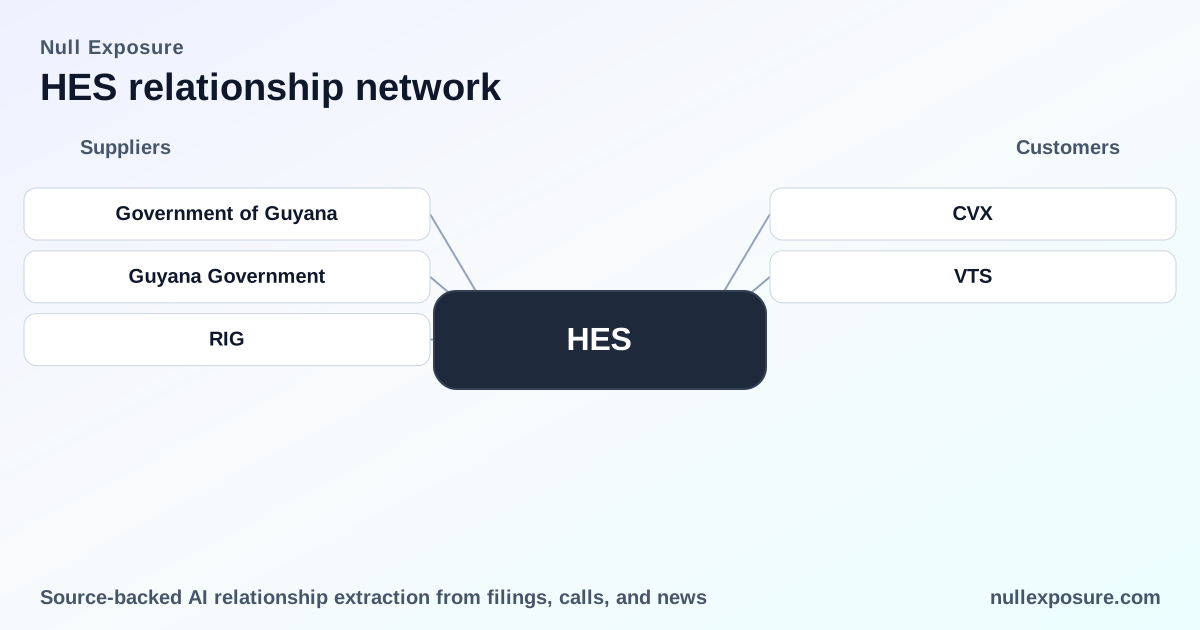
Hess (HES) — customer and partner map for investors
Hess historically operated as a focused upstream oil and gas company that monetized through production revenues, selective midstream stakes and strategic asset sales, culminating in a transformational sale of the company to Chevron. For investors, the company’s commercial posture over the last decade has been one of deliberate portfolio pruning—selling non-core retail and midstream assets while concentrating value in high-return exploration and production positions, most notably offshore Guyana. Visit https://nullexposure.com/ for a consolidated view of counterparty exposure and reporting tools.
Why counterparties matter: concentration, exit strategy and who takes the assets
Hess’s counterparties tell a persistent story: value concentrated in upstream Guyana assets and a deliberate unwind of lower-margin retail and midstream businesses. That strategy produced large, visible counterparty events—an acquisition by Chevron and several asset sales to third-party infrastructure and downstream buyers—that materially change counterparty risk profiles for customers, suppliers and creditors.
The relationship map: the counterparties you need to know
Chevron (CVX)
Chevron completed a large-scale acquisition of Hess for roughly $53–55 billion, taking control of Hess’s Guyana position and other upstream assets; post-closing, David Hess (Mr. Hess) will serve in an advisory and government-relations role. According to multiple media reports (Axios, IEEFA, Offshore-Energy and other coverage in 2025–2026), Chevron’s purchase is the defining counterparty event and re-frames Hess’s customer relationships under a major integrated oil platform.
Sources: Axios (July 2025) reporting on closing and arbitration resolution; IEEFA and Offshore-Energy coverage of the acquisition and advisory arrangements (FY2023–FY2024).
Global Infrastructure Partners
Hess sold half of its Bakken midstream holdings in North Dakota to Global Infrastructure Partners for $2.68 billion in cash, a transaction that reflects Hess’s strategy to monetize midstream value and de-risk capital intensity. News coverage in mid-2026 documents the completed sale and the cash proceeds that funded upstream priorities.
Source: SpaceWar report summarizing the sale (reported July 2026 / FY2026).
Marathon Petroleum Corporation (MPC)
Hess exited the retail gasoline and convenience-store business in 2014 when it sold the unit to Marathon’s Speedway subsidiary; that earlier divestiture demonstrates Hess’s long-running push to concentrate on upstream production rather than downstream retail operations. Historical reporting from Petroleum News and later references note the 2014 definitive agreement transferring Hess Retail Holdings to Marathon.
Source: Petroleum News reporting on the 2014 sale (reported FY2014; cited in later summaries FY2026).
Speedway (Marathon Petroleum subsidiary)
Speedway, a Marathon Petroleum subsidiary, purchased Hess’s retail business in 2014 for roughly $2.6 billion; the retail exit removed a downstream operating line and associated counterparty complexity for Hess. U.S. national coverage reiterates Speedway’s role in acquiring Hess’s retail portfolio and the cash proceeds’ role in Hess’s strategic reshaping.
Source: USA Today coverage on the 2014 Speedway transaction and later reporting (contextualized FY2023).
Hovensa
Hess’s historical sale of a refinery to Hovensa, and Hovensa’s subsequent transaction history with Limetree Bay, is part of the company’s legacy downstream footprint and litigation history that has required settlements and remediation efforts. Local reporting on settlements and refinery ownership transitions captures the downstream legacy risks that Hess has worked to detach from its core upstream profile.
Source: St. Thomas Source reporting on the St. Croix asbestos claims and refinery ownership history (reported FY2026 context).
Vitesse Energy (VTS)
Vitesse Energy elected to take nearly all of its gas production in-kind from Hess-operated wells and entered into new long-term gas gathering, processing and marketing agreements with Hess affiliates—an example of Hess acting as an operator and counterparty to smaller producers through midstream and contract take arrangements. Local press filings (2025) document the in-kind production election and contractual terms.
Source: Minot Daily News coverage of legal filings and contract arrangements (reported FY2025).
What these relationships reveal about Hess’s operating model
- Contracting posture: Hess executed large, structured sales and long-term midstream agreements rather than short-term spot arrangements; the company used asset sales to reallocate capital toward upstream development. This was implemented via definitive asset transactions (retail sale to Marathon in 2014; midstream sale to GIP in 2026) and commercial agreements (Vitesse in-kind gas arrangements).
- Concentration: The counterparty map shows concentration of strategic value in a small number of high-return upstream projects (notably Guyana); that concentration is the central reason Chevron paid a premium to acquire Hess.
- Criticality: Many counterparties—buyers of midstream and retail assets and small producers contracting with Hess—view Hess as a critical operator or counterpart for specific assets and supply flows; transfer of control to Chevron reduces integration risk for some counterparties but increases dependence on a larger supplier for others.
- Maturity and exit behavior: Hess’s pattern of divesting legacy retail and midstream holdings in favor of core upstream development constitutes a mature, exit-oriented capital allocation strategy that concluded with an outright sale to Chevron.
No explicit contractual constraints were captured in the reporting reviewed for this note; that absence is itself a company-level signal that public reporting emphasized transactions and strategic outcomes rather than granular contract terms.
Investment implications — synthesize and act
- Value crystallization through M&A: The Chevron acquisition is the primary monetization event; investors evaluating counterparties should treat Chevron as the successor counterparty on most material Hess obligations and relationships. This consolidation reduces counterparty fragmentation and transfers commercial execution to an integrated supermajor.
- Liquidity from asset sales: Sales to GIP and Marathon demonstrate Hess’s use of asset sales to generate liquidity for upstream investment and to streamline operations—useful when modeling cash flow and counterparty credit exposure prior to the acquisition.
- Legacy risk management: Downstream legacy issues (refinery transitions and litigation traceable to Hovensa/Limetree Bay) remain a reputational and remediation headline risk historically; these issues have been largely removed from the company’s operating core through divestiture.
- Small-producer exposure: Agreements like Vitesse’s in-kind election show Hess’s operational role in regional gas systems and the resulting counterparty credit exposure inherent in operator-take arrangements.
If you require an in-depth counterparty exposure table or a tailored risk matrix for Hess counterparties under Chevron ownership, review our full analytics and reporting at https://nullexposure.com/ — we provide ready-to-use counterparty views for investor diligence.
Bottom line
Hess executed a deliberate commercial strategy: strip non-core downstream and midstream assets, concentrate value in high-return upstream projects, then monetize via large-scale M&A. For investors and operators, the Chevron acquisition is the defining event that shifts counterparty risk to an integrated supermajor while leaving a clear audit trail of how Hess monetized legacy assets and managed small-producer commercial arrangements.