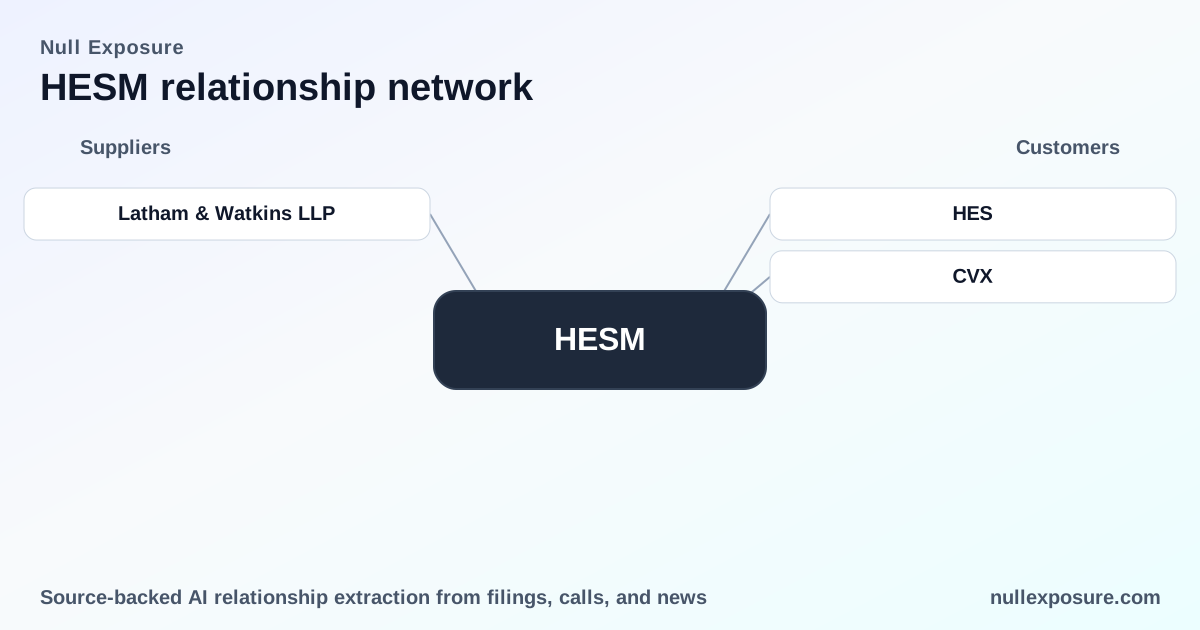
Hess Midstream (HESM) — customer relationships that drive cash flow and concentration risk
Thesis: Hess Midstream Partners LP operates a fee‑based midstream business that monetizes infrastructure through long‑term, usage‑priced contracts—primarily with Hess and with limited third‑party business—earning fees per barrel or Mcf for gathering, processing, storage, terminaling and water services. The partnership’s cash flow profile is therefore driven by volumes and contract mechanics (minimum volume commitments, tariff resets and inflation escalators) rather than commodity prices, making customer contract durability the central underwriting issue for investors. Learn more about our relationship intelligence at https://nullexposure.com/.
What the public signals say about HESM’s customer map
HESM’s public footprint in press and filings is narrowly focused: multiple news reports and the company’s own filings repeatedly reference long‑term agreements with Hess and, to a lesser extent, commercial relationships with Chevron and other third parties. The dominant counterparty for revenue is Hess and affiliated entities; Chevron appears as a named customer in recent communications but is not the primary revenue source.
Hess / HES / Hess Corporation — the undeniable core customer
Hess (listed in multiple sources under Hess, HES and Hess Corporation) is the central counterparty: HESM provides comprehensive midstream services to Hess under long‑term, fee‑based agreements across gathering, processing & storage, and terminaling and export logistics. According to the company’s Form 10‑K and related press coverage, these agreements include minimum volume commitments (MVCs), multi‑year renewal options and fee mechanisms that reset and escalate—the foundation of HESM’s cash‑flow stability. Sources: AIJourn summarizing the Form 10‑K filing (FY2024) and SureDividend coverage (FY2025).
Chevron / CVX / Chevron Corporation — a named customer in disclosures
Multiple press items and the company’s earnings commentary list Chevron (shown in results as Chevron, CVX and Chevron Corporation) as a counterparty that receives services from HESM, including terminal and rail logistics and processing access. Recent reporting frames Chevron as a secondary customer referenced in FY2026 corporate communications, not as the revenue driver that Hess is. Sources: Yahoo Finance Singapore (FY2026) and MarketScreener press (FY2026).
Relationship inventory — every counterparty mentioned in the results
Below are the counterparties and how they are referenced across the sourced results; each bullet is a concise plain‑English summary tied to the indicated public reference.
-
Hess / HES / Hess Corporation — HESM’s primary customer under long‑term, fee‑based commercial agreements that cover gas and crude gathering, gas processing and fractionation, storage, and terminaling; Hess provides MVCs and dedicated production that underpin nearly all revenue. According to the 2023 Form 10‑K (reported via AIJourn) and subsequent coverage in SureDividend and InsiderMonkey (FY2025), these agreements are the nucleus of HESM’s cash flows.
-
Chevron / CVX / Chevron Corporation — Identified in HESM press and earnings commentary as a named recipient of midstream services (terminaling, rail logistics and processing access), listed in FY2026 coverage; Chevron is referenced across Yahoo Finance (SG and NZ) and MarketScreener pieces reporting FY2026 distribution and operational notes.
(Each of the above entities appears multiple times in the collected results: the Hess relationship is reflected under the names "Hess", "Hess Corporation" and ticker "HES" in sources such as AIJourn, SureDividend, InsiderMonkey and SahmCapital (FY2024–FY2026); the Chevron relationship is referenced under "Chevron", "Chevron Corporation" and ticker "CVX" in Yahoo Finance, MarketScreener and other FY2026 reporting.)
How the contract architecture shapes risk and return
-
Usage‑based fee model: HESM recognizes revenue on the volumes it handles and invoices fees by the barrel/Mcf rather than trading commodity value, which isolates operating cash flow from commodity price swings and concentrates risk on throughput. Evidence in the filings describes fee per barrel/Mcf billing and output‑method revenue recognition.
-
Long‑term, renewing contracts: The majority of the Hess contracts originated January 1, 2014 with initial 10–15 year terms and, where exercised, a Secondary Term through December 31, 2033; annual rate redetermination for some services ended in 2023 and fees now largely escalate via CPI‑based mechanisms. This structure provides downside protection (MVCs, shortfall fees) while limiting upside tied to commodity booms.
-
Extremely high customer concentration: HESM reported that ~98% of revenues in 2024 derived from agreements with Hess, which is a critical single‑customer dependency and a central credit and operational risk for investors.
-
Service provider posture and operational criticality: HESM functions as an essential service provider—gathering, compression, processing, fractionation and rail logistics—so customer relationships are operationally critical; disruptions or performance issues could trigger suspension or termination provisions under the contracts.
-
Geographic concentration: Operations are heavily concentrated in the Bakken/Williston Basin and other U.S. locations, exposing the partnership to regional drilling cycles, seasonal weather impacts and jurisdictional regulatory changes.
Investment implications — what investors should price in
-
Upside is anchored to volume growth and third‑party diversification. HESM has begun modestly expanding direct third‑party services (ramping activity observed in 2023 filings and press), but the firm’s near‑term cash generation will remain tied to Hess production levels and any incremental third‑party business it can capture.
-
Downside is concentrated but contractually buffered. MVCs and shortfall fees create a revenue floor, yet a prolonged decline in Hess volumes, major permit or regulatory constraints, or credit stress at Hess would have outsized impact given the 98% revenue concentration.
-
Renewal terms reduce rate volatility but cap re‑pricing opportunities. The Secondary Term mechanics (fixed initial year based on prior averages plus CPI adjustments) stabilize revenue but limit tariff resets that could participate in quick commodity price recoveries.
Roadmap for further diligence
- Review the full Form 10‑K and the annexed commercial agreement summaries for MVC schedules, shortfall fee formulas and renewal mechanics (the Form 10‑K is summarized in AIJourn’s FY2024 note).
- Quantify downside scenarios: simulate throughput decline vs shortfall fee recognition and assess covenant/coverage impacts on distributions and leverage.
- Track third‑party commercial uptake: management commentary in FY2024–FY2026 filings and press notes (InsiderMonkey, SahmCapital, SimplyWallSt) give the first public indicators of diversification progress.
If you want a consolidated, investor‑grade view of HESM’s counterparty exposures and contractual protections, explore our platform at https://nullexposure.com/ for deeper relationship analytics and document‑level sourcing.
Bold takeaways: Hess is the critical revenue engine; contracts are long‑term and usage‑based; geographic and customer concentration are the principal risk levers that investors must underwrite.