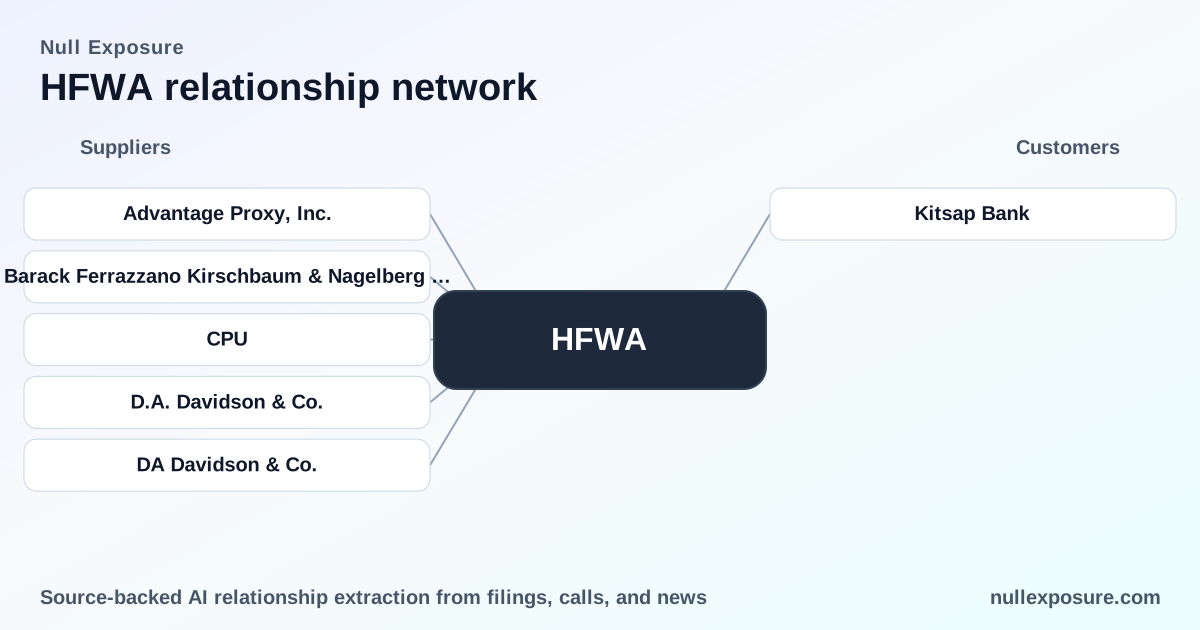
Heritage Financial (HFWA): customer relationships and what they mean for investors
Heritage Financial Corporation is a regional bank holding company that monetizes through spread-based lending, fee income from deposit and treasury services, and wealth management fees. The franchise operates a 50-branch community bank concentrated in the Pacific Northwest, funding loan growth primarily with core, non‑maturity deposits and generating recurring service fees from business and retail customers. For a concise map of customer-level relationships and implications for execution risk, see NullExposure’s coverage at https://nullexposure.com/.
The commercial banking business model in plain English
Heritage runs a traditional community bank model: originate and hold a large commercial loan portfolio, attract deposit balances from households and small-to-mid businesses, and collect fees on accounts and wealth-management assets. Company filings for the period ending December 31, 2024 show that commercial business loans account for the majority of loan balances ($3.76 billion, 78.3% of loans receivable) and that non‑maturity deposits are the primary funding source, representing a high share of total deposits. These two facts drive both revenue stability and funding sensitivity: lending spreads and deposit retention dictate earnings, while deposit flight or rate competition would pressure margins and liquidity.
Contract mix and revenue cadence: short-term, long-term, and transaction income
Heritage’s revenue streams come from contracts with materially different economics and maturities. The company discloses a mix of:
- Short‑term contracts: speculative construction loans and certain revolving commitments priced as variable‑rate instruments generate immediate interest when funded but are typically shorter in tenor.
- Long‑term contracts: residential and owner‑occupied CRE loans with terms typically ranging 15–30 years provide durable interest income and book value stability.
- Spot/transaction fees: wire fees, NSF charges and similar items are recognized when executed and produce a highly elastic, low‑commitment revenue stream.
- Subscription‑style wealth fees: Wealth Management fees are recognized monthly and are largely proportional to assets under management, producing predictable recurring revenue.
These contract types create a hybrid revenue profile: stable long‑term interest margins from amortizing loans, intermittent growth from short-term construction activity, and fee income that scales with deposit and AUM growth.
Counterparty mix: diversified retail plus concentrated commercial exposures
Heritage’s customer base is a mix of individual consumers, small and mid-sized businesses, and some government‑guaranteed loans:
- Individuals and retail are large in number and provide transactional deposits and consumer lending revenue; filings document large consumer loan pools and retail deposit products.
- Small and mid‑market businesses form the core of commercial lending and cash-management relationships, consistent with management’s expressed emphasis on “total relationship banking.”
- Government‑guaranteed exposures are present but small in absolute terms (examples given of nonaccrual loans guaranteed by government agencies), while most activity is regional and domestic.
This counterparty mix supports cross‑sell opportunities but concentrates credit exposure in commercial business lending, where losses on a small number of larger loans can be material to results.
Geographic concentration and operational footprint
Heritage is a regional operator with all activity conducted domestically and a branch footprint concentrated in Washington, Oregon and Idaho. Management states that operations and collateral values are concentrated along the I‑5 corridor and selected counties. That geographic concentration creates idiosyncratic risk tied to regional economic cycles, but it also provides underwriting knowledge and local relationships that support origination and deposit gathering.
Materiality and criticality: what risks matter to investors
Heritage’s balance‑sheet posture drives two investor priorities:
- Credit risk concentration: Commercial loans are material to the company’s economics and capital; a small number of impaired commercial loans would have outsized earnings and capital impact.
- Funding and liquidity dependence on deposits: Deposits are the primary source of funding; the bank emphasizes maintaining non‑maturity deposits to internally fund loan growth. Any sustained deposit outflow or competitive pressure on deposit pricing would meaningfully affect funding costs and loan growth capacity.
- Operational reliance on customer servicing and third‑party systems: Information and transaction systems used to service customers are critical for business continuity and regulatory compliance; the bank references both internal systems and external partners for digital services.
These are company‑level constraints drawn from the firm’s public disclosures (December 31, 2024 filings) and inform an investor’s assessment of capital and liquidity stress scenarios.
Customer relationships: the complete set from recent coverage
The dataset of reported customer relationships for HFWA contains one recent, explicit customer transaction covered in public press. Below is every relationship item present in the public results.
Kitsap Bank — customers and employees integrated into Heritage Bank
Heritage announced the completion of a transaction that brings Kitsap Bank’s customers and employees into Heritage Bank, with management explicitly welcoming the acquisition into its franchise. This is a customer‑integration outcome reflecting Heritage’s acquisitive, regional expansion strategy and was reported in a press release posted to Yahoo Finance on March 10, 2026.
Source: Yahoo Finance press release, March 10, 2026 — “Heritage Financial Corporation announces completion” (news item).
(There are no other individual named customer relationships in the public results returned for this query.)
Relationship lifecycle and portfolio stage signals
Public filings and disclosures show the loan and customer book contains a mix of active, renewing, winding‑down and terminated relationships:
- Majority of lending relationships are active; loans receivable increased year‑over‑year and the company reports a substantial balance of current performing loans.
- The bank ceased origination of residential real estate loans in 2024, a clear strategic shift that moves that line into a winding‑down/terminated origination posture while still allowing purchases of loan pools.
- A small number of payoffs and completed terminations are normal; Heritage reports specific payoff events and select modified loan populations. These lifecycle signals reflect a mature, active lending franchise managing origination cadence and portfolio risk.
What investors and operators should take away
- Core thesis: Heritage is a deposit‑funded regional lender focused on commercial business loans; earnings are driven by net interest margin on a predominantly commercial portfolio and by deposit and fee income growth. That model scales well in stable regional markets but is sensitive to deposit retention and commercial credit quality.
- Key exposures: geographic concentration in the Pacific Northwest, material commercial loan balances, and reliance on non‑maturity deposits for funding are the primary risk vectors investors must monitor.
- Execution signals: the Kitsap Bank integration demonstrates active market consolidation and customer acquisition, which supports deposit growth and scale in Heritage’s markets (press release, March 10, 2026).
For a consolidated view of customer relationships, contract characteristics, and operating constraints that matter for valuation and risk modeling, explore our investor brief at https://nullexposure.com/.
Final notes for research teams
Use the combination of loan‑level maturity signals (short‑term construction versus 15–30 year amortizing credits), deposit composition metrics, and public M&A notices (for example, the Kitsap Bank integration) to stress‑test earnings and liquidity scenarios. Monitor the 10‑largest borrower concentration, deposit beta to market rates, and credit grade migration trends in quarterly filings to detect inflection points in performance.