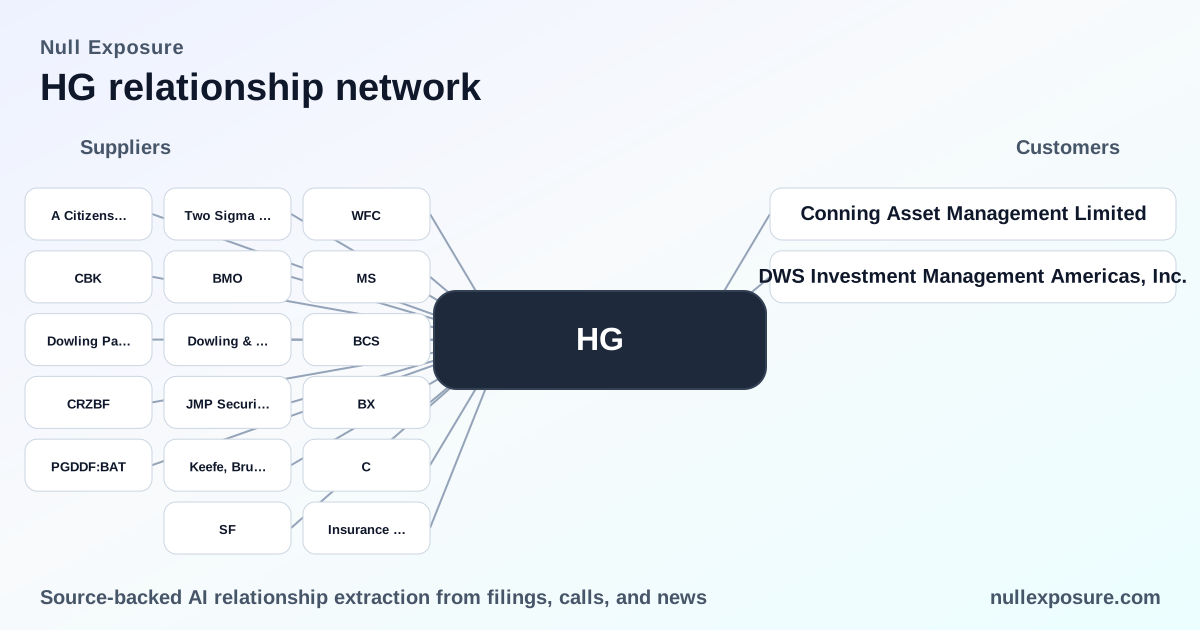
Hamilton Insurance Group (HG) — the customer relationships that matter to investors
Hamilton underwrites specialty insurance and reinsurance globally and monetizes through premiums, reinsurance participations and fee income from syndicate and capital-management services; investment income on the premium float is managed externally. The company earns underwriting revenue across three underwriting platforms (Lloyd’s Syndicate 4000, HIDAC in Dublin and Hamilton Select in the U.S.), cedes and retains risk, and uses third‑party investment managers to run its fixed‑income portfolio. For investors, that mix creates a dual operating lever: underwriting performance and the productivity of invested premiums. Learn more at NullExposure.
Two named external managers: a concise register from the 10‑K
Hamilton discloses two external investment managers for its fixed‑income portfolio in the FY2024 Form 10‑K. These relationships are limited in number but central to how the company converts underwriting float into investment returns.
Conning Asset Management Limited
Conning is one of the two external managers that Hamilton uses to manage its fixed‑income investment portfolio, as disclosed in the company’s FY2024 10‑K. According to the 2024 Form 10‑K, Conning shares portfolio duties with a second manager rather than exercising sole discretion.
Source: Hamilton Insurance Group, Ltd., 2024 Form 10‑K (fiscal year ended December 31, 2024).
DWS Investment Management Americas, Inc.
DWS Investment Management Americas, Inc. is the other external manager named alongside Conning to manage Hamilton’s fixed‑income investments, per the same FY2024 filing. The 10‑K lists DWS and Conning explicitly as Hamilton’s fixed‑income managers, signalling a bilateral outsourcing arrangement for core investment activities.
Source: Hamilton Insurance Group, Ltd., 2024 Form 10‑K (fiscal year ended December 31, 2024).
What the disclosed relationships mean operationally
The 10‑K language is unambiguous: Hamilton delegates management of its fixed‑income portfolio to two external managers. That operational choice concentrates investment implementation with a small set of counterparties while leaving strategic asset‑allocation decisions and capital deployment with Hamilton’s treasury and investment oversight functions. Outsourcing investment execution supports scale and specialist access but creates single‑point dependencies at the manager level and requires robust governance and monitoring by Hamilton.
Company‑level constraints and the business model they imply
Hamilton’s 10‑K contains a set of structural signals that define how it runs the business and the attendant risk profile. These constraints are company‑level characteristics, not relationship‑specific assertions.
- Contracting posture — predominantly short‑term insurance contracts with subscription elements. The underwriting book is heavily short‑tail (premiums generally earned over ~12 months) while Lloyd’s Syndicate 4000 operates on a subscription basis. This drives near‑term earnings visibility but leaves casualty exposures as a source of growing long‑tail uncertainty.
- Concentration and counterparty mix — material broker concentration and a broad spectrum of clients. The company reports its top 10 brokers account for approximately 55% of gross premium written in International, indicating distribution concentration; counterparties range from government and large enterprise cedants to mid‑market and small commercial accounts.
- Criticality of ratings and capital — insurer ratings are essential to distribution. Hamilton states that maintaining strong credit and financial strength ratings is critical to placing business and retaining broker and cedant relationships.
- Geographic footprint — global with North America and EMEA focus. Hamilton underwrites worldwide, with material exposures concentrated in North America and Europe, and active business in APAC and Latin America.
- Relationship roles and lifecycle — multi‑role interactions and mature engagements. Hamilton functions both as seller (underwriter) and buyer (policyholder/cedant relationships in certain structures), acts as distributor via MGAs and HMGA Americas, and operates mature, active relationships across its platforms.
- Segments and product focus — underwriting is the core product, supported by services and proprietary software. Underwriting and premium generation are the primary revenue drivers; the firm also earns third‑party syndicate management fees and uses proprietary systems (HARP, Timeflow) to scale underwriting and accumulation management.
- Spend and scale signal — enterprise scale with >$2.4bn gross premiums written (2024). The firm operates at the high end of the market; syndicate capacity and catastrophe exposures are consistent with 100M+ spend and claims potential.
These constraints collectively shape Hamilton’s operating model: fast premium turnover from short‑tail lines, concentrated distribution channels that amplify pricing power and vulnerability, and externalized investment execution that makes manager selection and oversight a governance priority.
Investor implications — where value and risk concentrate
- Underwriting economics are the primary value driver. Net premiums earned and combined‑ratio improvement have driven recent profit growth; for 2024 Hamilton reported material increases in net premiums earned and underwriting income. Underwriting performance therefore dominates near‑term earnings volatility.
- Investment management outsourcing is a leverage point. By placing fixed‑income management with Conning and DWS, Hamilton extracts specialist execution while creating operational dependency; investors should track manager performance and any shifts in allocation or manager count disclosed in future filings.
- Distribution concentration is a risk‑return amplifier. With a handful of brokers responsible for over half of International premiums, fee and placement decisions by those brokers materially affect sales and renewal economics.
- Catastrophe and casualty exposures remain capital‑intensive. The company carries significant catastrophe reserve volatility and explicit event loss estimates; capital adequacy and rating agency responses will dictate capacity and cost of capital going forward.
- Governance and technology matter. Hamilton’s proprietary underwriting systems and the contract structure for MGAs and syndicate management underpin its ability to scale; licensing and IP protections are therefore strategic assets.
Tactical checklist for analysts evaluating HG customer relationships
- Confirm any changes to the fixed‑income manager roster in subsequent filings or risk‑disclosures.
- Monitor broker concentration trends and renewal metrics for Syndicate 4000 and HIDAC placements.
- Watch rating agency commentary and capital ratios after major catastrophic loss events.
- Review third‑party fee income and syndicate management renewals as indicators of non‑underwriting revenue growth.
For a concise, investor‑focused extraction of counterparty relationships and contractual cues from Hamilton’s filings, explore the Hamilton customer relationship coverage at NullExposure home — a practical starting point for due diligence.
Bottom line
Hamilton’s customer and counterparty footprint is deliberately concentrated across high‑value distribution partners and global underwriting platforms, while investment execution is concentrated with two named managers (Conning and DWS) per the FY2024 10‑K. That structure accelerates scale and underwriting reach but imposes governance and concentration risks that investors must monitor alongside underwriting metrics and rating agency signals.