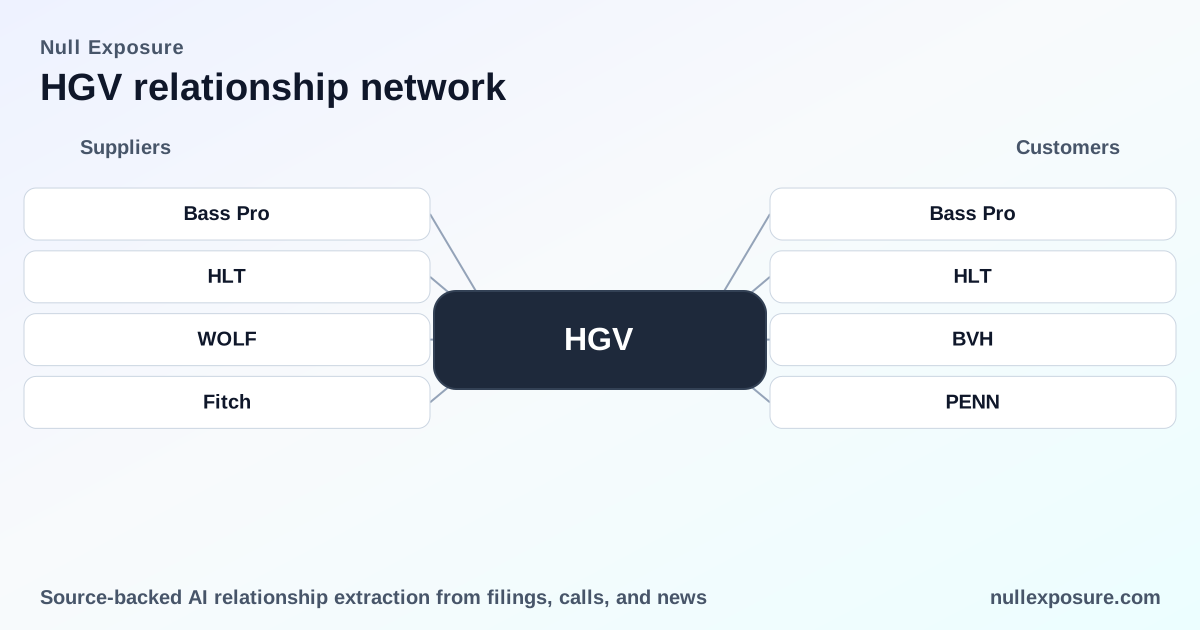
Hilton Grand Vacations (HGV): customer relationships that drive recurring cash and leveraged financing
Hilton Grand Vacations sells deeded and points-based vacation ownership interests, finances purchases with largely 10‑year amortizing loans, and operates a recurring-fee club and resort management business that extracts ongoing cash from both owners and third‑party HOAs. The company monetizes through three linked channels: VOI sales and financed receivables, annual and activation club fees (subscription economics), and fee-for-service resort management and rentals (usage and licensing fees). For a focused review of named partner relationships called out in HGV’s 2025 Q4 commentary, see the relationship scorecard below. Learn more at https://nullexposure.com/.
How HGV’s customer contracts turn into predictable revenue
HGV’s cash model blends transactional real‑estate sales with recurring finance and servicing economics. Financing is structurally long‑dated: the company’s originated timeshare loans are typically 10‑year, fully amortizing instruments and the originated portfolio had a weighted‑average remaining term of roughly 8.6 years as of December 31, 2024, with weighted average interest rates in the mid‑teens on many cohorts. According to company filings, HGV actively securitizes seasoned receivables while using near‑term facility borrowing to smooth liquidity around originations and portfolio seasoning.
At the same time, membership/subscription dynamics provide annuity cash flows: club activation fees, annual dues and transaction fees are recognized over time and support repeat engagement from a roughly 724,000‑member base at year‑end 2024. Management agreements with HOAs are typically three‑ to five‑year contracts that renew for one‑ to three‑year periods, providing recurring management revenue while preserving optionality for owners and associations. Company disclosures show a deliberate mix of long‑term financing, medium‑term management contracts and usage‑based fees that together create a diversified revenue ladder (sales → financing interest → club fees → management & rental income).
Geography, concentration and materiality — what matters to investors
HGV is global in footprint but North America is predominant. The customer base for financing is concentrated in U.S./Canada (about 90% of financed borrowers in recent years) while marketing and resort footprints extend to Europe, Mexico, the Caribbean and Asia (notably Japan and South Korea), per company disclosures for FY2024. Revenue concentration is modest at the counterparty level: the company reports that no single non‑U.S. country or single customer generated more than 10% of revenue in the recent periods disclosed, but portfolio concentration in financed receivables is material — the timeshare receivable book is several billions and the allowance for financing losses is sizable (reported at approximately $1.1 billion at year‑end 2024), which is a meaningful contingency for investors.
Learn more about how we map customer exposure at NullExposure: https://nullexposure.com/.
Relationship scorecard: partners called out on the Q4 call
HGV referenced a small group of named partners in the 2025 Q4 earnings call that illustrate its distribution and marketing strategy. Below are each of the named relationships pulled directly from that call with a concise, plain‑English takeaway and source.
Bass Pro
HGV opened marketing kiosks with Bass Pro as part of a retail lead‑generation program; the company also signed a 10‑year exclusive marketing agreement with Bass Pro Shops in November 2023 to sell vacation packages in Bass Pro/Cabela’s retail locations. Source: HGV 2025 Q4 earnings call and corporate filings noting the November 2023 10‑year Bass Pro agreement.
Hilton (HLT)
HGV operates and markets under the Hilton Grand Vacations brand and lists Hilton as a distribution and marketing partner; the Q4 call notes joint marketing site openings with Hilton to support tour flow. Source: HGV 2025 Q4 earnings call and related FY2024 disclosures referencing Hilton partnership activity.
HLT (duplicate reference)
The call contains a separate line item labeled “HLT” that refers to the same Hilton corporate relationship and joint marketing activity highlighted in the earnings commentary. Source: HGV 2025 Q4 earnings call.
Bluegreen (BVH)
Bluegreen is an acquired business and distribution channel: HGV introduced HGV Max memberships to Bluegreen members and reported a 35% membership growth in that cohort, reflecting integration of the Bluegreen customer base into HGV’s subscription offerings. Source: HGV 2025 Q4 earnings call and the Bluegreen Acquisition disclosures (completed January 17, 2024).
BVH (duplicate reference)
The dataset includes a second entry for BVH; this duplicate reiterates the expansion of HGV Max into Bluegreen’s membership base and the integration results discussed by management. Source: HGV 2025 Q4 earnings call.
Great Wolf
Great Wolf is listed as a partner in HGV’s expansion of marketing sites to drive tour flow, included alongside Bass Pro and Hilton in the Q4 commentary about lead‑generation investments. Source: HGV 2025 Q4 earnings call.
Operating constraints and practical implications for partnerships
- Contracting posture is hybrid: HGV uses long‑term finance product structures (10‑year amortizing loans) and medium‑term management agreements (3–5 years with renewals), while memberships and activation fees create subscription economics that are recognized over multiyear schedules (company filing details). This mix gives cash stability from dues and interest while maintaining optionality on property management rights.
- Concentration and scale: No single customer generates >10% of revenue, but the secured financing book is large and credit‑sensitive; the company’s allowance and securitization strategy are core to earnings sensitivity. Company filings list $2.9bn of originated receivables as of a recent maturity schedule and a large allowance at year‑end 2024.
- Criticality of consumer finance: Financing is a profit center and a distribution lever; securitization markets and interest‑rate regimes are therefore critical to HGV’s unit economics. Management explicitly ties future securitization timing to sales volume and financing propensity.
- Maturity profile: Loans and many revenue recognition schedules are multi‑year (loans ~10 years, activation fee amortization on a seven‑year straight‑line basis), so revenue and credit trends unfold slowly and require multi‑period monitoring.
Investment implications — what to watch next
- Credit performance (default rates and allowance): the receivable book size and allowance are material to earnings volatility.
- Securitization and funding: timing and pricing of securitizations will influence leverage and return on VOI sales.
- Distribution effectiveness: the Bass Pro 10‑year partnership and expanded retail kiosks with Hilton and Great Wolf are concrete tests of off‑site marketing ROI; tour flow and VPG trends will quantify effectiveness.
- Regulatory and reputational risks: marketing rules, GDPR and consumer protection frameworks affect cross‑border sales and telemarketing costs.
Bottom line
HGV’s customer relationships mix high‑touch, long‑dated financing with recurring subscription and usage‑based management economics. For investors, the core trade is between durable annuity cash flows from club and management revenues and headline sensitivity to credit losses and securitization cycles in the financed VOI book. For depth on customer exposure mapping and partner signals, visit https://nullexposure.com/.