Hingham Institution for Savings (HIFS): A Direct-Lender Profile for Investors
Hingham Institution for Savings is a Massachusetts-based regional bank that monetizes through lending spreads, mortgage origination, and fee income, maintaining profitability that supports a modest dividend for common shareholders. The franchise’s balance-sheet lending — including first-mortgage commercial loans — is a core revenue driver, and current public filings through Q1 2026 show a compact but profitable operation (Revenue TTM $97.5M; Profit Margin 51.6%; Market Cap ~$609M). For investors evaluating counterparty exposures, the bank’s customer footprint is dominated by traditional mortgage and deposit relationships, with observable activity in commercial real estate lending. Learn more about customer-level signals at https://nullexposure.com/.
Single visible customer relationship: direct first-mortgage for a waterfront office purchase
Hingham Institution for Savings shows active participation as a first mortgage lender on commercial transactions in its regional market. A single, documented customer relationship in public reporting illustrates that posture.
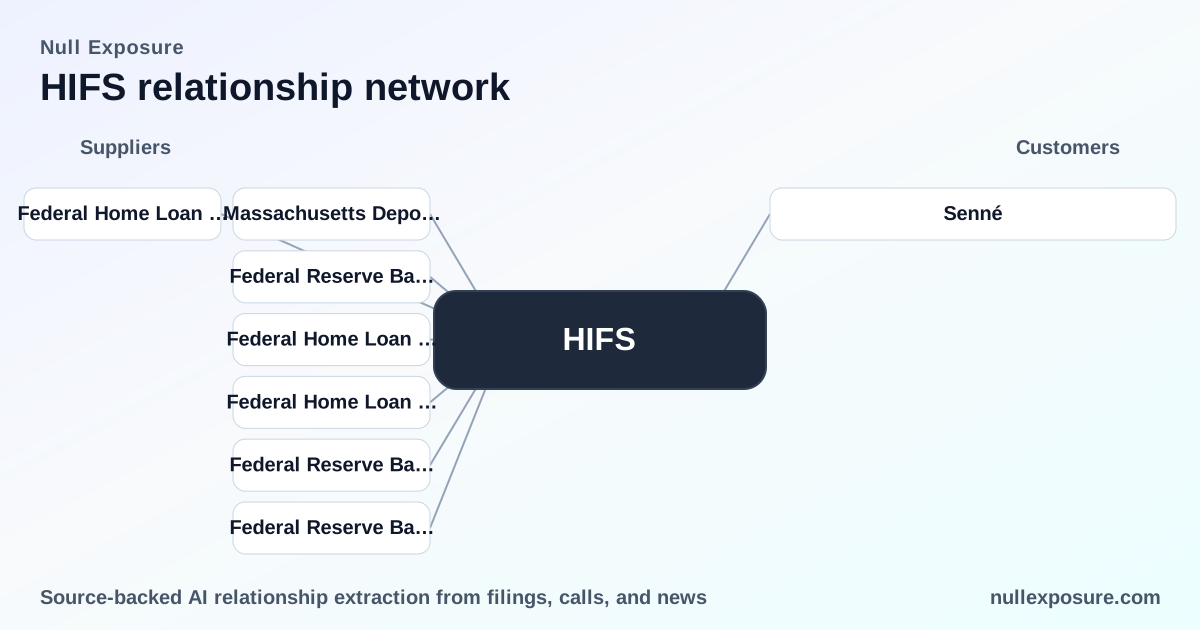
Senné — One Lewis Wharf (FY2020 commercial purchase)
Hingham Institution for Savings provided first mortgage financing for Senné’s acquisition of One Lewis Wharf, a North End waterfront office building, in a $13.2 million private transaction brokered by CBRE. This transaction is recorded in a New England Real Estate Journal report dated March 10, 2026, which identifies HIFS as the direct first-mortgage lender on the deal (NEREJ, March 2026: https://nerej.com/senne-acquires-one-lewis-wharf-for-13-2m).
What that relationship signals about HIFS’s operating model
The Senné transaction is consistent with a conservative, relationship-driven commercial lending posture typical of a community/regional bank:
- The bank acts as a direct lender on first-mortgage commercial real estate, indicating an underwriting and credit-approval capability oriented to local transactions rather than brokered securitizations.
- As a first-mortgage provider, HIFS assumes primary lien exposure on asset-backed commercial real estate, which is credit-critical for transaction counterparties and operationally central to the bank’s loan book strategy.
These are company-level signals: the public relationship record does not list any constraints that change this assessment, so these characteristics should be treated as descriptive of HIFS’s standard commercial-lending posture.
Company-level characteristics that matter to counterparties and investors
Use the following firm signals when evaluating HIFS customer relationships and concentration risk:
- Profitability and capital efficiency: Public figures through Q1 2026 show a high reported profit margin (51.6%) and an ROE around 10.9%, reflecting a profitable bank-level model that funds dividends and supports continued lending activity (company financials, latest quarter 2026-03-31).
- Size and market focus: Market capitalization is roughly $608.8M and shares outstanding are limited (~2.18M), confirming a compact institution with strong local market focus and the ability to underwrite bespoke loans in its geography.
- Ownership profile: Institutional ownership is substantial at ~67.2% while insiders hold ~5.3%, which signals active monitoring by professional investors and limited insider concentration — a governance signal relevant to strategic lending decisions.
- Valuation orientation: Price-to-book sits near 1.3 and trailing P/E at ~11.27, indicating the market prices HIFS as a mature, cash-generative regional bank with stable returns relative to book value.
- Dividend and shareholder return: A dividend per share of $2.52 (ex-dividend in early May 2026, with payment on May 13, 2026) demonstrates a shareholder-return focus supported by consistent earnings.
These attributes frame HIFS as a mature community bank that funds local commercial and residential lending from a stable deposit franchise and capital base.
Risk implications from observed relationships
The Senné / One Lewis Wharf financing underlines a few practical investment and operational considerations:
- Direct credit exposure: By providing first-mortgage financing, HIFS holds primary loss-absorption exposure on the asset; any deterioration in the underlying property or tenant mix would translate directly to credit risk for the bank.
- Local market concentration: The bank’s transaction footprint is regionally concentrated in Massachusetts, so portfolio performance will correlate with New England commercial real estate cycles.
- Underwriting discipline: The bank’s profitability and dividend support suggest disciplined underwriting and risk management, but investors should monitor quarterly credit metrics and non-performing loans to validate that discipline over time (company Q1 2026 filing data).
- Counterparty criticality: For borrowers and brokers, HIFS functions as a reliable local capital source; for investors, the bank’s role as first-lien lender makes it a primary counterparty to watch when tracking CRE exposures.
How to use this view in a valuation or credit monitoring framework
- Treat HIFS as a relationship lender with localized CRE exposure: prioritize tracking new first-mortgage commitments in the New England market for signs of growing CRE concentration or loosening underwriting.
- Use profitability and capital metrics (ROE, profit margin, P/B) as leading indicators of the bank’s ability to absorb localized credit stress without curtailing dividends.
- Monitor institutional ownership and insider activity for shifts in strategic posture; high institutional ownership implies market scrutiny will quickly surface changes in risk appetite.
Bottom line: a compact, profitable direct lender with local CRE footprint
Hingham Institution for Savings operates as a profitable regional bank that directly underwrites first-mortgage commercial loans and maintains a conservative shareholder-return profile. The documented Senné/One Lewis Wharf financing is a representative example of the bank’s on-balance-sheet lending activity and reinforces the bank’s identity as a local direct lender with credit exposure concentrated in regional CRE. For investors and operators focused on counterparty risk, the critical signals are underwriting posture, local market concentration, and continued monitoring of credit performance.
For a deeper read on customer-level intelligence and to track additional counterparty signals, visit https://nullexposure.com/.