Hartford (HIG) — Customer relationships and commercial posture investors should price in
Thesis: The Hartford monetizes through three predictable channels — short-duration insurance premiums, management fees tied to Hartford Funds AUM, and investment income — while underwriting long-tail employee benefits that create multi-year reserve obligations; its commercial relationships therefore drive both near-term cash flow and long-duration liability risk. For investors, the revenue mix (earned premiums + fee income) and the company’s distribution and licensing arrangements determine earnings cyclicality and margin exposure. Learn more at https://nullexposure.com/.
Why Hartford’s customer map matters to the P&L
The Hartford is primarily an insurer that writes a large volume of short-term P&C business (six–12 month policy terms) while also selling long-duration employee benefits such as long‑term disability and group life that produce multi-year liabilities and reserves. On the revenue side, Hartford Funds contributes usage-based fee income that rises and falls with AUM, so equity markets and flows directly affect fee revenue. According to the company’s FY2026 disclosures reported in market filings and press summaries, total revenues were roughly $28.3bn, driven by higher earned P&C premiums and increased fee income from Hartford Funds (TradingView summary of the FY2026 10‑K).
Operating posture and commercial constraints you need to know
The filings and excerpts reveal a mixed contracting posture and distribution structure that create predictable pockets of risk and optionality:
- Contracting maturity and cadence: Property & casualty premiums are earned over short policy terms (primarily six to twelve months), while employee benefits include long-duration liabilities (discounted LTD reserves and paid‑up life) that extend the company’s exposure beyond rating cycles. This creates near-term revenue repriceability on P&C and long-tail reserve uncertainty on benefits.
- Revenue sensitivity: Fee income is usage-based, tied to average daily net asset values of mutual funds/ETFs; Hartford Funds’ AUM volatility therefore translates directly into fee volatility.
- Licensing concentration: The Personal Insurance channel includes an exclusive AARP licensing arrangement that runs through December 31, 2032, which structurally concentrates a material distribution channel.
- Customer mix and concentration: The company’s counterparties span individuals, small businesses, mid‑market and large enterprise accounts, with over 95% of revenues generated in the U.S. but a meaningful global specialty footprint. Distribution relies heavily on independent agents, brokers, and national intermediaries — an aggregation risk as intermediaries consolidate.
- Critical cost drivers: Claim payments are the largest single expenditure; catastrophe losses and long‑tail reserve re‑estimations are material to operating results. Public excerpts flag multi‑hundred‑million dollar sensitivities for adverse loss development.
- Commercial maturity: Many relationships are active and renewing; some historic legacy lines (pre‑1986 A&E) are in run‑off and winding down.
These characteristics combine to make Hartford a capital‑intensive, underwriting‑sensitive business with a complementary, market‑sensitive fee stream.
The named customer relationships you need on your model
Below I cover every named relationship in the source results, with plain-English summaries and source citations.
Xerox (XRX) — commercial insured for cyber
Xerox disclosed on its Q4 2025 earnings call that cyber insurance coverage is provided by The Hartford, confirming Hartford’s role as the cyber insurer for at least part of Xerox’s program (Xerox Q4 2025 earnings call transcript, March 2026). A separate call transcript notes the coverage was brokered by Aon, which implies Hartford participates behind a brokered commercial placement (Xerox Q4 2025 earnings transcript, posted March 10, 2026 on industry transcript services).
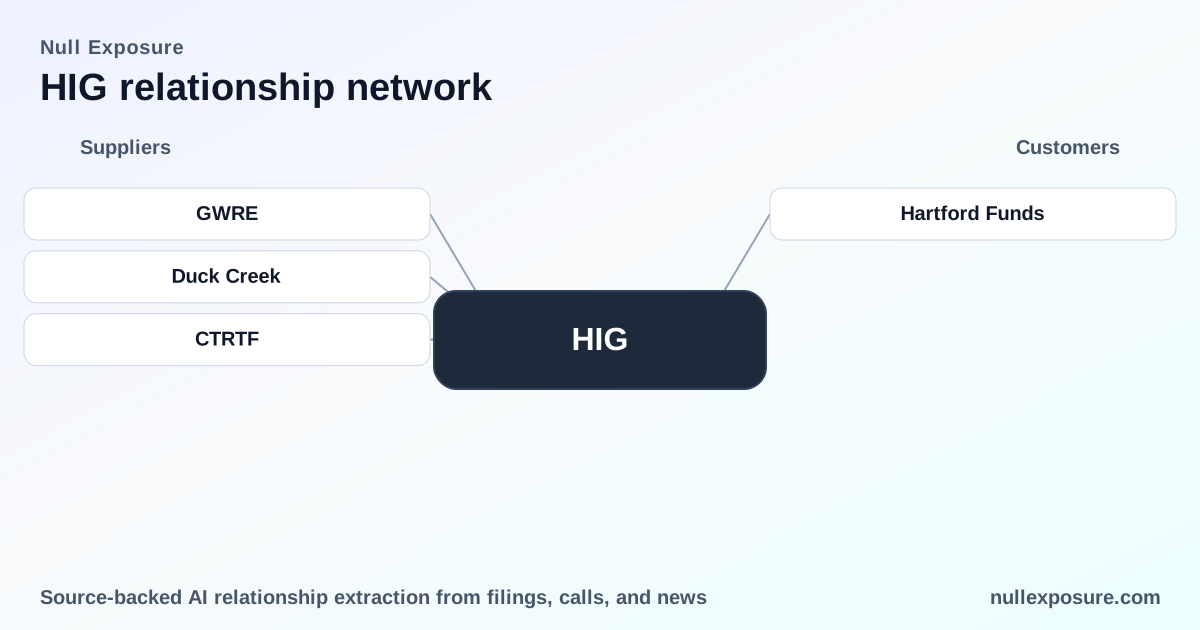
Hartford Funds — AUM‑driven fee engine inside the group
Hartford Funds is an internal business unit but functions economically as a fee-for-service, usage‑based revenue source: trading summaries of HIG’s FY2026 filings report that fee income from Hartford Funds helped drive FY2026 revenue growth to about $28.4bn, reflecting higher earned premiums in P&C and incremental fee revenue at Hartford Funds (TradingView coverage of HIG FY2026 10‑K, March 2026). Model Hartford Funds as a daily‑AUM fee stream with direct sensitivity to market levels and net flows.
AARP — long‑dated licensing and affinity channel
The Hartford markets Personal Insurance in large part through an exclusive licensing arrangement with AARP that runs through December 31, 2032, giving Hartford privileged access to an affinity cohort and a durable distribution channel for the over‑50 market (10‑K disclosures cited in FY2026 commentary; HIG investor materials). Management has explicitly referenced continuing to focus on niches such as the AARP channel as part of its growth strategy (Q1 2026 investor call transcript, May 2026).
What these relationships mean for investors and operators
- Revenue resilience vs. underwriting volatility: Short‑term P&C policies provide quick re‑pricing ability but expose Hartford to cycle‑driven premium resets; long‑duration benefits stabilize top line but create reserve risk that can affect capital suddenly. Key takeaway: balance AUM sensitivity with underwriting margin management.
- Distribution concentration risk: The AARP license provides scale and better pricing access to a high‑value demographic, but affinity dependence and broker concentration among commercial lines create negotiation leverage for intermediaries — model distribution risk in actuarial and expense assumptions.
- Claims are critical: Because claim payments are the single largest outflow, underwriting performance and reserve adequacy drive capital and earnings; stress scenarios should include catastrophe and adverse long‑tail development shocks.
- Hartford Funds introduces market correlation: Fee revenue functions as a hedge to underwriting-driven volatility in some periods but creates correlation to equity markets — model AUM declines in downside equity scenarios and the resulting fee contraction.
Practical next steps for research and operations
- For financial modeling: stress test P&C combined ratio assumptions and Hartford Funds AUM simultaneously; run scenarios that incorporate adverse reserve development and market drawdowns.
- For diligence: verify reinsurance and broker placements on large cyber, D&O and excess casualty programs (Xerox disclosure shows Hartford participates in cyber placements brokered by Aon).
- For operations: track Hartford’s renewal pricing cadence and AARP program performance through each renewal window to assess retention and pricing leverage.
If you want a structured commercial‑exposure memo or counterparty heat map for HIG, request a tailored customer‑relationship brief at https://nullexposure.com/.
Final thought: Hartford’s earnings hinge on its ability to price short‑term P&C appropriately while managing long‑tail benefit reserves and extracting steady fee income from Hartford Funds — investors should underwrite both underwriting execution and asset‑market sensitivity.