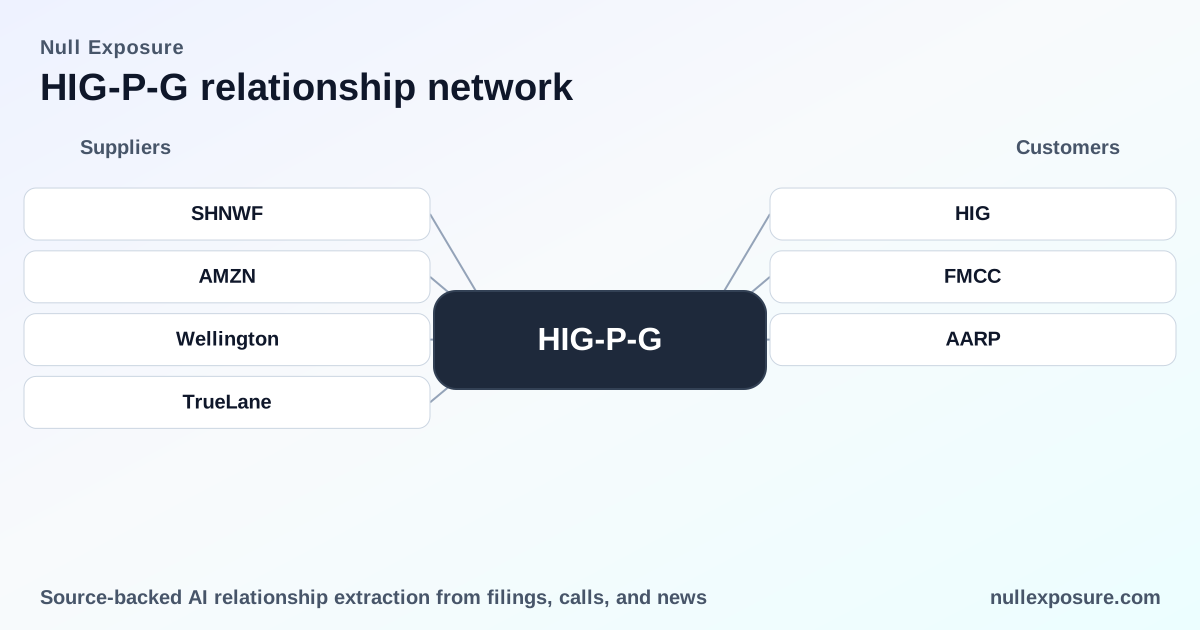
HIG-P-G (The Hartford): customer relationships that move underwriting risk and distribution economics
Thesis: The Hartford underwrites a broad mix of commercial and personal lines and monetizes through periodic premium collection and multi-layered risk transfer, supplemented by investment income and strategic joint-venture placements. Investor focus on HIG-P-G should center on how customer contracts, affinity channels and litigation dynamics alter underwriting expense, claims frequency and capital deployment.
For relationship-level monitoring and deal intelligence, see NullExposure’s coverage: https://nullexposure.com/
What a recent workplace-injury dispute says about claims exposure
Hartford’s insurer units continue to face disputes over policy exclusions and defense obligations. In a March 2026 case involving a worker injured while employed by SIR Electric LLC, Hartford Underwriters argued that policy language excluding intentional-harm claims removed an obligation to provide a defense to its insured. This illustrates that contractual policy wording is an active lever in limiting defense costs and reserving cash flow. According to Business Insurance, the case was filed in 2026 and involved multiple defendants in addition to SIR Electric. (Business Insurance, March 10, 2026)
- SIR Electric LLC — The plaintiff’s suit stems from an on-the-job injury; Hartford’s invocation of an intentional-harm exclusion is the defense posture that limits the carrier’s duty to defend under the policy language. (Business Insurance, March 10, 2026)
Layered D&O exposure and the limits of excess defense rights
A split decision from the U.S. District Court in D.C. clarified that excess carriers generally cannot second-guess coverage decisions made by lower-layer insurers, in a dispute involving Freddie Mac and Twin City Fire Insurance Co., a Hartford underwriting entity. This ruling tightens the deference paid to lower-layer underwriters and reduces the potential for excess carriers to impose additional payouts, which is valuation-relevant for multi-layered commercial placements. (Insurance Business Magazine, March 10, 2026)
-
Federal Home Loan Mortgage Corp (Freddie Mac / FMCC) — The litigation centered on a fifth-layer excess D&O policy within an eight-layer structure, where the court constrained excess carriers’ rights to challenge lower-layer payments, reinforcing the primacy of the lead-layer coverage determinations. (Insurance Business Magazine, March 10, 2026)
-
Twin City Fire Insurance Co. (a Hartford underwriting unit) — As the named lower-layer carrier, Twin City’s coverage decisions were upheld in practice by the court’s deference, which supports the underwriting leverage of Hartford-affiliated entities in complex layered placements. (Insurance Business Magazine, March 10, 2026)
Affinity distribution: AARP remains a gating relationship for retail lines
Hartford’s consumer lines distribution includes affinity relationships that materially shape its addressable retail market. MarketWatch noted that access to Hartford’s auto and homeowners products is often limited to AARP members or to people on a Hartford policy with an AARP member, making AARP a structural distribution gatekeeper that influences customer acquisition and retention economics. (MarketWatch insurance review, March 2026)
- AARP — Acting as a membership-based distribution channel, AARP’s arrangement with Hartford concentrates a portion of the insurer’s retail customer flow and reinforces the importance of partnership management for personal-lines growth. (MarketWatch, March 2026)
Institutional asset-placement and equity partnership activity
Hartford’s asset management affiliates place capital alongside developers and financial partners to generate fee revenue and investment returns. A JLL release covering financing for Holder Properties notes that Hartford Investment Management Company (“HIMCO”) participated in the joint-venture equity placement for a 389k sf development, demonstrating Hartford’s role as a capital partner in commercial real-estate investment. This shows Hartford extends beyond pure underwriting into institutional capital deployment that influences fee income and portfolio risk. (JLL press release, May 3, 2026)
- Holder Properties — HIMCO participated as JV equity alongside Pinnacle Financial Partners as lender, highlighting Hartford’s integration of insurance balance-sheet capital and asset-management placement capabilities in commercial real estate. (JLL, May 3, 2026)
Company-level operating signals and what they imply for investors
No explicit constraints were returned by the relationship feed, which itself is a signal: the captured relationships are event-driven (litigation, distribution, JV placements), not a catalog of long-term exclusive supplier contracts. From the relationship evidence we draw these firm-level operating characteristics:
-
Contracting posture: Hartford actively enforces policy language and exclusions (defense obligations are contested in court), signaling a defensive legal posture designed to protect loss reserves and near-term cash. This posture reduces upside in claim scenarios but protects capital in adverse outcomes.
-
Concentration and criticality: Some retail distribution is materially concentrated via affinity partners (notably AARP), giving Hartford a critical but manageable channel dependency for personal lines; institutional relationships (Freddie Mac, HIMCO placements) reflect diversified, high-maturity counterparties whose scale reduces counterparty credit risk.
-
Maturity and complexity: The firm operates in mature, legally complex markets—multi-layered excess structures, JV equity placements and affinity marketing—requiring sophisticated claims management, legal strategy and capital allocation.
Investment implications for HIG-P-G holders
-
Claims governance matters for preferred security protection. Active litigation over defense duties affects near-term reserve volatility and the potential for dividend-supporting capital to be diverted to claims.
-
Affinity partnerships are revenue multipliers and concentration risks. AARP drives retail distribution economics; loss of or renegotiation of such relationships would alter premium flow predictably.
-
Institutional placements diversify revenue but tie capital to real-estate cycles. HIMCO joint-venture activity supports fee income yet exposes balance-sheet capital to property markets.
For deeper relationship intelligence and to monitor counterparty events that affect underwriting and capital deployment, visit NullExposure: https://nullexposure.com/
Bottom line
The Hartford’s customer relationships in recent public records show a carrier simultaneously defending policy language to control claims outflow, relying on affinity partners for retail distribution, and deploying balance-sheet capital through HIMCO-style placements. For HIG-P-G investors, the mix of legal exposure, distribution concentration, and institutional asset activity defines the core vectors for dividend resilience and downside protection.