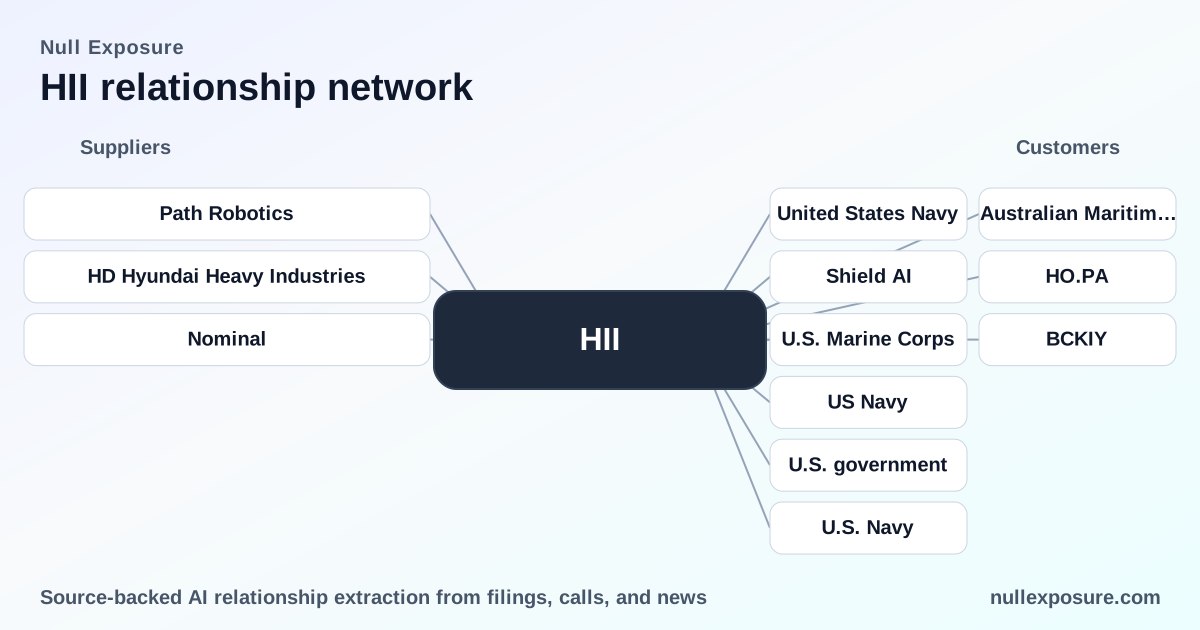
HII’s customer network: mission-critical government demand underpins revenue and risk
Huntington Ingalls Industries (HII) monetizes by designing, building, and sustaining naval platforms and related mission technologies—selling large, long-duration shipbuilding contracts and ongoing services to the U.S. Government and allied customers, plus export and partner work through its Mission Technologies unit. The business is driven by multiyear, capital-intensive contracts, concentrated government buyers, and recurring service streams that together create durable revenue visibility but concentrated program and execution risk. For more structured relationship signals on HII, see https://nullexposure.com/.
Why customers define HII’s economics and risk profile
HII’s operating model is straightforward: prime contractor and manufacturer for the U.S. Navy, Coast Guard and allied navies, plus a technology and services arm that supplies unmanned systems and C5ISR capabilities. Company filings disclose $53.1 billion of remaining performance obligations as of December 31, 2025, and that roughly 80%+ of revenue is Navy-driven, which creates both high visibility and high concentration. Contracts are predominantly long-term, cost-reimbursable or mixed-priced, often spanning multiple years and recognized over time using cost-to-cost accounting; the company also executes shorter-term services and time-and-material arrangements through Mission Technologies.
Key operating-model signals investors should weight:
- Contracting posture: dominated by multi-year, complexity-heavy awards with a high mix of cost-type and fixed-price incentive vehicles, and occasional time-and-material task orders. Company filings list numerous long-lead and multi-ship awards and note revenue recognition over multiple years.
- Customer concentration: U.S. Government (especially the U.S. Navy) is the primary counterparty, making cash flow and backlog sensitive to appropriations, audits, and program priorities.
- Criticality: HII offers capabilities that are often non‑substitutable in the U.S. market (nuclear ship construction, certain carrier RCOH work, advanced unmanned systems), making many relationships strategically critical.
- Maturity and scale: Shipbuilding is capital‑intensive and mature, while Mission Technologies competes globally with both traditional and non‑traditional defense firms; HII operates across a broad risk spectrum from steady manufacturing throughput to R&D and platform integration.
For a deeper look at HII’s relationship map and media signals, visit https://nullexposure.com/.
Customer relationships — granular read (each relationship from recent disclosures)
Below are concise, source‑anchored summaries for every relationship referenced in HII’s recent customer signals.
Shield AI
HII disclosed a partnership with Shield AI to accelerate cross‑domain and modular mission autonomy solutions during its 2025 Q3 earnings call, indicating collaboration on autonomy integration for unmanned systems. (HII 2025 Q3 earnings call, March 2026)
U.S. Marine Corps
Management referenced the U.S. Marine Corps while discussing service anniversaries and force requirements during the 2025 Q3 earnings call, underscoring the Corps’ role as a recurring customer and stakeholder in amphibious platforms and expeditionary operations. (HII 2025 Q3 earnings call, March 2026)
United States Navy (U.S. Navy)
The Navy is HII’s dominant customer: HII reiterated commitments to accelerate shipbuilding throughput, noted numerous awards (including a $283 million Ingalls FF(X) lead yard support contract), and is identified as the source of the majority of revenue and backlog. Company statements and multiple news reports confirm extensive Navy work across carriers, destroyers, submarines, unmanned systems, and sustainment. (HII 2025 Q3 earnings call, March 2026; Ingalls contract coverage in Finviz and Business Insider, April–May 2026; company SEC disclosures, FY2025)
U.S. Coast Guard
HII’s Ingalls division has a history of shipbuilding for the Coast Guard (10 NSCs delivered) and was referenced in press coverage concerning reuse of proven build sequences for the FF(X) program; management has also negotiated program conclusions with the Coast Guard in prior periods. (Finviz coverage of Ingalls award, April 2026; company filings on NSC deliveries, 2025)
Australian Maritime College (AMC)
HII provided remote technical support for REMUS unmanned underwater vehicle operations at AMC; a media report credited HII with near‑perfect availability of the REMUS100 at AMC after extensive missions, demonstrating international operational sustainment and after‑sales support capacity. (Finviz / Australian maritime report on AMC — March 2026)
U.S. Government (federal customer group)
At the company level, filings and press alerts describe HII as a leading provider of professional services to the U.S. Government, with federal agencies representing the bulk of revenue and contractual exposure; filings warn that appropriations and audits materially affect receipts and program continuity. (MarketBeat instant alert and HII 2025 SEC filings)
Thales (listed as HO.PA)
HII announced a partnership with Thales to develop advanced autonomous undersea mine‑countermeasure capabilities, reflecting international systems integration and coalition technology cooperation in undersea autonomy. (HII 2025 Q3 earnings call, March 2026)
Babcock International (BCKIY)
HII described joint work with Babcock to integrate HII’s unmanned underwater vehicles with Babcock submarine weapon handling and launch systems, and validated REMUS 620 for torpedo‑tube deployment—an example of prime/subcontractor and systems integration partnerships with large defense OEMs. (HII 2025 Q3 earnings call, March 2026)
Constraints that matter for investors (how the business model shapes risk)
- Execution risk is structural. Long‑duration shipbuilding and RCOH work produces multi‑year revenue visibility but exposes margins to labor, materials, and quality issues; HII disclosed prior quality and welding noncompliance investigations that required government notification and remediation.
- Revenue concentration magnifies political and appropriation risk. Over 80% of revenue is Navy‑related; continuing resolutions, audits, or shifts in defense priorities can materially affect cash timing and backlog realization.
- Contract mix tempers upside but raises variability. A blend of cost‑reimbursable, fixed‑price incentive, and time‑and‑materials contracts reduces near‑term margin volatility on some programs but leaves the company exposed to catch‑up adjustments and potential unrecoverable overruns.
- Strategic criticality but regulatory tethering. HII operates in a regulated, audit‑intensive sphere where suspension/debarment or negative audit findings have outsized consequences for future awards and capital allocation.
- Global reach in Mission Technologies. While shipbuilding is U.S.-centric, Mission Technologies sells and supports systems in 30+ countries—offsetting some concentration but introducing export control and partner‑integration complexity.
Bottom line for investors
HII’s customer set is both an asset and a risk: concentrated, long‑term government demand underpins large backlog and high visibility, while execution, appropriations, and audit risk drive episodic earnings volatility. The company’s recent partnerships (Shield AI, Thales, Babcock) and international support cases (AMC) demonstrate strategy to diversify technology and sustainment revenue within a government‑dominated portfolio.
To track evolving customer signals and relationship-level disclosures for HII, visit https://nullexposure.com/ for structured coverage and alerts.