Hippo Holdings (HIPO): Distribution partnerships reshape customer economics
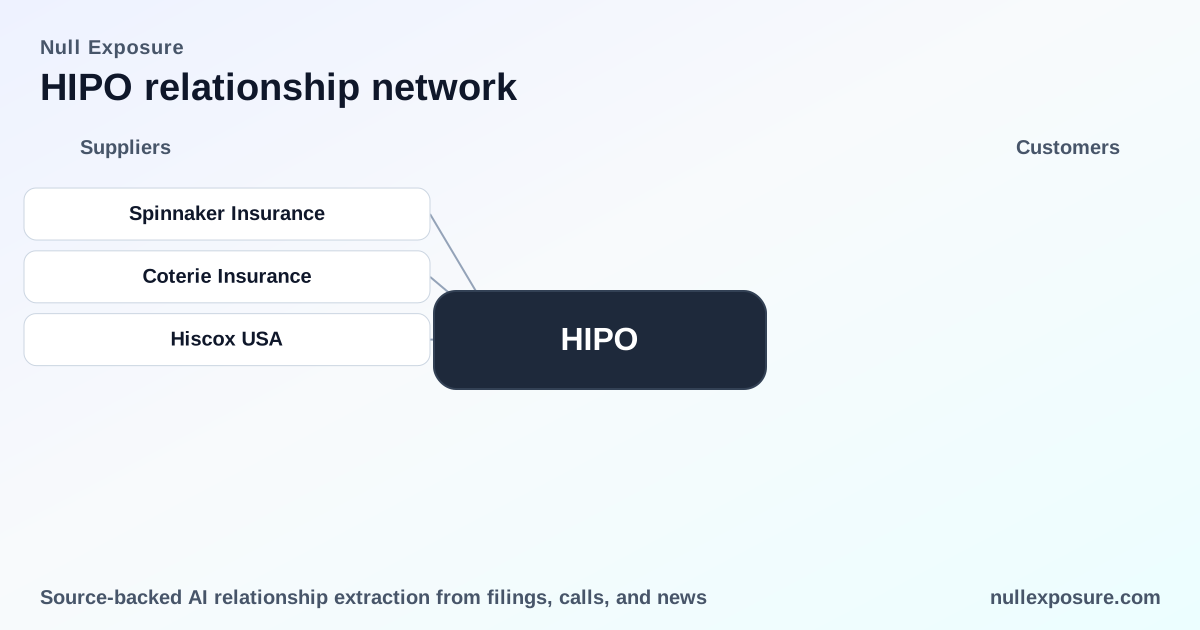
Thesis: Hippo operates a three‑leg model — direct homeowners underwriting (Hippo Home Insurance Program), a services/agency business that sells policies and collects commissions, and an Insurance‑as‑a‑Service fronting/licensing operation (via Spinnaker) that rents capital and state licenses to third‑party MGAs — and it monetizes through net earned premium, recurring commission and policy fees, fronting/licensing fees, and ancillary service revenue. Recent distribution moves with Progressive and the maintenance of Westwood coverage expand non‑direct channels, while the sale of Hippo’s homebuilder distribution assets to BWIN signals a tightening of capital and focus on higher‑margin, fee‑oriented relationships. For model and dataset access, see our homepage: https://nullexposure.com/
What investors should take from the headline moves
Hippo’s commercial posture is distribution‑led and fee‑augmented rather than pure balance‑sheet underwriting. The company collects insured premiums where it underwrites risk, earns commissions and policy fees where it acts as a producer or MGA, and takes fronting fees when it licenses Spinnaker’s carrier capacity. The Progressive relationship is a strategic distribution partnership intended to broaden market reach across multiple states, translating distribution scale into fee and commission income without a proportional increase in Hippo’s retained underwriting risk. The Westwood alliance remains an important complementary channel. Conversely, the Baldwin Group (BWIN) acquisition of Hippo’s homebuilder distribution assets crystallizes Hippo’s recent shift away from owning low‑margin distribution infrastructure.
Every reported customer/distribution relationship (concise, sourced)
Progressive — strategic distribution partnership (InsiderMonkey transcript, May 3, 2026)
Hippo announced a strategic distribution partnership with Progressive to support long‑term growth and diversification; management described the deal as part of its distribution strategy to scale profitable channels (InsiderMonkey, Q1 2026 earnings call transcript — May 3, 2026). Source: https://www.insidermonkey.com/blog/hippo-holdings-inc-nysehipo-q1-2026-earnings-call-transcript-1752180/
Progressive Insurance — eight‑state distribution rollout (Finviz news, May 2026)
Public reporting framed the Progressive arrangement as a distribution relationship spanning eight states, highlighting the partnership’s immediate geographic expansion benefits for Hippo’s homeowners product reach (Finviz news, May 3, 2026). Source: https://finviz.com/news/325805/hippo-holdings-hipo-achieves-2025-financial-turnaround-with-58m-net-income
Westwood — complementary channel alongside Progressive (InsiderMonkey transcript, May 3, 2026)
Management stated that the Progressive partnership is complementary to Hippo’s existing Westwood distribution, and that the two together create a differentiated platform for homeowners distribution supportive of profitable growth (InsiderMonkey, Q1 2026 call). Source: https://www.insidermonkey.com/blog/hippo-holdings-inc-nysehipo-q1-2026-earnings-call-transcript-1752180/
BWIN / The Baldwin Group — sale of homebuilder distribution (news report, March 9, 2026)
The Baldwin Group’s affiliate Westwood Insurance Agency completed acquisition of the homebuilder distribution network previously owned and operated by Hippo, indicating Hippo’s divestiture of direct homebuilder distribution assets (news report covering BWIN transaction — March 9, 2026). Source: https://www.stocktitan.net/news/BWIN/the-baldwin-group-completes-acquisition-of-homebuilder-distribution-vup6z1k80pge.html
How constraints shape Hippo’s operating model and investor risks
Hippo’s public disclosures and regulatory filings describe a set of recurring commercial characteristics that define revenue convertibility, contract durability, and capital exposure. These are company‑level signals that map directly to valuation levers and downside risk.
- Contracting posture: usage‑based and fee‑oriented. Hippo’s Services and Insurance‑as‑a‑Service segments earn fees and commissions tied to premiums placed or supported by its platform, effectively monetizing distribution activity with limited retained underwriting risk in many instances. This supports a high‑leverage growth profile driven by distribution scale rather than proportional capital deployment.
- Term structure: short‑duration, spot and 12‑month ratable economics. Most revenue streams are short‑term and recognized over a typical 12‑month insurance policy cycle, with many commission and policy fees recognized at policy effective dates. That implies high revenue churn and sensitivity to retention and pricing dynamics.
- Licensing and fronting: structured capital rental. Hippo rents Spinnaker’s licenses and rating to support third‑party MGAs and collect fronting fees; licensing is a deliberate path to diversify income without proportionate reserve capital, but it also creates regulatory and counterparty concentration vectors.
- Counterparty mix: consumer‑centric with growing small‑business exposure. Hippo’s primary counterparty is individual homeowners, producing revenue that is granular but sensitive to seasonality and weather‑driven loss volatility; the Services segment exposes Hippo to small business producers and aggregator channels.
- Geographic concentration: primarily U.S. (California and Texas material). Hippo’s revenue and regulatory footprint are concentrated in the U.S., with outsized exposure to a handful of states—this increases regulatory and catastrophe risk within those jurisdictions.
- Materiality and criticality: customer retention is material and customer growth is critical. Disclosures treat customer retention and regulatory compliance as potentially material to results; investor focus should be on renewal rates, loss ratios, and the stability of fronting relationships.
- Relationship roles and lifecycle: diversified roles but varying stages. Hippo functions as seller, licensor, buyer (asset sales), service provider and distributor partner, with relationships across active, renewing, ramping, and some winding‑down stages. This mix creates revenue diversification but requires disciplined counterparty management.
- Spend and scale signals: Advertising and advances are modest relative to written premium, and gross written premium sits in the hundreds of millions, implying the company is scaling distribution with controlled marketing burn but remains exposed to underwriting volatility.
These constraints collectively imply a business where distribution scale, renewal economics, and fronting/licensing terms are primary value drivers, while underwriting performance and state regulation are primary risk levers.
What this means for investor positioning
- Upside: The Progressive partnership and continued Westwood coverage expand low‑capex distribution channels that monetize through commissions and fees; that expands scalable revenue without proportional reserve growth. Progressive’s multi‑state reach accelerates distribution density, which is the most direct path to improved unit economics under Hippo’s model.
- Downside: Hippo retains material underwriting and regulatory exposure where it underwrites (net earned premium and loss ratio volatility remain material), and selling off distribution assets (BWIN purchase) compresses direct control of acquisition funnels. Investors should watch renewal rates, loss ratio trends, and the economics of fronting/licensing deals (fee splits and quota‑share arrangements).
- Catalysts to monitor: quarterly retention and renewal performance, state‑level regulatory actions in California/Texas, and any disclosures that change the capital allocation between underwriting and Insurance‑as‑a‑Service.
For an in‑depth view into Hippo’s customer relationships and how distribution agreements convert into revenue lines, visit our research hub: https://nullexposure.com/
Bottom line: Hippo is deliberately shifting toward scaled, fee‑heavy distribution partnerships (Progressive + Westwood) and away from owning low‑margin distribution assets (BWIN sale), making distribution economics and underwriting discipline the central thesis for future valuation moves.