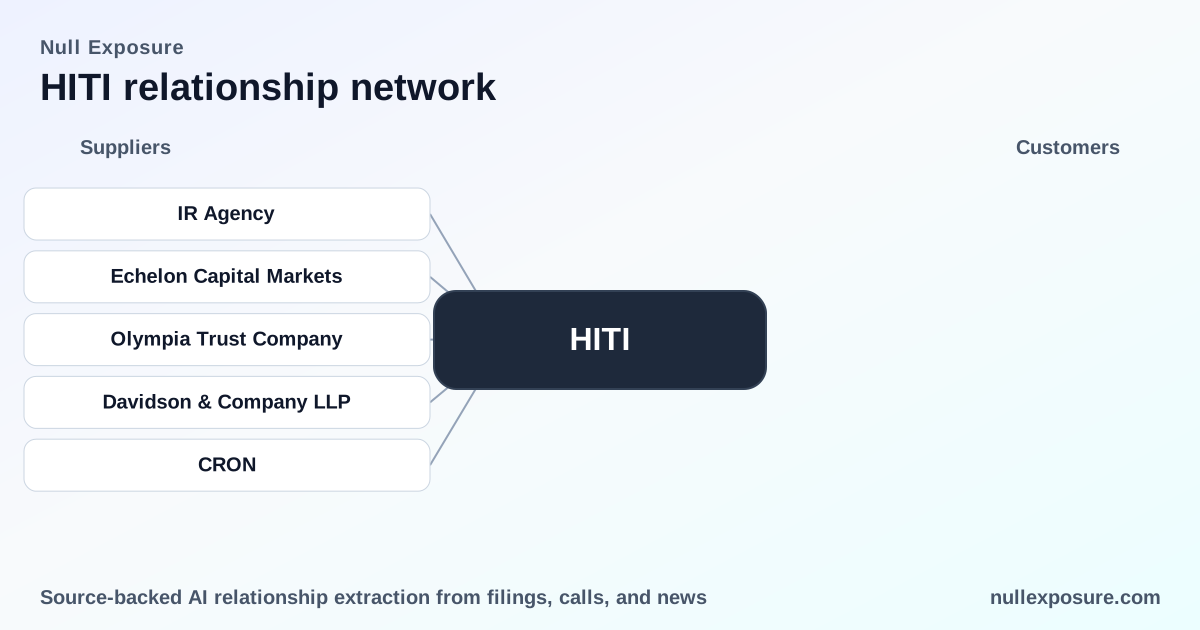
HITI customer relationships: what investors should know
High Tide Inc. (HITI) operates a vertically integrated cannabis platform that monetizes through retail sales, branded consumer products, and distribution partnerships that extend its reach into regulated international markets. The company grows revenue by scaling retail footprint and by leveraging wholesale and distribution relationships to access higher-margin medical channels abroad — a dynamic that drove record Q1 FY2026 revenue tied to German medical cannabis demand. For a quick look at customer-driven signals and how they affect commercial concentration and execution risk, see Null Exposure’s customer intelligence hub: https://nullexposure.com/.
Why a single customer mention matters for valuation
Investors often underweight single-source revenue commentary when it is buried in broader corporate press releases. In HITI’s case, management explicitly credited growth in its German medical cannabis business through a named partner, which is a clear commercial signal: the company is not only expanding retail, it is executing cross-border distribution deals that are material enough to lift quarterly results. That changes the valuation lens — from a pure retail multiple to a hybrid retail + distribution growth story where partner performance directly impacts near-term top-line variability.
The relationship you need on your model: Remexian
Remexian — High Tide reported that strong growth in its German medical cannabis business was driven through Remexian, contributing to record revenue in Q1 FY2026. This is a customer/distribution relationship that is operationally consequential for the period cited. Source: High Tide press release covering Q1 FY2026 results, published May 3, 2026 on hightideinc.com.
How to read this partnership in practical diligence
- Commercial criticality: When management highlights a named partner in quarterly results, that partner is functionally meaningful for revenue recognition in the period discussed. Investors should treat Remexian as a revenue driver for FY2026 until subsequent disclosures adjust the narrative.
- Concentration and sensitivity: A revenue swing tied to one partner implies higher short-term concentration risk. Financial models should test scenarios where German medical demand normalizes or distribution terms change.
- Maturity of the channel: The reference in a fiscal-quarter release implies an operational, revenue-generating arrangement rather than an early exploratory agreement. That elevates the partnership from a pipeline item to a current contributor.
- Geographic diversification: The German medical channel provides HITI with regulatory diversification beyond North American retail, which supports multiple growth vectors for the company’s branded products.
Operating model and company-level constraint signals
Search results returned no explicit contractual constraints or term excerpts for HITI’s customer relationships. Treat that absence as a company-level signal: public disclosures emphasize commercial outcomes (revenue growth) rather than contract specifics, which indicates that HITI currently positions these international arrangements as executed commercial partnerships rather than long-term, heavily negotiated exclusivity deals disclosed in filings.
From a contracting posture and maturity standpoint:
- HITI operates with a sales-first, distribution-led posture in international markets, prioritizing revenue capture and market entry speed over publicly documented long-term contractual protections.
- Because contractual terms are not disclosed in the result set, investors should assume transactional commercial relationships where pricing, supply cadence, and regulatory compliance are managed operationally rather than protected by visibly disclosed long-term exclusivity.
- The absence of constraints in public search results creates an information gap on termination clauses, minimum purchase commitments, and pricing protections — items that materially affect downside in stress scenarios.
Risk and opportunity implications for investors
- Opportunity: International distribution partnerships like the one with Remexian accelerate topline growth and enhance branded product penetration; this supports upside to consensus if German medical demand remains robust and incremental markets are added.
- Risk: Revenue tied to a single partner and market introduces volatility; regulation changes in Germany, supply-chain interruptions, or renegotiated commercial terms would flow directly to quarterly results.
- Mitigant: Expansion of multiple international channels and continued retail footprint growth would reduce single-partner concentration over time; track subsequent quarterly commentary for evidence of diversification.
How to act on this signal in a model or diligence checklist
- Stress-test FY2026 and FY2027 revenue scenarios with a discrete Remexian contribution line that can be shocked down 25–50% to reflect regulatory or demand shifts.
- Request or monitor disclosures for contract length, minimum purchase obligations, and pricing corridors in follow-on earnings materials or investor presentations.
- Prioritize third-party verification of supply-chain continuity in Germany and regulatory stability for medical cannabis reimbursement frameworks.
- Reweight valuation multiples to reflect the hybrid nature of HITI’s business: apply partial retail multiples and incorporate a distribution-growth premium for markets with proven contribution.
If you want comprehensive, ongoing customer signal feeds and relationship tracking for HITI and comparable issuers, visit Null Exposure to see how customer intelligence changes the investment checklist: https://nullexposure.com/.
Bottom line
High Tide’s Q1 FY2026 disclosure names Remexian as a revenue-driving customer in the German medical cannabis channel — a clear commercial signal that elevates both opportunity and short-term concentration risk. With no public contractual constraints returned in the search, investors must underwrite the relationship as an active, revenue-generating commercial partnership and build downside protection into models until more detailed contract terms are disclosed.