Hitek Global (HKIT): Customer relationships and what the market should price in
Hitek Global sells blockchain and digital-asset solutions to enterprises and monetizes through contractual sales, implementation services and recurring platform support. Revenue is generated from enterprise contracts and channel agreements, with current public financials showing modest scale (Revenue TTM $6.54M) and constrained market capitalization ($8.2M), which makes every named customer relationship relatively material to near-term revenue visibility. For investors evaluating HKIT as a small-cap tech play, the commercial book and the health of distribution partners are central value drivers — and recent public disclosures have changed that calculus. For further diligence, see the company summary and coverage at the NullExposure homepage: https://nullexposure.com/
Quick read: how Hitek operates and is paid
Hitek positions itself as an enterprise technology vendor focused on blockchain security and scalability. The firm sells software and services to corporate customers and through channel partners, collecting upfront implementation fees, ongoing support/maintenance and potential transaction or usage-based revenues. Public financials for the latest quarter (2026-03-31) show a small but revenue-positive business with negative EBITDA and narrow profitability margins, underlining the importance of stable customer channels to convert technology into predictable cash flow.
What the customer footprint tells investors
Because Hitek is a small-cap technology services issuer, the contracting posture, concentration, criticality and maturity of its customer relationships are primary risk levers for valuation:
- Contracting posture: Public records show at least one named channel sales agreement and a public termination event; this signals the company uses third-party distribution as part of go-to-market, and those agreements can be binary revenue events.
- Concentration: With limited publicly disclosed customers, revenue concentration risk is elevated — a single partner change can meaningfully affect near-term top-line visibility.
- Criticality: Partners that act as sales conduits or sales agents will be highly critical when Hitek’s direct enterprise pipeline is thin; loss of such partners reduces sales velocity.
- Maturity: The public record does not show a broad stable roster of enterprise anchor clients; this suggests commercial relationships are at relatively early or transactional stages rather than sticky, long-term contracts.
No contractual constraints are disclosed in the customer-scope public record we reviewed; the absence of documented constraints itself is a company-level signal of limited public disclosure on contractual limits, lock-ins, or third-party dependencies.
Customer relationships — the public record (complete)
Below is every customer-scope relationship disclosed in the public record we reviewed.
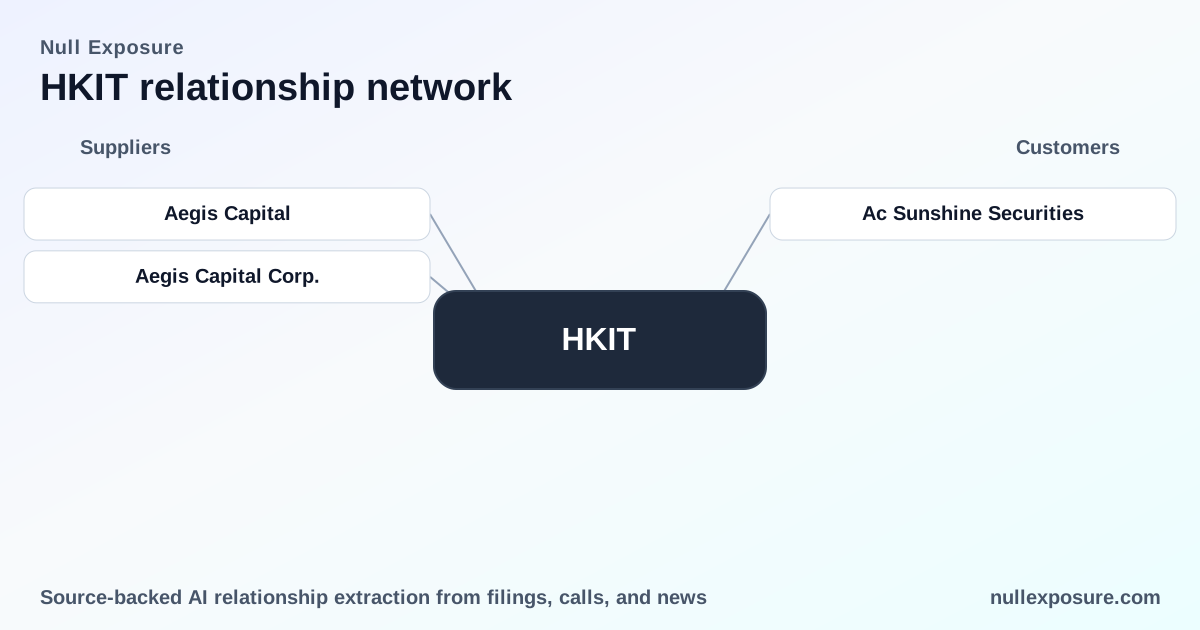
- Ac Sunshine Securities
Hitek and Ac Sunshine Securities mutually agreed to terminate a sales agreement that related to FY2025, removing that named channel partner from Hitek’s go-to-market mix. This termination was reported via a Reuters-derived notice republished on TradingView on March 10, 2026. (Source: Reuters notice carried on TradingView, March 10, 2026.)
Why the Ac Sunshine Securities termination matters
The terminated sales agreement was a named channel relationship, which implies Hitek relied on third-party distributors for some portion of sales flow. The public termination accomplishes two immediate things for investors:
- Reduces near-term revenue visibility because a named revenue conduit is no longer in place. With Hitek’s small absolute revenue base, the drop of one partner can change short-term growth profiles.
- Changes go-to-market risk calculus: investor focus shifts to Hitek’s direct sales capability and the health of remaining or replacement channels.
The source for the termination is a Reuters report republished on TradingView (March 10, 2026), which gives the event public and verifiable status.
Operational implications for forecasting and valuation
Given Hitek’s reported figures for the latest quarter (2026-03-31) — Revenue TTM ~$6.54M, negative EBITDA, and low institutional ownership — analysts must price greater revenue volatility and a higher risk premium:
- Revenue sensitivity: Small-dollar revenue bases mean single-partner changes can drive outsized percentage swings. Model revenue scenarios assuming delayed replacement of the terminated partner and slower sales conversion from direct channels.
- Margin impact: The business already reports negative operating margins on a trailing basis; losing a partner increases short-term fixed-cost absorption pressure and delays path to margin improvement.
- Governance and liquidity signals: Insider ownership is material (~23%), while institutional ownership is low (~0.2%), which concentrates decision-making and can affect access to institutional capital during periods of stress.
Key risk factors investors should track now
- Customer concentration risk: With few named public partners, monitor customer roll-ups in filings or press releases for emerging anchors.
- Channel dependency: Track contracts and terminations similar to the Ac Sunshine event; channel churn is a vector for sudden revenue declines.
- Execution capacity: Hitek must demonstrate the ability to replace or augment lost channel capability with direct sales or alternative partners to sustain growth.
- Financial runway: Negative EBITDA and the small market cap make access to capital and margin improvement urgent priorities.
Bottom line and recommended next steps
Hitek is a small, revenue-producing technology vendor whose valuation is sensitive to single-customer and single-channel developments. The public termination of the Ac Sunshine Securities sales agreement is a material commercial event for a company of this scale — it reduces near-term revenue visibility and forces investor scrutiny of Hitek’s sales replacement strategy and pipeline strength.
For professional diligence, investors should:
- Request the most recent customer revenue breakdown and any post-termination remediation plans.
- Review upcoming quarterly disclosures for replacement channel announcements or direct-sales ramp metrics.
- Monitor liquidity and cash-burn disclosures given the company’s negative EBITDA profile.
If you want a snapshot of how these customer events change exposure and risk scoring, NullExposure provides curated relationship coverage and alerts: https://nullexposure.com/
Bold takeaways: Hitek’s small revenue base amplifies partner events; the Ac Sunshine termination materially shifts near-term sales visibility; investors must prioritize evidence of channel replacement and cash runway.