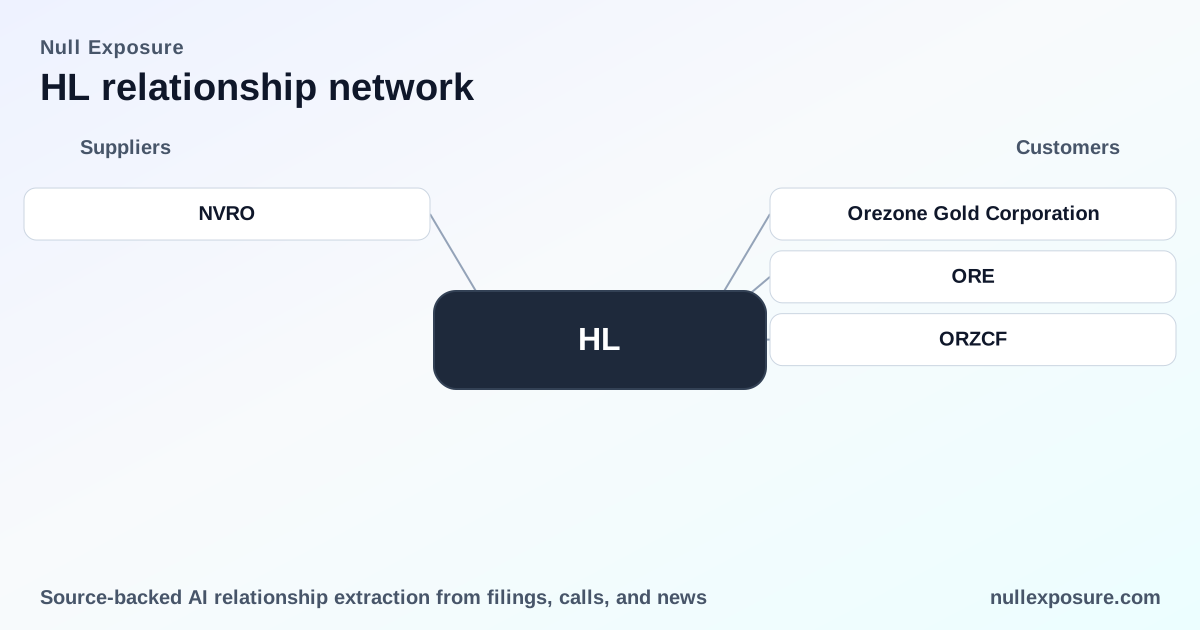
Hecla Mining (HL) — Customer relationships, recent divestitures and what they mean for investors
Hecla Mining generates cash by operating North American and international silver‑ and gold‑focused mines and selling concentrates, doré and carbon material to smelters, refiners and metal traders; the company supplements cash flow with environmental remediation services through its ERDC unit, and manages price risk with a mix of forward contracts, framework smelter agreements and selective spot sales. Recent deal activity—most notably the disposition of the Casa Berardi asset—reconfigures Hecla’s revenue mix and concentrates counterparties; investors should read this profile with an emphasis on customer concentration, contract tenor and access to refiners and smelters. For a structured view of relationship signals, visit https://nullexposure.com/.
How Hecla monetizes customer access and what that implies for revenue quality
Hecla’s cash generation rests on three commercial levers: (1) selling payable metals in concentrates and doré to a relatively small set of smelters and traders, (2) using long‑dated framework contracts and shorter provisional/forward settlements to manage price timing, and (3) providing environmental remediation services to government customers through ERDC. Frame contracts provide price and delivery stability for a large share of concentrates, while provisional shipments and spot sales create both upside and settlement volatility. Hecla’s top three customers accounted for meaningful shares of revenue in 2024 (approximately 28%, 19% and 17%), which makes counterparty selection and credit terms a primary operational risk.
- Contracting posture is mixed but deliberate. Hecla runs long‑term “frame” arrangements with smelters for much of its concentrates, while retaining short‑term forward contracts for provisional sales and exposing portions of production to spot to capture favorable pricing.
- Concentration is material and operationally critical. Access to economic smelters and refiners is essential to realize payable metal value; loss of favorable treatment or access would directly depress realized prices.
- Geographic exposures are diversified but sensitive. Sales flow to North America, APAC (including China) and other global smelters; tariffs or trade actions can change economics for represented customers.
Deal‑level snapshots: every reported customer relationship and source
Below are the reported customer or counterparty references in the source set; each listing is a single, plain‑English customer relationship note with the cited reporting source and date.
- Orezone Gold Corporation — StockTwits reported on March 10, 2026 that Hecla agreed to sell the Casa Berardi gold mine subsidiary in Quebec to Orezone for approximately $593 million. (StockTwits, 2026‑03‑10)
- Orezone Gold Corporation (inferred OEX.FRK) — Investing.com noted on May 3, 2026 that Hecla will sell Casa Berardi to Orezone for up to $593 million, citing the company announcement. (Investing.com, 2026‑05‑03)
- DVS (Dolly Varden) — StreetwiseReports reported that Hecla sold the Kinskuch property to Dolly Varden for CA$5 million, paid in shares (1,351,963 shares), closing a land sale that expanded Dolly Varden’s Golden Triangle position. (StreetwiseReports, article dated May 28, 2025 / referenced 2026)
- DVS — A follow‑up StreetwiseReports piece (dated June 30, 2025) reiterated that Kinskuch was obtained from Hecla for CA$5 million or 1.35 million shares, confirming the consideration structure. (StreetwiseReports, 2025)
- IDR (Idaho Strategic Resources) — Yahoo Finance reported on May 3, 2026 that Idaho Strategic had entered a lease agreement and referenced Hecla’s sale of the Toboggan project to Idaho Strategic as part of its local asset transfers. (Yahoo Finance / SG, 2026‑05‑03)
- ORE (Orezone / related ticker mentions) — PR Newswire published a March 10, 2026 release noting that a Canadian First Nation sought consultation rights as part of the proposed sale of Hecla Quebec and the Casa Berardi mine to Orezone. (PR Newswire, 2026‑03‑10)
- Orezone — TipRanks summarized Hecla’s earnings call and flagged that the pending Casa Berardi sale to Orezone would increase Hecla’s silver revenue mix to roughly 73% post‑close. (TipRanks / earnings call coverage, 2026)
- ORE — TradingView reported on March 10, 2026 that Hecla is optimizing its portfolio by selling its Hecla Quebec subsidiary (Casa Berardi and Quebec exploration properties) to Orezone for up to $593 million in total consideration. (TradingView, 2026‑03‑10)
- Orezone (duplicate TradingView entry) — A second TradingView piece repeated the strategic portfolio focus and the share‑purchase agreement details tied to the Casa Berardi sale. (TradingView, 2026‑03‑10)
- Orezone Gold Corporation (PR reiteration) — PR Newswire coverage on March 10, 2026 again described the proposed sale of Hecla Quebec and the Casa Berardi mine to Orezone, including related stakeholder commentary. (PR Newswire, 2026‑03‑10)
- Orezone — InsiderMonkey reported on May 3, 2026 that the Casa Berardi transaction closed with Hecla receiving $160 million in cash plus approximately 65.8 million Orezone shares on closing, with further deferred and contingent cash consideration totaling roughly $321 million. (InsiderMonkey, 2026‑05‑03)
- DVS — MiningNewsNorth (Jan 14, 2026) covered Dolly Varden’s expansion and explicitly noted the land sale agreement with Hecla that enlarged Dolly Varden’s Kitsault Valley footprint. (MiningNewsNorth, 2026‑01‑14)
- ORE — MiningNewsNorth (Jan 30, 2026) reported that Hecla agreed to sell Casa Berardi to Orezone Gold for up to $593 million in cash and shares, framing the agreement as a strategic portfolio realignment. (MiningNewsNorth, 2026‑01‑30)
- Orezone Gold — MiningNewsNorth’s Jan 30, 2026 item again identified Orezone as the buyer in the Casa Berardi transaction and quantified the transaction range. (MiningNewsNorth, 2026‑01‑30)
- Orezone Gold — TradingView ran a separate March 10, 2026 story about Hecla signing a share purchase agreement with Orezone Gold that transfers the Casa Berardi mine and exploration portfolio for up to $593 million. (TradingView, 2026‑03‑10)
- ORZCF — A TradingView duplicate entry recorded the same Share Purchase Agreement coverage and the up‑to‑$593 million consideration detail attributed to Orezone/ORZCF on March 10, 2026. (TradingView, 2026‑03‑10)
What constraints and relationship signals mean for strategy and risk
The document‑level constraints synthesize into clear operating model characteristics for Hecla:
- Contract tenor and pricing posture: Hecla uses a mix of long‑term framework contracts with smelters and multi‑year hedging for planned exposure, while provisional shipments and short‑term forwards cover settlement risk — this mix balances revenue predictability and price upside.
- Concentration and criticality: The company reports material customer concentration (three largest customers representing a sizable share of revenue) and explicitly states that access to refiners and smelters is critical to monetize production. This is a structural business risk.
- Geography and regulatory sensitivity: Hecla sells globally with notable North American and APAC flows; tariffs or trade actions can change buyer economics and treatment charges.
- Service revenue and counterparty type: ERDC’s revenue is government‑sourced (CIRNAC), demonstrating a stable but single‑customer revenue stream for the environmental services segment, with receivables tracked separately.
- Spend profile: Identified reclamation and remediation commitments (CAD$348M estimated over five years) and historic note issuance indicate large, multi‑year capital and cash‑flow planning implications.
Investment implications and action checklist
- Positive: The Casa Berardi sale materially reallocates Hecla’s production mix toward silver and reduces geographic operational complexity in Quebec while delivering immediate cash and equity; the mix of frame contracts and forwards preserves revenue visibility.
- Watchpoints: Customer concentration, dependency on refinery/smelter access, and settlement mechanics (provisional pricing) remain core execution risks. Government receivables from ERDC are modest but concentrated, and reclamation spend is large enough to influence near‑term free cash flow.
- Catalysts: Closing of the Casa Berardi transaction, realization of deferred consideration, and any changes to smelter arrangements or forward contract coverage will re‑rate realized prices and margins.
For a concise signal matrix and deeper counterparty coverage across mining and metals buyers, explore our platform at https://nullexposure.com/.
Key takeaway: Hecla’s revenue model combines long‑dated contractual relationships with targeted spot exposure; the recent portfolio pruning reduces operational dispersion but leaves customer concentration and smelter access as the dominant commercial risks for investors to monitor.