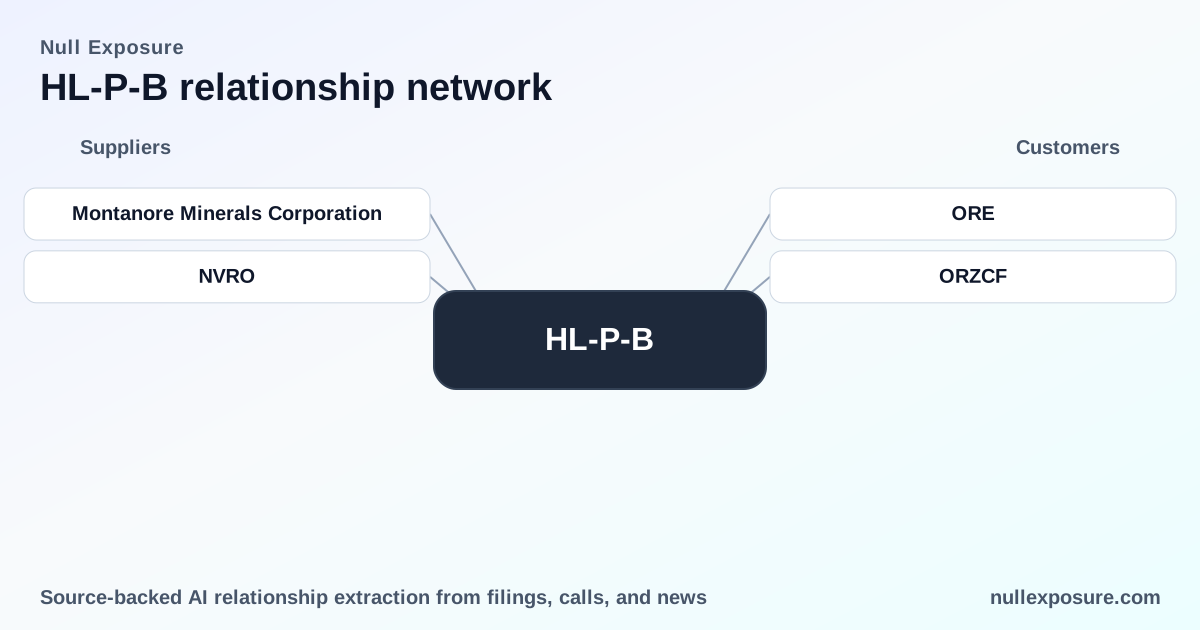
Hecla’s Casa Berardi Exit: A Clear Monetization Move and What It Says About Customer Links
Hecla Mining monetizes through mineral production (predominantly silver) and opportunistic asset sales to redeploy capital into higher-margin silver projects and exploration. The company is executing a strategic pivot away from gold-heavy assets by divesting Casa Berardi, converting a long-lived operating asset into cash consideration while preserving operational focus on silver production and upside exploration. This transaction restructures Hecla’s customer and counterparty footprint by transferring a material gold operation to Orezone, reducing Hecla’s exposure to gold-cycle volatility and crystallizing near-term liquidity. For an at-a-glance background on how we track these moves, visit https://nullexposure.com/.
The strategic logic behind the Casa Berardi sale
Hecla closed the sale of Casa Berardi to Orezone as a deliberate portfolio-management action: the company monetized a gold asset to accelerate investment in silver-led assets and exploration. Proceeds reported in press coverage range from roughly US$272 million to up to US$593 million depending on source framing of upfront versus contingent consideration, which underscores deal complexity but not the basic fact—Casa Berardi moved to Orezone ownership in Q1–Q2 2026.
This is a classic mining-industry reallocation: convert a non-core asset into immediate capital, lower operating complexity, and sharpen the revenue mix. For operators and creditors, the transaction changes counterparty risk concentrations (Orezone becomes the operating counterparty for Casa Berardi output and vendors tied to that mine).
Visit https://nullexposure.com/ for a consolidated view of counterparties and transaction notes.
Line-by-line: every customer relationship flagged in the record
-
Hecla divested Casa Berardi to Orezone Gold Corp for a deal value reported as up to $590 million, per an Ad‑Hoc News overview published May 3, 2026. — Ad‑Hoc News, May 3, 2026.
-
Simply Wall St’s user narrative notes Hecla finalized the sale of Casa Berardi to Orezone on March 25, 2026, and frames the move as completing Hecla’s transformation into a high‑margin, silver‑dominant producer. — Simply Wall St community narrative, May 3, 2026 (refers to closing March 25, 2026).
-
Investing News Network reports Hecla agreed to sell Casa Berardi to Orezone for total consideration of up to US$593 million, presenting the transaction as a material cash realization for Hecla. — Investing News Network, March 10, 2026.
-
A second Investing News Network entry reiterates the same commercial terms and buyer identity, confirming market coverage of the agreement to transfer Casa Berardi to Orezone. — Investing News Network, March 10, 2026.
-
GlobeNewswire states Orezone completed the acquisition of Hecla Quebec Inc. (the Casa Berardi owner) and describes the transaction as a completed transfer of the mine and related Quebec exploration portfolio. — GlobeNewswire press release, March 25, 2026.
-
Simply Wall St’s market news piece summarizes the transaction as an up-to-$593 million sale to Orezone, and positions it alongside Hecla’s plans to increase exploration and pre-development spending in 2026. — Simply Wall St news article, March 10, 2026.
-
A related Simply Wall St news item (alternate ticker mapping) repeats that Hecla agreed the sale to Orezone for up to US$593 million while pivoting to silver and raising near‑term exploration investment. — Simply Wall St news article, March 10, 2026.
-
Finviz aggregates a MarketBeat note that characterizes an earlier framing of the transaction as a $272 million deal with a Q1 2026 closing target; the figure reflects alternative reporting on upfront cash versus contingent/total consideration. — Finviz (MarketBeat note), May 3, 2026.
-
A final result listing under variant name mappings reconfirms Orezone as buyer and reiterates media coverage of the Casa Berardi transfer to Orezone in Q1–Q2 2026. — Multiple press summaries March–May 2026 (see GlobeNewswire and Investing News Network).
Each entry above references primary reporting or company press release coverage; the record shows multiple outlets and formats but a single commercial reality: Casa Berardi ownership moved from Hecla to Orezone in the March–May 2026 window.
What the relationships reveal about Hecla’s operating model
No formal constraints are recorded in the relationship payload, which is itself a company‑level signal: there are no flagged contractual restrictions or vendor constraints captured for these customer relationships in the record.
From the transaction and coverage we derive these operating-model characteristics:
-
Contracting posture — active divestiture: Hecla is selling non-core operating assets to monetize value and refocus capital allocation, indicating an assertive contracting posture rather than passive asset retention.
-
Concentration — lower gold concentration for Hecla: transferring Casa Berardi reduces Hecla’s gold-weighting and concentrates its revenue profile toward silver and exploration upside; for Orezone, concentration around the newly acquired asset increases in the near term.
-
Criticality — materiality for counterparties: Casa Berardi was a material operational asset; its ownership transfer is critical to Hecla’s near-term cash profile and critical to Orezone’s operational expansion plans.
-
Maturity — closed transaction: press releases and completion notices (GlobeNewswire, March 25, 2026) indicate the deal moved past signing to closing, reducing execution risk tied to the transfer itself.
Investor implications and risks to monitor
-
Earnings mix and commodity exposure: Hecla’s revenue sensitivity to silver prices will increase post-sale; investors should re-calibrate price‑sensitivity models accordingly.
-
Counterparty risk shift: Orezone assumes operational, environmental, and offtake counterparty obligations for Casa Berardi; any vendor or supply-chain exposures tied to that operation now flow to Orezone.
-
Deal economics ambiguity: Reported headline values diverge (roughly $272M vs. up to $593M), so investors must parse upfront cash, assumed liabilities, and contingent consideration when modeling proceeds and balance‑sheet effects.
-
Execution of redeployment: Monitor how Hecla allocates proceeds—whether into exploration, debt reduction, buybacks, or capex—because capital redeployment will determine the long‑term value creation of this sale.
Bottom line
The Casa Berardi sale is a decisive monetization that reshapes Hecla’s customer and operational footprint while creating a concentrated operating responsibility for Orezone. Coverage across investment press and company releases confirms the transfer occurred in the March–May 2026 window, with headline consideration varying by reporting approach. For operators and investors, the key next steps are to reconcile reported deal economics, track Hecla’s redeployment choices, and evaluate Orezone’s capacity to integrate and operate Casa Berardi at scale.
For a consolidated view of counterparty moves and to stay updated on related transactions, visit https://nullexposure.com/.