Herbalife Nutrition (HLF): Customer Relationships and the Korea Institutional Channel
Herbalife is a global direct-selling nutrition company that monetizes by selling consumable nutrition and personal-care products through a network of independent “Members” who purchase product at wholesale and retail it to end customers; the company records distributor allowances as reductions to net sales and generates recurring revenue from repeat consumption. With roughly $5.0 billion in trailing revenue and a concentrated product mix (Formula 1 accounted for about 26% of net sales in 2024), Herbalife’s economics combine high gross margins on consumables with dependence on Member engagement and international market performance. For a granular look at customer-facing relationships in Korea and what they signal for investors and operators, read on. Visit NullExposure for more on customer-risk mapping: https://nullexposure.com/
What investors need to know up front
- Business model: direct selling through independent Members; revenue recognized on delivery to Members or, in some China cases, when service providers resell to end customers.
- Revenue scale and concentration: ~$5.0bn TTM revenue with a best-selling product line representing a material share of sales—this concentrates product risk and brand dependency.
- Global footprint: sales in 95 markets with ~79% of sales outside the U.S., creating foreign-exchange and regulatory exposure.
- Operating leverage to Member activity: sales, cash flow and working capital flow directly with Member purchasing and downstream retailing; distributor allowances are an explicit margin lever.
Institutional and professional relationships active in Korea
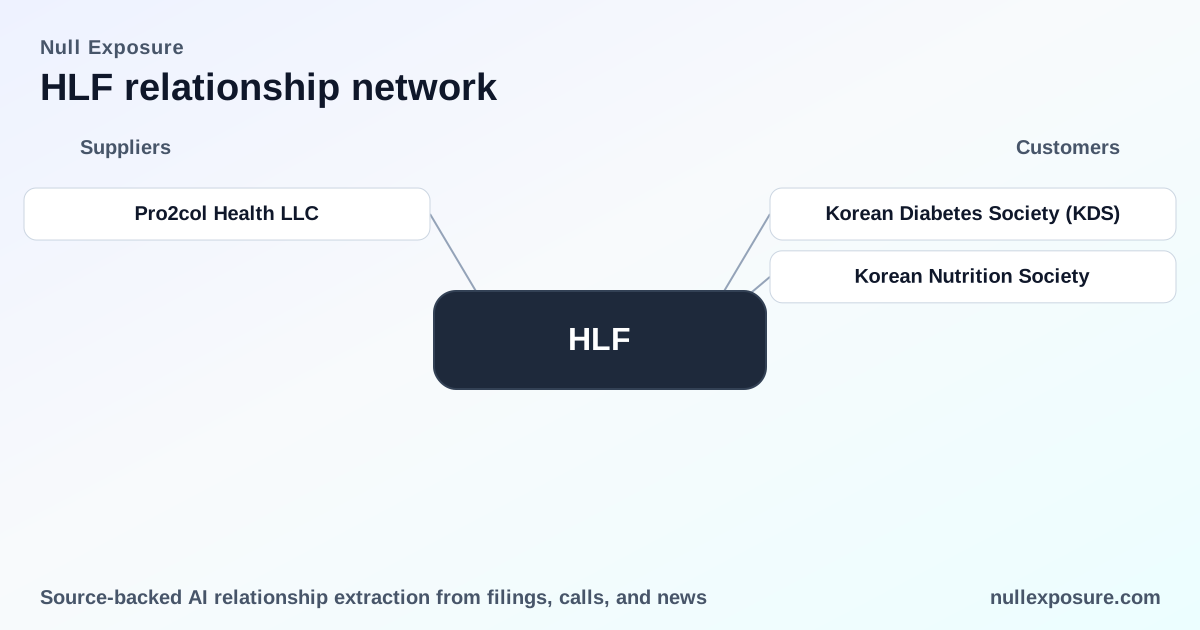
Herbalife Korea is engaged with local professional and scientific organizations as part of its public-health and education outreach. These relationships are transactional and promotional in nature, focused on product donations, nutrition education, and event sponsorship. The two documented engagements in the public record for FY2026 are summarized below.
Korean Diabetes Society (KDS)
Herbalife Nutrition Korea participates in KDS-organized public education and blood-sugar testing campaigns, donating products and delivering nutrition information to the diabetes community. This represents a community-health outreach and product-donation relationship that supports local brand positioning among patient and provider groups (Newswire Korea, March 10, 2026: https://www.newswire.co.kr/newsRead.php?no=918884).
Korean Nutrition Society
Herbalife Nutrition Korea sponsored the Korean Nutrition Society’s international conference and ran the “e-Wellness Tour” webinar series to disseminate science-based nutrition information, strengthening scientific positioning and professional engagement in Korea. This is an academic-sponsorship and education partnership that supports credibility with nutrition professionals and regulators (Newswire Korea, March 10, 2026: https://www.newswire.co.kr/newsRead.php?no=918884).
How these Korea relationships fit the company picture
These Korea engagements are tactical elements of Herbalife’s broader market approach: product donations and conference sponsorships advance brand credibility and create channels to health professionals and consumers, but they are not revenue drivers in isolation. They reinforce a global pattern in Herbalife’s go-to-market strategy: combine Member-led retail distribution with local professional outreach to sustain product trust and retention.
If you are modeling country-level growth or reputational risk, treat these programs as marketing and stakeholder-management expenditures that support Member recruitment and retention, not as direct sales contracts.
Company-level relationship constraints and what they imply for risk and governance
The public record and company filings provide a set of constraints and structural characteristics that define Herbalife’s contracting posture and counterparty profile. These are company-level signals, not specific to any one Korea relationship.
- Contracting posture: Herbalife operates a mix of spot and framework relationships. Revenue recognition language indicates spot (recognize on delivery or point-of-sale) for most Member transactions, while long-standing agreements with Members and the 2002 marketing-plan framework create framework-style constraints on distribution channels. Evidence of long-dated financing obligations exists as long-term convertible notes maturing in 2028.
- Counterparty concentration: The counterparty base is dominated by individuals (independent Members, distributors and preferred customers), with government and small-business exposures present via tax audits and local importer relationships. This structure creates operational complexity in compliance, classification and incentive alignment.
- Geographic footprint and complexity: Global operations in 95 markets produce material foreign-exchange, regulatory and IP risks; roughly 79% of sales are outside the U.S., and several regions generate >$500m in net sales (North America, EMEA, Latin America, Asia Pacific, China separately reported).
- Materiality signals: Some items are immaterial (product returns/buybacks ~0.1% of net sales), while others are material or critical—notably: Formula 1’s share (~26% of net sales), the company’s dependence on its Member network for substantially all sales, and regulatory exposure around direct-selling practices.
- Relationship maturity and role mix: Many relationships are long-lived (e.g., member agreements dating to 2002, multi-year Digital Technology Program investments). Roles run across buyer, distributor, reseller, seller, manufacturer and service-provider categories—reflecting end-to-end control over manufacturing plus a distributed selling ecosystem.
These signals produce a clear operating profile: high-margin consumables sold through a decentralized salesforce, with centralized IP and manufacturing assets, and concentrated reputational risk tied to Member conduct and product perception.
Operational implications for investors and operators
- For investors: value hinges on Member engagement. Monitor Volume Points trends regionally and product mix shifts (Formula 1 concentration). Foreign exchange and regulatory developments in large markets (India, Mexico, China) will move topline and margins.
- For operators: prioritize Member-facing technology, distribution resiliency and compliance. Herbalife is already investing heavily in a multi-year digital program (Herbalife One) to modernize Member tools—this is a core operational lever for retention and growth.
For deeper customer-relationship intelligence and cross-market exposure analytics, see NullExposure’s customer mapping tools: https://nullexposure.com/
Final takeaways
- Herbalife is a direct-selling company whose topline and cash flow are tightly coupled to Member purchasing behavior and product acceptability.
- Korea engagements with the Korean Diabetes Society and Korean Nutrition Society are consistent with a global approach of professional sponsorships and product-donation outreach intended to protect brand and support Member sales channels.
- Key investment risks remain concentrated around Member dynamics, product concentration, and international regulatory exposures, while growth levers include digital tooling and execution in fast-growing regional markets.
For investors constructing scenarios, stress Member activity and regulatory outcomes first; for operators, align spend to Member enablement and compliance to protect the brand and distribution channel.