Helios Technologies (HLIO) — Customer Relationships That Drive Repeatable Industrial Revenue
Helios Technologies monetizes engineered motion-control and electronic control systems by selling hardware and integrated solutions into two core segments — Hydraulics and Electronics — to OEMs, distributors and end-market customers around the world. Revenue is generated primarily through standard product sales and OEM integrations, complemented by engineered services and after‑market support; Helios captures value both at initial sale and through sustained replacement and software-enabled support for platform customers. For investors, the company’s customer base blends high-repeatability OEM contracts with short-term transactional sales, creating a revenue model that is resilient but exposed to cyclical capital goods demand and FX/trade dynamics. For a deeper view of relationship mapping, visit https://nullexposure.com/.
How Helios’ customer model actually works — one clear sentence
Helios designs and manufactures hydraulic components, electronic displays and control systems and sells them directly to OEMs and through distributors worldwide, monetizing via product margins, engineered services, and recurring after-market support tied to installed equipment.
Key takeaway: Helios combines short-term transactional orders with long-lived customer relationships embedded in OEM platforms, producing recurring revenue potential without relying on long-duration contract lock‑ins.
Contracting posture: transactional today, relationship value over time
Helios’ public filings describe the typical contract as short-term, single-performance-obligation product sales, generally completed within a quarter and with payment terms under one year. At the same time, the company records intangible customer relationships with useful lives of 8 to 26 years, indicating that while orders are short, customer dependencies and specification cycles are long-lived. Company filings for FY2023–FY2024 document these accounting policies and useful-life assumptions.
- Investor implication: Revenue visibility is limited to quarters, but product specification cycles and replacement lifecycles create multi-year revenue streams tied to installed OEM platforms.
Geography and concentration: global reach with regional dynamics
Helios is a global seller, with roughly half of net sales generated outside the U.S. (about 53% internationally in 2024). Regional mix is meaningful: Hydraulics sales were roughly balanced across Americas, EMEA and APAC (41% / 29% / 30% in 2024), while Electronics skews toward the Americas. Growth in APAC in 2024 was driven by increased sales to China and Australia. These geographic patterns are confirmed in recent filings and segment disclosures for 2023–2024.
- Investor implication: Global diversification mitigates single-market concentration but introduces FX, trade and regulatory exposure; growth is sensitive to regional industrial cycles.
Customer types and criticality: OEMs plus distributors and service relationships
Helios sells directly into OEMs (a material portion of revenue) and via distributors. The public record emphasizes:
- direct OEM integrations and specification-based sales,
- distributor networks for reach and fulfillment, and
- engineering and aftermarket services (e.g., i3 Product Development acquisition) that support product adoption and lifecycle revenue.
The company states that direct OEM sales account for a substantial portion of business and that it invests in "in the region, for the region" manufacturing to align with customer needs.
Key takeaway: The business model is oriented around being a reliable supplier to OEMs and distributors — product quality and delivery performance are critical to sustaining orders.
Publicly disclosed customer relationships (complete coverage)
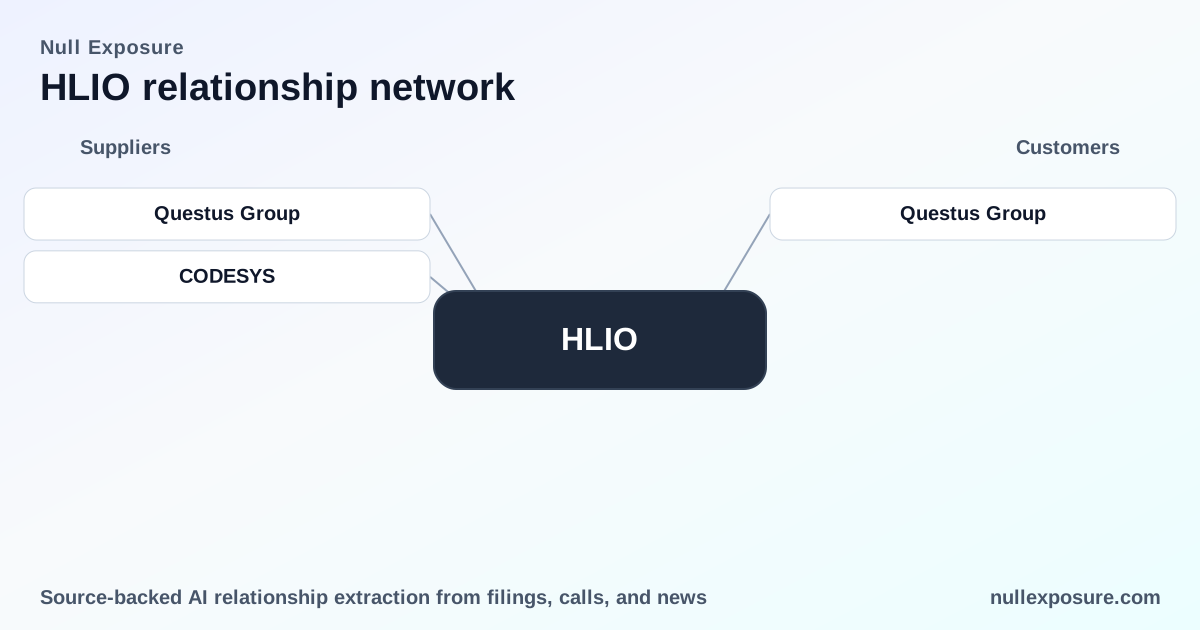
Questus Group — exclusive Australian distributor for Sun Hydraulics products
Helios disclosed in its Q4 2025 earnings call that it is aligning its Australian go-to-market by leveraging an exclusive agreement with Questus Group to provide distribution and fulfillment services for Sun Hydraulics products in Australia. This is an explicit commercial arrangement disclosed on the Q4 2025 earnings call (mentioned March 2026). (Source: HLIO Q4 2025 earnings call transcript, March 2026.)
Jacuzzi Group — Balboa Water Group supplies controls for the new J5 collection
Multiple May 3, 2026 news items report that Helios’ Balboa Water Group subsidiary continues supplying advanced display, control and lighting systems for Jacuzzi Group’s new premium J5 spa collection; press coverage framed this as a continuation of a long-standing partnership that supports Jacuzzi’s product refresh. (Sources: SimplyWallStreet and FinViz coverage of Helios news, May 3, 2026.)
Constraints and what they say about Helios’ operating model
The company-level signals drawn from filings and public disclosures describe a hybrid operating posture:
- Contracting posture: Predominantly short-term, transactional contracts for the manufacture and sale of products (typically completed within a quarter), coupled with long-lived customer relationships recognized as intangible assets and amortized over 8–26 years. This implies limited contractual revenue lock-ins but enduring specification and replacement economics.
- Counterparty mix: Helios targets a mix of large enterprises (OEMs) and mid-market customers, and operates distributors and direct-sales channels concurrently — a deliberate approach to balance scale with niche customization.
- Geography: A global footprint with material revenue outside the U.S. and concentrated sales in China and Australia within APAC; regional manufacturing strategy indicates sensitivity to local supply chains and tariffs.
- Materiality and risk: The company calls out possible material exposures from product liability, sustainability/regulatory shifts, epidemics and supply-chain disruption — risks that can affect working capital and order flow.
- Relationship maturity and role: Customer engagements range from mature OEM partnerships to active transactional buyers; Helios functions as manufacturer, seller, distributor partner and service provider depending on the end-market and product.
Investor implication: The combination of short transactional contracts and long amortized customer relationships suggests operational flexibility but requires continual product quality, engineering support and regional supply-chain resilience to sustain throughput and margins.
Risk and opportunity lens for investors
- Opportunities: High-margin aftermarket and specification wins with OEMs; global installed base creates recurring replacement and upgrade demand; software-enabled controls increase per-unit value.
- Risks: Cyclicality in capital goods markets, regional demand weakness (Americas/EMEA softness in 2024), FX and trade policy exposure, and product liability or sustainability-driven compliance costs that can be material to operations.
Bottom line: what ownership implies
Helios’ customer relationships are a blend of short-term order execution and long-term platform economics. For investors, the core signal is predictable engineering stickiness rather than contractual lock-in — Helios wins when it sustains product performance, timely delivery and global support. Monitor regional demand indicators, OEM order pipelines, and any shifts in distribution agreements (such as the Australian Questus arrangement) for signs of revenue durability or volatility.
For a detailed relationship map and continual monitoring of counterparty exposures, visit https://nullexposure.com/.