Hillman Solutions (HLMN): Customer Relationships That Drive Revenue—and Risk
Hillman Solutions is a distribution-led hardware and home-improvement supplier that monetizes through high-volume product sales, in-store merchandising services, and proprietary kiosk-driven key/engraving services. The business captures margin by selling core fasteners and adjacent products to national chains and independent retailers, charging for merchandising and equipment access, and manufacturing/maintaining robotic kiosks that generate recurring retail throughput. Top-line exposure is concentrated in a few national accounts while the operating model relies on short order cycles, field sales coverage, and a mix of manufactured and resold goods. For an institutional read on client concentration and commercial posture, see more at https://nullexposure.com/.
What investors should take away up front
- Customer concentration is material: the top two customers (Home Depot and Lowe’s) accounted for roughly 41% of 2024 revenue, a structural lever for both upside and downside, per the FY2024 10‑K.
- Contracts are short and transactional: Hillman recognizes revenue on delivery and notes most terms do not extend beyond one year, which enforces near-term revenue visibility but limits long-term contract protection.
- Mixed counterparty base: sales span individuals (DIY consumers via kiosks), small contractors, and large national retailers—creating a diversified route-to-market but with large-account concentration at the top.
If you want the raw relationship excerpts and a concise commercial map, visit https://nullexposure.com/ for a direct view of the source material.
How Hillman sells: commercial posture and operating constraints
Hillman’s revenue model is built on a classic retail-supplier posture: sell product, provide merchandising, and support proprietary kiosk services. The FY2024 Form 10‑K states revenue is recognized upon delivery; merchandising and kiosk access are part of the performance obligations, and the firm retains ownership of some kiosks. That operational mix implies:
- Short order cycles and low-cost-to-obtain contracts, which reduce long-term contractual lock-ins but increase sensitivity to retail demand swings.
- Field sales intensity: roughly 1,200 field staff with regular retailer visits, creating a service moat but also fixed-cost leverage.
- Geographic concentration in North America with explicit exposure to Canada, Mexico, and Latin America; Hillman highlights foreign currency and international operational risks in filings.
- Material concentration risk: management identifies the top two customers as a material factor and records receivable concentration and bankruptcy-related reserve activity (e.g., True Value impact in 2024).
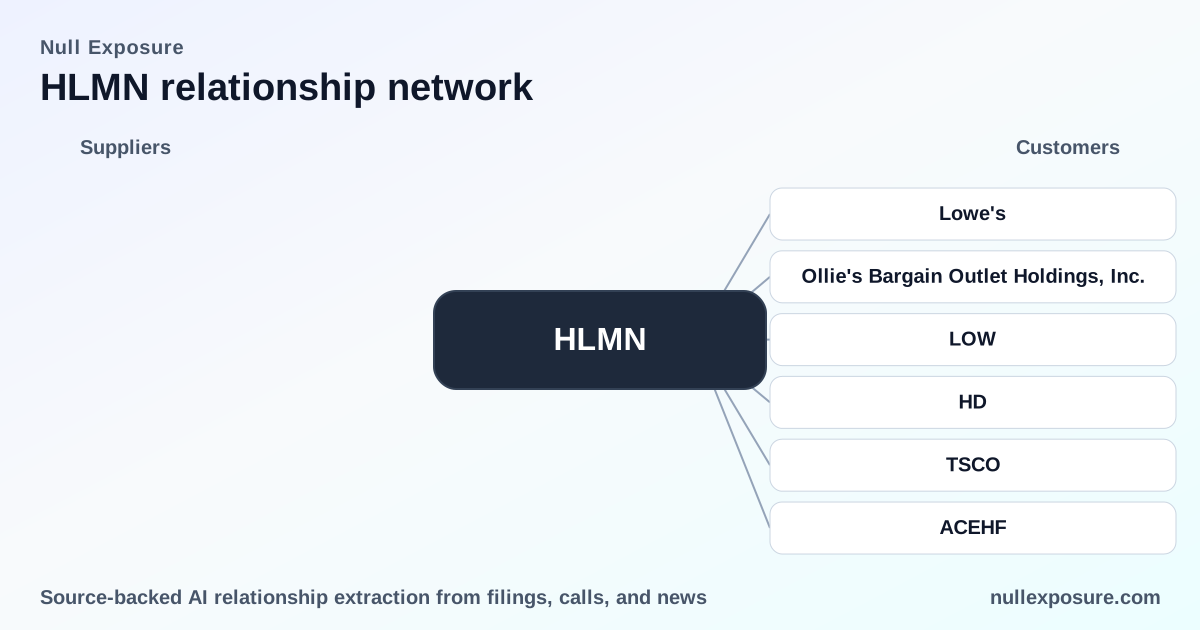
The customer map — every named relationship in the report
Below are the counterparties named in the available records; each entry is a concise, plain‑English description with the source noted.
-
Lowe's
Hillman identifies Lowe’s as one of its two largest customers, contributing materially to revenue—Lowe’s represented roughly $277.5 million or ~18.8% of 2024 revenues. Source: Hillman 2024 Form 10‑K (Year ended December 28, 2024). -
Lowe's Companies, Inc. (LOW)
Media coverage cites Hillman as a primary supplier to Lowe’s, positioning Hillman’s performance as a sectoral indicator for the big‑box channel. Source: FinancialContent / MarketMinute (Dec 2025) and FinancialContent coverage (Apr 2026). -
Lowe s (alternate mention in commentary)
Analyst and news write‑ups repeatedly reference Lowe’s when discussing Hillman’s retail exposure and shipment versus demand dynamics. Source: InsiderMonkey and Investing.com articles (Mar–May 2026). -
Home Depot / The Home Depot, Inc. / HD
Home Depot is the single largest customer, representing approximately $325.7 million or ~22.1% of 2024 revenue; Hillman explicitly calls out Home Depot among its large national accounts. Source: Hillman 2024 Form 10‑K (Year ended December 28, 2024) and multiple MarketMinute articles (Dec 2025). -
HD (ticker shorthand in news)
Financial press references Hillman as a primary supplier to HD; those stories treat Hillman’s sales performance as a leading indicator for Home Depot’s hardware channel health. Source: MarketMinute / FinancialContent (Dec 2025). -
Home Depot (news repeats)
Independent news pieces reiterate the same supplier relationship and the revenue linkage to Home Depot’s retail performance. Source: DecaturDailyDemocrat / FinancialContent (Dec 2025). -
Ollie's Bargain Outlet Holdings, Inc.
Hillman records sales of excess inventory to Ollie’s as related‑party activity and includes those transactions within net sales. This is a small, transactional outlet for surplus inventory. Source: Hillman 2024 Form 10‑K (FY2024 related‑party disclosure). -
Walmart (WMT)
Hillman highlights a structural advantage in key duplication and kiosk placement with major mass merchants such as Walmart; the company’s physical kiosk base and in‑store services underpin that relationship. Source: FinancialContent (Apr 2026). -
Tractor Supply (TSCO)
Media reports list Tractor Supply among the major retailers whose rising sales support Hillman’s growth outlook; Tractor Supply is one of several national accounts contributing meaningful volume. Source: InsiderMonkey (Mar 2026). -
Ace Hardware / Ace Hardware purchasing cooperative
Hillman notes the Ace cooperative as a revenue source and that approximately 15% of accounts receivable at year‑end related to Ace purchasing arrangements, reflecting cooperative billing and concentration. Source: Hillman 2024 Form 10‑K (FY2024 receivable disclosures) and InsiderMonkey (Mar 2026). -
Ace Hardware (ACEHF mention in news)
News commentary groups Ace with other major retail partners when discussing Hillman’s exposure and the retailer-driven demand thesis. Source: InsiderMonkey (Mar 2026).
Notes on coverage: several press items use shorthand tickers (HD, LOW) and repeated mentions across outlets corroborate Hillman’s reliance on a small set of large national retailers. The FY2024 Form 10‑K is the primary formal source for concentration statistics and related‑party disclosures, while FinancialContent, InsiderMonkey, and Investing.com provide market commentary and analyst perspectives (Dec 2025–May 2026).
Risk and opportunity framed by these relationships
- Opportunity: placement with Home Depot, Lowe’s, Walmart, Tractor Supply and Ace secures wide retail distribution and recurring replenishment demand; proprietary kiosks and merchandising services add revenue per square foot for partners (FinancialContent analysis, Apr 2026).
- Risk: customer concentration is material—the top two customers represented ~41% of revenue in 2024; short contract tenures and short order cycles reduce contractual protection and amplify exposure to retail inventory swings (Hillman 2024 10‑K).
- Working capital sensitivity: receivable concentration and bankruptcy events (True Value) have produced non‑recurring write‑offs and drove the company to sell some receivables, increasing financing reliance (10‑K disclosures).
Final read: what investors and operators should track next
- Monitor relative sell‑through at Home Depot and Lowe’s versus shipments; public commentary and analyst write‑ups (Investing.com, Mar–May 2026) have already flagged potential disconnects between shipments and retail demand.
- Watch accounts receivable trends and any further disruptions among large national customers; Hillman disclosed an $8.6 million charge tied to True Value and continues to securitize receivables, which affects liquidity and credit exposure (FY2024 10‑K).
- Track international FX and Canadian performance: Hillman calls out Canadian results and FX impacts, which matters for consolidated margins and cash flow.
For a direct copy of the underlying relationship evidence and a consolidated view for diligence, visit https://nullexposure.com/.
Bold decision-making requires clear inputs: Hillman has a compelling distribution footprint and service offering, but investors should underwrite both the concentration tail‑risk and the short‑contract commercial posture when sizing exposure.