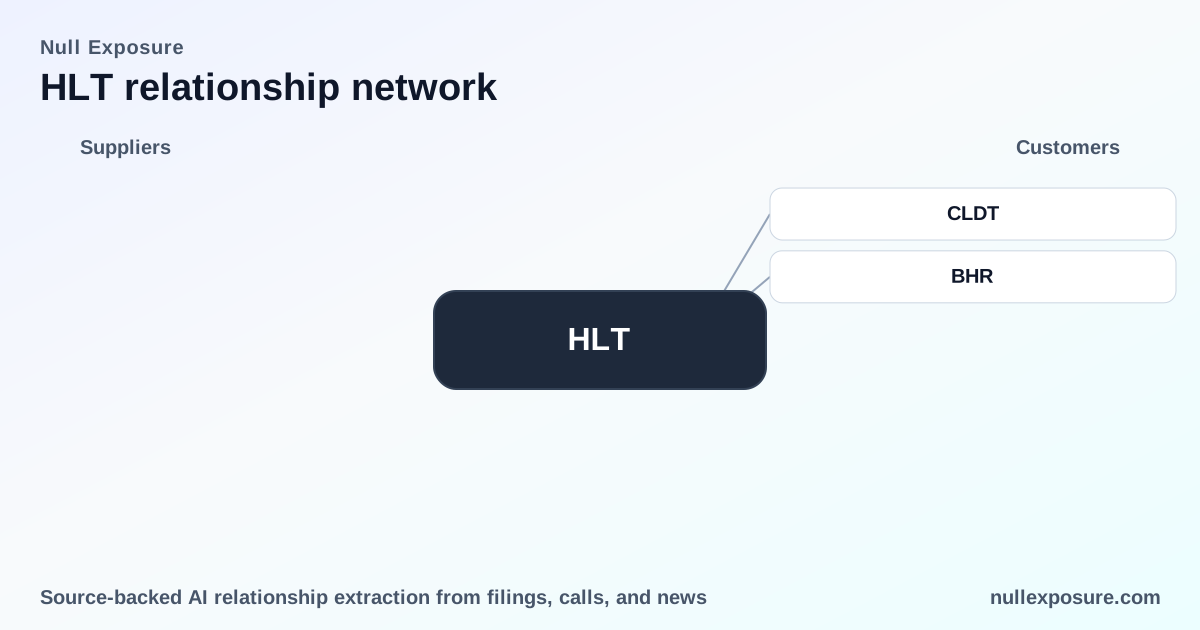
Hilton’s customer map: where the fees, brands and partners actually come from
Hilton Worldwide monetizes a globally distributed business of franchising, management and ownership: recurring management and franchise fees that are largely percentage-based on hotel revenues, a loyalty-driven distribution engine (Hilton Honors) that converts individual guests into high-margin revenue, and a smaller ownership portfolio that sells rooms and F&B directly. This model scales by signing long-term franchise and management agreements with third‑party owners and strategic partners, while preserving asset-light economics through usage‑based fees and brand licensing. For deeper, transaction‑level customer intelligence visit https://nullexposure.com/.
Why investors should care about Hilton’s customer relationships
Hilton’s economics are driven by three structural characteristics that show up across its customers: long-term contracting posture, usage‑based fee capture, and global footprint with U.S. concentration. Management and franchise contracts are typically multi‑year and generate recurring revenue; base fees are often a percentage of gross operating revenue, while incentive fees scale with performance — creating direct alignment between owner performance and Hilton topline. Hilton acts both as licensor and service provider, and the mix of REIT and owner customers creates concentration risk at the portfolio level even as individual owner exposures are dispersed.
The operational constraints investors should treat as company-level signals
- Contracting posture: long‑term, lock‑in orientation. Hilton depends on long‑term management and franchise agreements for fee revenues, which supports revenue visibility but raises owner negotiation and renewal risk.
- Fee structure: usage‑based core economics. Hilton’s base management fees are typically a percentage of monthly gross operating revenue, so revenue performance from owners flows directly to Hilton.
- Geography: global scale with U.S. concentration. Hilton operates in 143 countries, but the U.S. represents a meaningful share of rooms and revenues, concentrating economic sensitivity to U.S. travel cycles.
- Relationship role: licensor and service provider. The management and franchise segment includes properties that license Hilton IP and booking channels while day-to-day operations may be run by third parties.
- Materiality and stage: material and active. Management and franchise contracts are a material and active source of fees, reflected in thousands of franchised/managed properties at year‑end 2025.
If you want a concise feed of customer-level relationships and citations, explore more at https://nullexposure.com/.
Relationship-by-relationship: the customer roster that drives fees and distribution
Below I list the partner companies cited in coverage and filings, with a plain‑English summary of the connection and a concise source nod.
-
Braemar Hotels & Resorts (BHR / BHR‑P‑D) — Braemar repositioned the Cameo Beverly Hills into Hilton’s luxury LXR brand, and the property began booking on hilton.com and joined Hilton Honors; that rebranding shows Hilton’s role as a conversion partner for owners. Source: HotelBusiness and Braemar earnings highlights (2023–2026 reporting).
-
RLJ Lodging Trust (RLJ) — RLJ converted multiple assets into Curio Collection and Tapestry Collection flags, leveraging Hilton’s distribution and loyalty to relaunch properties after renovations. Source: HospitalityNet announcement and HotelManagement coverage (FY2022–FY2025).
-
Travelzoo (TZOO) — Travelzoo marketed deals at Hilton resorts (for example a Hilton resort package in Cabo), demonstrating Hilton’s channel visibility with third‑party travel marketers. Source: TravelandTourWorld (FY2025).
-
Apple Hospitality REIT (APLE) — Apple Hospitality owns a large portfolio with numerous Hilton flags (Garden Inn, Hampton, Residence Inn, etc.), illustrating a sizable franchised relationship with Hilton across select‑service and upscale segments. Source: Ladenburg Thalmann commentary cited on Investing.com (FY2026).
-
Pebblebrook Hotel Trust (PEB / PEB‑P‑F) — Pebblebrook rebranded flagship assets into Hilton’s Curio Collection and retained entrepreneurial operators while leveraging Hilton distribution to preserve hotel character. Source: Pebblebrook earnings call transcript (Q1 FY2026).
-
Park Hotels & Resorts (PK) — Park Hotels’ asset management discusses co‑operation with Hilton as operating partner and contemplates brand and in‑hotel sub‑operators, reflecting Hilton’s operational role on large urban assets. Source: Park Hotels earnings and SEC filings (FY2026).
-
Royal Orchard Hotel (unnamed ticker) — Hilton signed a strategic agreement to open 125 Hampton hotels in India with Royal Orchard Hotel, indicating a sizable franchise pipeline in a priority emerging market. Source: Hilton Q1 FY2026 remarks (May 2026).
-
Chatham Lodging Trust (CLDT / Chatham) — Chatham acquired six Hilton‑branded hotels (Homewood Suites, Hampton Inn & Suites, Home2 Suites) for $92M, underscoring investor appetite for Hilton‑flagged, select‑service assets. Source: TradingView/HotelNewsResource press coverage (FY2026).
-
DiamondRock Hospitality Company (DRH / DiamondRock) — DiamondRock evaluated franchise renewal options for the Hilton Boston Downtown/Faneuil Hall, illustrating renewal decision economics where owners weigh deflagging versus incremental investment. Source: DiamondRock earnings call transcript (Q1 FY2026).
-
Hilton Grand Vacations (HGV) — HGV is the exclusive vacation ownership partner of Hilton; its license agreement with Hilton is critical and any breach would materially affect HGV’s business, reflecting high interdependency. Source: HGV filings and press (FY2025–FY2026).
-
YOTEL — YOTEL became the first brand to join Hilton’s new Select by Hilton via an exclusive agreement, showing Hilton’s willingness to incubate third‑party brands under its platform. Source: LodgingMagazine/TopHotel.News (March 2026).
-
The InterGroup Corporation (INTG) — InterGroup operates a Hilton‑branded hotel in San Francisco’s Financial District, where Hilton provides branding and operational oversight under management/license arrangements. Source: SimplyWall.st and TradingView coverage (FY2025–FY2026).
-
Summit Hotel Properties (INN / INN‑P‑E) — Summit’s portfolio includes hotels under Hilton flags, reflecting the broad adoption of Hilton brands across REIT owned assets. Source: The Globe and Mail/press coverage (FY2025).
-
Sunstone Hotel Investors (SHO / SHO‑P‑I / SHO‑P‑I) — Sunstone’s asset base includes Hilton‑branded upper‑upscale and resort properties, and it completed transactions involving Hilton assets, reinforcing asset recycling strategies tied to Hilton flags. Source: InsiderMonkey/HotelNewsResource (FY2022–FY2026).
-
Marcus Corporation (MCS) — Marcus rebranded and will manage properties under the Tapestry Collection by Hilton, showing third‑party managers working under Hilton flags. Source: HospitalityNet (FY2024).
-
Regenta (Regenta Hotels) — Regenta signed a 125‑hotel India expansion deal with Hilton, a material pipeline move supporting Hilton’s international franchise growth. Source: MarketBeat/press alerts (FY2026).
-
The Generation Essentials Group (TGE) — TGE (AMTD Digital subsidiary) completed acquisition and rebranding of the Hilton Garden Inn Tribeca property, illustrating third‑party buyers continuing to transact Hilton‑flagged assets. Source: TipRanks/Finance Yahoo (March 2026).
-
AMTD Digital / HKD — AMTD’s affiliates completed acquisition of a Hilton Garden Inn in Tribeca, which was rebranded post‑close — an example of buyers taking operational control of Hilton assets. Source: Yahoo Finance/MEXC coverage (FY2026).
-
Ashford Hospitality Trust (AHT / AHT‑P‑D / AHT‑P‑F) — Ashford’s portfolio and transactions reference multiple Hilton‑branded hotels, underscoring REIT exposure to Hilton flags across full‑service and select‑service segments. Source: MarketBeat/TipRanks (FY2021–FY2026).
-
Sotherly Hotels (SOHOO) — Sotherly’s property roster includes several Hilton‑branded hotels (DoubleTree, Tapestry), consistent with Hilton’s penetration in investor portfolios. Source: MarketScreener (FY2022).
-
The St. Joe Company (JOE) — St. Joe opened a Home2 Suites by Hilton, reflecting joint development and franchising activity in regional markets. Source: HospitalityNet announcement (FY2023).
-
Playa Hotels & Resorts (PLYA) — Playa’s incentive management fees and new openings feed into branded operator economics where Hilton branding and performance fees influence outcomes. Source: SahmCapital/earnings coverage (FY2026).
-
Various REITs and owners referenced generically (AHT, APLE, PK etc.) — Multiple REITs repeatedly appear in filings and press as Hilton owners or franchised partners, collectively forming the owner base that generates Hilton’s management and franchise fee revenue. Source: company earnings, filings and press coverage (FY2025–FY2026).
What this map implies for investors and operators
- Revenue predictability is stronger than for pure‑play hoteliers because long‑term franchise and management contracts plus usage‑based fee structures produce recurring, indexed revenue streams.
- Renewal and reputational risk are the primary levers. Large owner concentrations and brand conversions (Curio, LXR, Tapestry, Select) make renewals and conversions an economic inflection point for fee growth and brand strength.
- International pipeline and strategic brand incubations (Select by Hilton, brand partnerships like YOTEL) are the near‑term growth vectors; U.S. cyclical exposure remains an earnings sensitivity.
If you want a structured export of these customer linkages and the underlying source coverage for due diligence, visit https://nullexposure.com/ for transaction‑level references and monitoring.