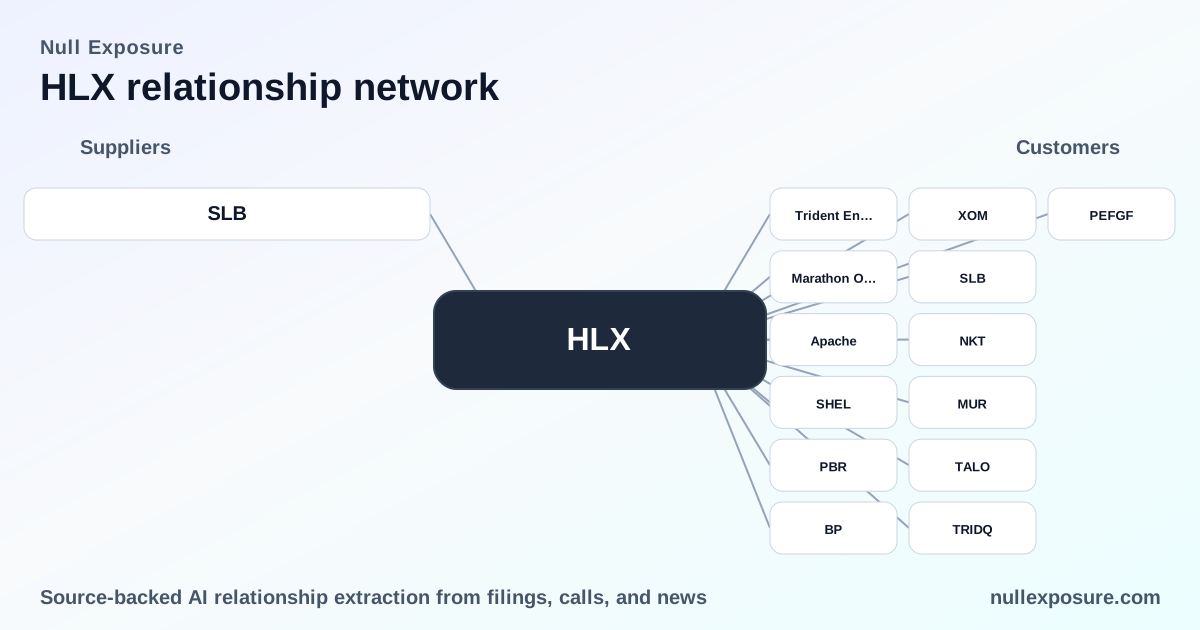
Helix (HLX) customer map — who pays for its vessels and why investors should care
Helix Energy Solutions is an international offshore services company that monetizes specialized well intervention, robotics, decommissioning and production-facility services by selling a mix of hourly/dayrate work and contracted projects ranging from spot engagements to multi‑year agreements; revenue converts through mobilization/dayrate billing and backlog recognition. For investors, the key dynamics are backlog concentration, contract mix (long-term vs spot), and geographic exposure, which together determine utilization, margin volatility and cash flow visibility. Visit https://nullexposure.com/ for more curated counterparty intelligence.
How Helix sells its services and where risk lives
Helix operates as a service contractor and vessel operator rather than a commodity producer. The business is contract-driven: some assets operate on usage-based or hourly dayrates, many contracts are short-term but the company has materially increased its stock of multi‑year, long‑term contracts and framework agreements that create multi-year backlog. Helix reports a sizeable backlog (roughly $1.2–$1.4 billion in recent disclosures) with a handful of customers representing the bulk of that backlog, so customer concentration is a defining counterparty risk. The company’s operating posture therefore blends asset intensity and counterparty credit exposure: high operational criticality for customers (decommissioning, well intervention) but also exposure to commodity-cycle-driven demand and weather/regulatory disruption across regions (North Sea, U.S. Gulf, Brazil, Asia Pacific, West Africa).
- Contracting posture: mix of spot, short‑term and long‑term; invoicing often hourly or dayrate (usage-based).
- Concentration: five customers accounted for roughly 90% of backlog at year‑end 2024 — a critical concentration risk.
- Geography and operational risk: truly global operations with material exposure to North Sea, Latin America, U.S. Gulf and APAC.
- Materiality and spend: backlog and multi‑year awards put a substantial portion of revenue in the $100m+ spend band while smaller work flows through Robotics and Alliance channels.
If you want a structured view of these counterparty relationships and how they feed Helix’s revenue profile, browse our coverage at https://nullexposure.com/.
The customer roll call — every relationship cited in filings and press
Below I list each relationship referenced in Helix’s public results package and relevant press, with a concise investor-oriented summary and source citation.
Marathon Oil Corporation
Helix is entitled to receive $30.0 million (undiscounted) from Marathon as decommissioning obligations tied to the Droshky properties are fulfilled, representing a receivable tied to future decommissioning activity. Source: HLX 2024 Form 10‑K (FY2024).
Apache
Apache represented 11% of consolidated revenue in 2023 under Helix’s customer concentration disclosure, signalling material revenue dependency in that period. Source: HLX 2024 Form 10‑K (customer concentration table, FY2023/FY2024).
Trident Energy do Brasil Ltda.
The Siem Helix 1 commenced operations in 2017 and was working on a long‑term P&A project for Trident through November 2025, demonstrating long‑dated Brazilian exposure. Source: HLX 2024 Form 10‑K (FY2024).
CNR
Helix’s reported backlog commentary lists CNR among major customers driving 2026 revenue recognition, indicating CNR contributes to near‑term backlog conversion. Source: TradingView coverage of HLX Q1 2026 commentary (backlog disclosure).
Petrobras (PBR / PEFFGF / PBR)
Multiple disclosures confirm Petrobras as a key, long‑term counterparty—including three‑year contracts for the Siem Helix vessels and prominent placement in Helix’s backlog. Source: HLX 2024 Form 10‑K and Q4 2025 earnings transcript reported by The Globe and Mail / Business Wire (FY2024–FY2026).
Shell (SHEL / SHEL.LON)
Shell is a major customer across segments; Helix noted a 400‑day Q7000 contract for Shell and multi‑year work in Brazil, and Shell represented a double‑digit percentage of revenue in recent years. Source: Q4 2025 earnings transcript (The Globe and Mail) and HLX 2024 Form 10‑K (FY2024/FY2025).
BP
Helix commenced work on a two‑scope program for BP, a sign of multi‑project operational engagement with a large international operator. Source: Q4 2025 earnings transcript (The Globe and Mail, FY2026 coverage).
NKT (NKTs / NKTR)
Helix announced a four‑year trenching agreement with NKT in the North Sea, positioning Robotics revenue in renewables and IRM work. Source: HLX press coverage and TradingView/Finviz summaries (FY2026).
Oxy (OXY)
Helix’s Q4000 vessel is reported as actively working for Oxy, reflecting ongoing operational deployment for U.S. Gulf customers. Source: Q1 2026 earnings call transcript coverage (InsiderMonkey, FY2026).
Chouest Group
Chouest completed the acquisition of Helix’s Alliance business, indicating Helix has divested an Alliance unit and changed its counterparty mix as of 2026. Source: MarineLink news report (May 2026).
Murphy / MUR
Murphy contracted Helix for lower‑rate R/V decommissioning projects for a significant portion of a quarter, demonstrating variability in dayrates across clients. Source: Q4 2025 earnings transcript (The Globe and Mail, FY2026).
SLB
A standalone 15K IRS was on hire in Brazil contracted to SLB, achieving high utilization prior to returning to the U.S., showing SLB engagement in Helix’s Brazil operations. Source: Q4 2025 earnings transcript (The Globe and Mail, FY2026).
ExxonMobil (XOM)
Helix disclosed a three‑year framework agreement with ExxonMobil for Gulf of Mexico decommissioning, signaling multi‑year framework exposure to a top‑tier operator. Source: HLX 2024 commentary summarized by TradingView and Zacks/Finviz news (FY2026).
Subsea 7
Subsea 7 appears in management backlog commentary as a major customer contributing to backlog conversion in 2026. Source: TradingView Q1 2026 backlog disclosure.
Talos (TALO)
Talos represented a material share (12% in 2024) of consolidated revenue and appears in backlog listings; Talos is a core U.S. Gulf customer for Helix. Source: HLX 2024 Form 10‑K (customer concentration table, FY2024).
TRIDQ / Trident (duplicate entries)
Press and transcripts note the vessel completed a decommissioning contract for Trident before entering a Petrobras contract, illustrating contract sequencing and asset redeployment. Source: Q4 2025 earnings transcript (The Globe and Mail, FY2026).
TRADINGVIEW / FINVIZ‑reported duplicates (Shell, Petrobras, XOM, Talos, NKT)
Several news aggregators reiterated Helix’s backlog composition—Shell, Subsea 7, Petrobras, Talos, NKT and CNR dominate recognized backlog for 2026—confirming multiple independent reports of the same concentration. Source: TradingView and Finviz news synopses (Q1 2026 coverage).
Esso Exploration and Production Nigeria / XOM reference
Helix was awarded deepwater well intervention work at Erha and Usan fields offshore Nigeria by Esso Exploration and Production Nigeria, expanding West Africa operations. Source: MarineTechnologyNews report (Mar 2026).
Additional 10‑K disclosures (segments and contract types)
Helix’s 10‑K discloses the Siem Helix 2 under Petrobras contract through at least December 2027, use of short‑term and long‑term contract classifications, and backlog expected to be recognized over 2025–2027. These are company filing facts that underpin the customer summaries above. Source: HLX 2024 Form 10‑K (FY2024).
What this counterparty map means for valuation and risk
- Backlog-driven visibility: With $1.2–$1.4 billion of backlog and $500–680 million expected to be recognized in the near term, revenue visibility is meaningful, but concentrated among a few large counterparties.
- Concentration is a double‑edged sword: Long‑term contracts with Shell, Petrobras, ExxonMobil and Talos create stable utilization, but the 5‑customer/90% backlog statistic is a critical single‑point risk.
- Mix of contract economics: The business captures both usage/dayrate economics (higher margin when utilization is strong) and fixed mobilization/reimbursable components; investors should model sensitivity to dayrate erosion and utilization swings.
- Geography and regulatory risk: Global footprint provides diversification of activity but introduces currency, regulatory and weather exposures that can affect mobilization and scheduling.
Bottom line for investors
Helix is a capital‑intensive services operator that has successfully booked meaningful multi‑year work, yet its earnings and cash generation remain tightly linked to a small group of large customers and the timing of vessel redeployments. For investors and operators evaluating HLX’s customer relationships, focus on backlog composition, contract duration, dayrate trends and counterparty credit — those variables determine near‑term revenue conversion and downside risk. For a structured counterparty dataset and deeper relationship signals, see https://nullexposure.com/.