HLXC: Sponsor Funding and IPO Structure — What Investors Should Know
Helix Acquisition Corp. III (HLXC) is a traditional SPAC that monetizes by raising public equity through an IPO, supplementing proceeds with sponsor private placements, and converting those pooled funds into value when it completes a business combination with a target operating company. The company’s cash profile and sponsor relationships drive near-term valuation and the timeline to a merger, so investors should evaluate the composition and terms of those capital inflows as signals of sponsor alignment and execution capacity. For a concise view of HLXC’s documents and market commentary, see https://nullexposure.com/.
How HLXC actually captures value
HLXC sells Class A ordinary shares to public investors at IPO, placing the proceeds in trust until a qualifying business combination closes. Sponsor economics are realized by the combination of the IPO proceeds, the sponsor’s private placement (the “PIPE” or sponsor pipe), and the post-merger equity split—those three levers determine cash available for an acquisition and dilution to public shareholders. As a shell company with no operating revenue, HLXC’s sole commercial output prior to a deal is the successful identification and closing of a merger partner; therefore, capital-raising events are the operational lifeblood.
The customer/partner activity identified in public reports
Below are every relationship mention identified in the public roll-up, each summarized in plain English with source attribution.
-
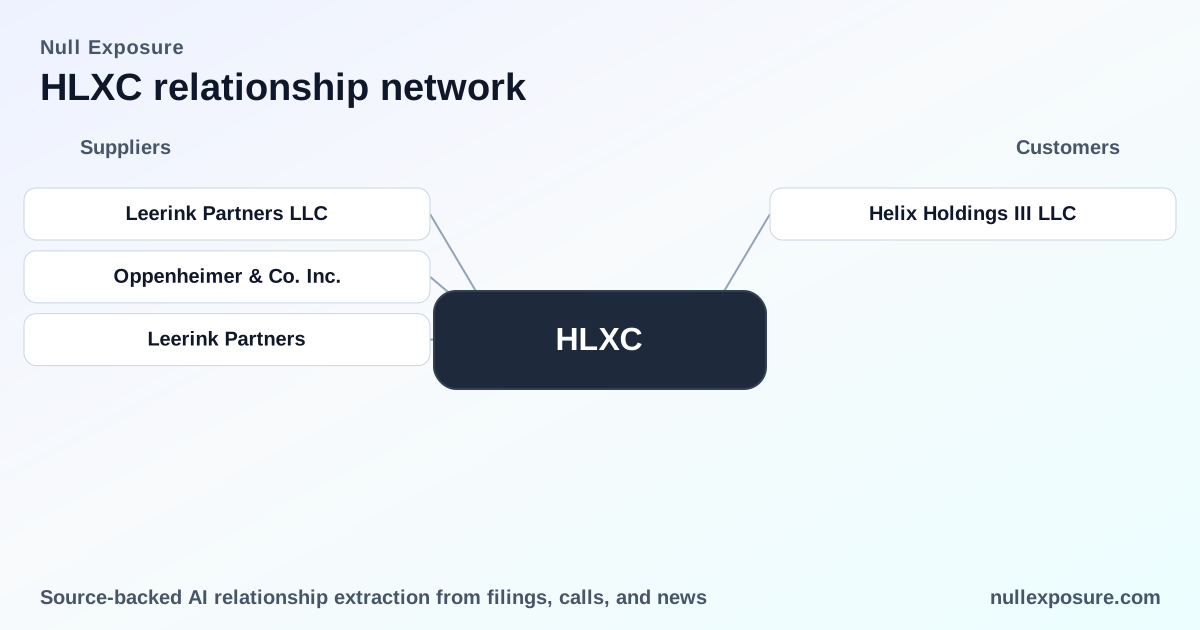
In a Yahoo Finance release covering the closing of the IPO, Helix Holdings III LLC purchased 497,500 Class A ordinary shares at $10.00 per share in a private placement that generated $4,975,000 of gross proceeds to HLXC for fiscal period FY2026. According to the Yahoo Finance filing summary, this private placement was executed concurrently with the IPO closing (FY2026). Source: Yahoo Finance press release (March 2026).
-
A FinancialContent markets notice reporting on HLXC’s offerings likewise documents that Helix Holdings III LLC bought 497,500 Class A ordinary shares at $10.00 each, adding $4.975 million to the company’s cash position concurrent with the initial public offering. The FinancialContent piece frames the private placement as part of the IPO close for FY2026. Source: Markets.FinancialContent.com (January–May 2026 coverage).
-
An Investing.com news item covering the Nasdaq IPO states that, concurrently with the IPO, the company completed a private placement of 497,500 Class A ordinary shares at $10.00 per share to Helix Holdings III LLC, providing an additional $4.98 million to HLXC’s proceeds. The Investing.com article forms part of the FY2026 reporting on the transaction. Source: Investing.com (May 2026).
-
A separate Investing.com SEC-filings summary reiterates that HLXC finalized a private placement of 497,500 Class A ordinary shares to Helix Holdings III LLC at $10.00 per share, generating $4,975,000 in gross proceeds as reported in FY2026 SEC coverage. This entry supplements the public filing narrative of concurrent IPO and sponsor pipe execution. Source: Investing.com SEC filings summary (May 2026).
Takeaway: all reported customer/partner activity in the public roll-up refers to the same sponsor-led private placement: 497,500 shares at $10 each to Helix Holdings III LLC, producing roughly $4.975–$4.98 million in sponsor proceeds concurrent with the IPO.
For broader context on HLXC’s market positioning and comparable SPAC structures, visit https://nullexposure.com/.
Why this sponsor placement matters for investors
-
Contracting posture: The private placement executed at IPO indicates a classic SPAC contracting posture—centralized sponsor funding that supplements public trust proceeds. That posture concentrates negotiation and closing power with a small sponsor group, rather than dispersing leverage across many strategic counterparties.
-
Concentration and counterparty risk: Because the sponsor purchase is material to initial cash on hand, HLXC’s capital composition is concentrated, with meaningful reliance on related-party sponsor funding rather than diversified institutional PIPEs or operating revenue. This raises the importance of sponsor capacity and willingness to support the search and deal process.
-
Criticality to execution: For a SPAC with no operating revenue, sponsor capital is mission-critical: private placements increase the war chest available for a target and can determine the feasibility and scale of prospective business combinations.
-
Maturity and runway: HLXC’s profile is early-stage and transaction-focused—no revenue or operating cashflow exists as a fallback, so the company’s maturity is measured by sponsor experience, timeline to announce a deal, and ability to attract post-announcement investors.
These company-level signals come from the structural nature of the SPAC and the public descriptions of the IPO/private placement; they are not attributed to any single relationship unless explicitly named in source excerpts.
Risk/return framing for investors evaluating HLXC
The economics here are straightforward: HLXC’s near-term valuation is driven by its cash-in-trust plus sponsor-provided capital and by investor confidence that management will complete a high-quality business combination. The disclosed $4.975 million private placement is beneficial because it increases available acquisition capital, but it also concentrates influence with Helix Holdings III LLC—investors must weigh whether that sponsor’s incentives align with public shareholders over the deal timeline.
Key risk vectors are timeline slippage to a business combination, sponsor dilution through warrants or founder shares upon a deal, and the inherent zero-revenue status of SPACs pre-merger. Key upside is a successful merger that delivers operating cashflow and re-rates post-transaction equity.
Final read: what investors should monitor next
- Watch for a definitive agreement announcement and the mix of PIPE commitments at that time, because the composition of additional PIPE investors will materially change dilution and post-merger liquidity.
- Track any sponsor-related agreements or backstop arrangements that could alter the company’s contracting posture or financing flexibility.
- Monitor the trust account amount versus announced target enterprise values to assess whether available cash supports the intended transaction scale.
Bottom line: HLXC is a textbook SPAC financed through a modest public IPO and an immediate sponsor private placement of $4.975 million; for investors, the sponsor’s role is central to both risk and opportunity. For continued coverage and access to transaction-level reporting, visit https://nullexposure.com/.