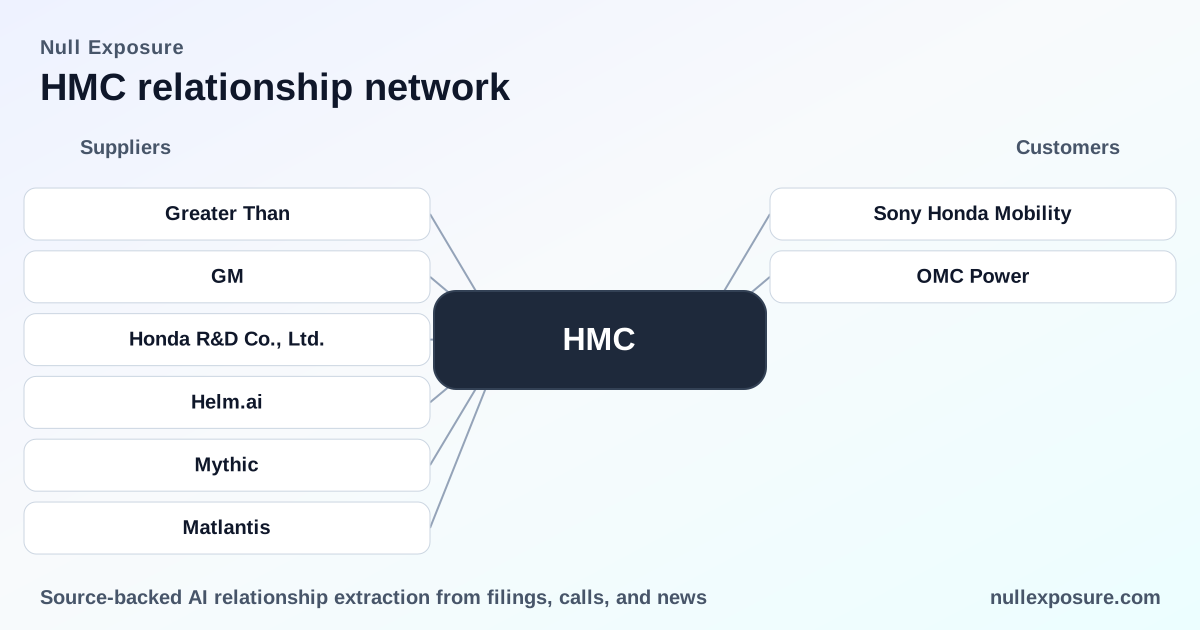
HMC Customer Landscape: How Honda's partner web shapes revenue, risk and optionality
Honda Motor Co., Ltd. is a global integrated OEM that monetizes through vehicle and motorcycle sales, parts and aftersales, captive financing, licensing of platform technologies, and strategic equity and operational partnerships that extend into micromobility, energy services, and aerospace initiatives. Revenue is anchored in a mature ICE and parts business while management is allocating engineering and IP into JV platforms and secondary services to capture recurring revenue streams and decarbonization upside. For investor due diligence and counterparty risk assessment, the composition and status of these customer and partner links materially affect near-term margin recovery and long-term capital allocation.
For a quick reference to our broader customer analytics, visit https://nullexposure.com/ — the homepage provides tools for mapping counterparties and news-driven relationship signals.
What this network says about Honda’s operating model and commercial posture
Honda operates with a hybrid contracting posture: it is a large OEM that both sells finished goods into dealer networks and supplies platform technologies and manufacturing capacity into joint ventures. That dual role creates mixed dependency dynamics — dealers and mobility operators are customers for finished vehicles, while ventures such as joint EV projects rely on Honda for intellectual property, platforms and assembly capacity. The business exhibits high concentration in traditional dealership channels (dealerships generate a substantial share of franchise new-vehicle revenue) but is simultaneously building alternative revenue pathways (micromobility, battery repurposing, aerospace letters of intent) to diversify aftersales and services.
- Contracting maturity: Honda’s core combustion business is mature and cash-generative; newer partnerships are early- to mid-stage commercial plays that demand capital and operational coordination.
- Criticality: When Honda supplies platform assets to partners, those partners’ production and go-to-market timelines become directly sensitive to Honda’s delivery of technology and manufacturing support.
- Concentration: Dealer relationships remain a core distribution concentration that underpins near-term revenue and margin stability.
- Optionality: Battery repurposing and micromobility ventures provide recurring-service and circular-economy optionality that improve lifetime unit economics for sold vehicles.
Relationship map — one-line investor takeaways
Bird (FY2026)
Honda’s Fastport micromobility venture is launching in the U.S. in partnership with Bird to deploy the all-electric eQuad on university campuses and in cities, positioning Honda as a platform supplier into shared-mobility channels. According to Simply Wall St, May 3, 2026, Bird is a launch customer for Fastport deployments.
Spin (FY2026)
Spin joins Bird as a U.S. operator for Honda’s Fastport eQuad rollout, giving Honda multiple distribution partners in the shared-micromobility segment rather than a single-customer concentration. Simply Wall St reported on May 3, 2026 that Spin is participating in the Fastport initiative.
Sony Honda Mobility — assembly at Honda’s Ohio plant (FY2026)
Sony Honda Mobility’s Afeela 1 model was slated to be assembled at one of Honda’s Ohio factories, indicating Honda’s role as an industrial partner supplying manufacturing capacity for the JV. Automotive News noted this manufacturing plan in a report published January 13, 2026.
Sony Honda Mobility — project cancellation (FY2026)
Sony Honda Mobility cancelled the Afeela program after concluding Honda could not supply the essential technologies and platform assets required for production, illustrating the operational dependency that entrants have on Honda-supplied IP and systems. Hypebeast reported the cancellation on March 2026, and coverage in International Business Times echoed the explanation on May 4, 2026 that Honda’s intended technology contributions were central to the decision.
SONY (FY2026)
Media coverage clarified that certain platform assets and technologies were expected to be provided by Honda to the AFEELA program, reinforcing that Honda’s transfer or non-delivery of technology is a production-critical vector for partners. The International Business Times discussed these planned contributions in early May 2026.
OMC Power (FY2026)
Honda acquired a minority stake in OMC Power in October 2025 and will supply used vehicle batteries after three years of use for seven years, creating a predictable feedstock and revenue channel for second-life battery services. The Times of India reported this battery repurposing arrangement in March 2026.
SAH — Sonic Automotive (FY2026)
Sonic Automotive’s analysis underscores dealer economics: luxury and import dealerships generate roughly 86% of franchise new-vehicle revenue and Honda is one of the brands contributing materially to that mix, indicating dealer network concentration as a consistent distribution anchor. SAH Capital discussed dealer revenue composition in a February 19, 2026 research piece.
SOAR-WS / Volato (FY2023)
Volato (trading as SOAR-WS) signed a letter of intent related to Honda’s Echelon long-range light jet, signaling early-stage commercial interest from specialized aircraft operators in Honda’s aviation ambitions. Private Jet Card Comparisons covered the LOI and referenced Honda’s Echelon development in December 2023.
For a consolidated view of these partner links and how they connect to Honda’s commercial exposures, explore our relationship dashboards at https://nullexposure.com/.
Investment implications — what the partner set means for valuation and risk
- Near-term margin stability is anchored in dealer and parts revenue, but dealer-driven demand is cyclical; Sonic Automotive’s dealer revenue breakdown confirms Honda remains exposure-heavy to traditional channels.
- Platform and technology supply is strategically critical. The cancellation of Afeela shows that when Honda is expected to provide core IP and it becomes constrained or strategically withheld, JV business plans can fail and reputational friction with dealers and mobility partners can increase.
- Micromobility partnerships (Bird, Spin) create a path for recurring service revenue and urban unit growth, but success depends on operational rollout and unit economics in campus and municipal contracts.
- Battery second-life through OMC Power is a positive structural signal: it monetizes used assets, improves sustainability reporting, and creates downstream revenue that is less cyclical than vehicle sales.
- Aerospace LOIs such as the Echelon interest are upside optionality for long-term diversification but remain early-stage and immaterial to near-term cash flow.
Bottom line for investors and operators
Honda’s customer and partner landscape is a mix of mature distribution concentration and strategic early-stage partnerships that jointly determine its revenue durability and technology leverage. The company’s role as both a seller of finished vehicles and a supplier of platform assets creates both diversification opportunities and single-point failure risks for joint ventures that depend on Honda engineering and assembly. Monitor partner execution — particularly manufacturing commitments and battery-supply contracts — as the primary signals that will move Honda’s risk-adjusted valuation in the coming quarters.
For a deeper mapping of counterparty exposures and to track these relationships over time, visit https://nullexposure.com/ for the full analytical toolkit.