HomeStreet (HMST): Loan sales to Bank of America crystallize liquidity-first posture
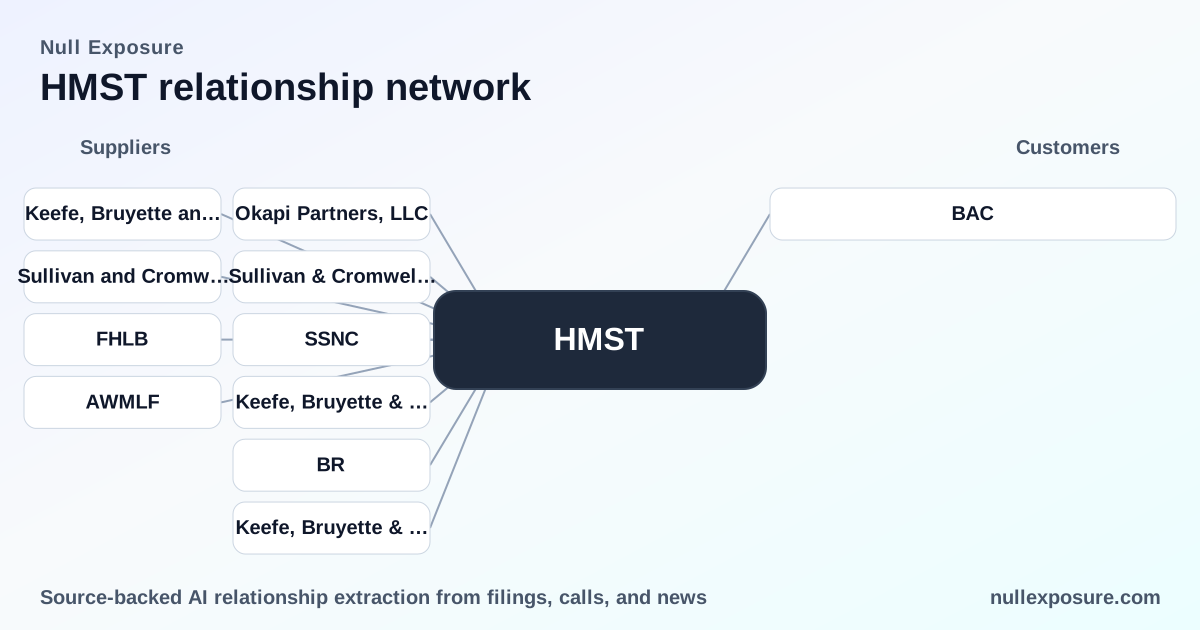
HomeStreet operates as a regional commercial bank that underwrites real estate and multifamily loans and monetizes through net interest margin, loan origination fees, and selective loan sales to manage capital and credit exposure. Recent transactions show HomeStreet executing large portfolio dispositions to institutional buyers, converting illiquid CRE positions into immediate liquidity while retaining core origination capability. For a visual map of these customer and counterparty linkages, see https://nullexposure.com/.
A decisive move into liquidity management: the Bank of America dispositions
HomeStreet executed a material sale of multifamily loans to Bank of America during FY2025 as part of a broader balance-sheet remediation program. This is not an incidental trading relationship but a tactical capital-management action that reduces asset-risk exposure and supplements liquidity.
BAC — American Banker (FY2025)
Late in FY2025, HomeStreet sold nearly $1 billion of multifamily loans to Bank of America as part of efforts to shore up its financials. According to American Banker reporting in March 2026, the sale was a direct component of HomeStreet’s recapitalization moves.
Source: American Banker, March 2026.
Bank of America — American Banker (FY2025)
The American Banker article specifically references the buyer by name, documenting HomeStreet’s disposition of nearly $1 billion in multifamily loans to Bank of America as an element of its year-end financial repositioning. This transaction underscores Bank of America’s role as a buyer of regional bank loan paper in stressed markets.
Source: American Banker, March 2026.
Bank of America — Banking Dive (FY2025)
Banking Dive reported on May 3, 2026, that HomeStreet sold $990 million in multifamily loans to Bank of America following termination of a merger and other strategic shifts. The $990 million figure provides a concrete dollar figure for the multifamily tranche HomeStreet offloaded in FY2025.
Source: Banking Dive, May 3, 2026.
What the relationships collectively reveal about HomeStreet’s operating model
The Bank of America transactions are the most visible customer relationship in the current record. Taken together, they reveal several company-level signals about how HomeStreet runs its business:
- Contracting posture — opportunistic and liquidity-driven. HomeStreet uses loan sales as a primary instrument to manage capital and de-risk the balance sheet when under stress, converting long-duration CRE exposures into cash quickly. This indicates a contracting posture that prioritizes balance-sheet repair over hold-to-maturity strategies.
- Concentration and exposure management. The concentration of the disposition in the multifamily CRE sector suggests HomeStreet carried sizable exposure to specific commercial real estate segments and is willing to materially reduce that exposure through large bilateral sales.
- Counterparty criticality. Large sales to national banks like Bank of America signal that HomeStreet relies on a small set of deep-pocketed counterparties to execute bulk liquidations—this increases the operational importance of maintaining institutional buyer access.
- Maturity of the franchise response. Using loan sales rather than equity raises or securitization shows an intermediate-level maturity in crisis response: the bank leverages market channels and counterparties rather than structural recapitalizations.
These are company-level signals not tied to any individual contractual text in the record; they characterize HomeStreet’s current business behavior and risk-management playbook.
Investment implications and risk considerations
- Liquidity and near-term solvency profile. The sale of nearly $1 billion (reported as $990 million in one source) materially improves near-term liquidity and reduces CRE concentration on the balance sheet. Investors should treat this as a liquidity-first action rather than a sustainable earnings driver.
- Earnings volatility trade-off. While the transaction de-risks assets, it also reduces future net interest income from the disposed portfolio; the trade-off favors capital and stability at the expense of long-term margin capture.
- Counterparty dependency. Reliance on large buyers like Bank of America creates a practical single-buyer dependency for large disposals—this is manageable in normal markets but increases execution risk if institutional appetite wanes.
- Strategic posture post-transaction. The transaction suggests HomeStreet will scale origination selectively or seek joint-venture arrangements to rebuild CRE exposure with lower balance-sheet risk; however, evidence of such strategic shifts is not present in the cited articles.
Where to watch next
- Monitor HomeStreet’s subsequent quarterly filings for realized gains/losses from the loan sale and explicit commentary about counterparty concentrations and remaining CRE exposure by vintage and geography.
- Track secondary-market appetite among large correspondent banks to assess whether HomeStreet can continue offloading assets at acceptable economics without resorting to distressed pricing.
- Watch for changes in funding mix—incremental wholesale or brokered deposits would signal a shift from asset-side repairs to liability-side stabilization.
For deeper intelligence on counterparty maps and transaction histories, visit https://nullexposure.com/ for consolidated relationship reporting and timeline views.
Bottom line
HomeStreet’s FY2025 disposition of multifamily loans to Bank of America is a high-conviction liquidity-management maneuver. The sale converts concentrated CRE exposure into sizeable cash, reduces near-term balance-sheet risk, and highlights dependence on large institutional buyers for bulk dispositions. For investors, the trade-off is clear: improved stability and lower immediate risk at the cost of reduced future interest income and increased reliance on counterparty market access.