Harmony Gold (HMY) — customer relationships and what the Kili Teke sale signals for investors
Harmony Gold Mining Company Limited operates as an integrated gold producer with extraction, processing and exploration assets in South Africa and Papua New Guinea, monetizing through gold (and ancillary copper) production sold into global commodity markets and strategic asset transactions. Revenue generation is driven by physical production and selective asset sales, while cash flow and margin durability are supported by recent operating margins and a disciplined capital allocation posture.
For a concise view of Harmony’s customer and transaction footprint, visit the NullExposure homepage: https://nullexposure.com/
Business model, operating posture and financial context
Harmony is a commodity producer with scale: market capitalization near $9.78 billion and trailing revenue of approximately $81.16 billion (TTM), with strong operating margins (33.3% TTM) and a profitable return profile (ROE ~33.5%). The company runs geographically concentrated operations in South Africa alongside a material, though smaller, PNG presence. Harmony’s commercial model blends production sales into spot/contracted gold markets with targeted portfolio management actions—dispositions and joint ventures—used to optimize capital allocation and geographic risk.
- Monetization is straightforward: mined metal sold into the market plus occasional asset disposals that crystallize value and reallocate capital.
- Contracting posture: Harmony often operates through local subsidiaries for exploration and asset ownership, which supports transactional flexibility such as sales to junior miners or partners.
- Concentration and criticality: South Africa is the principal operating base; remaining PNG exposure is smaller and therefore less critical to consolidated output, a dynamic reinforced by recent asset divestments.
- Maturity signal: Portfolio pruning through divestitures signals a mature operator focused on optimizing cash returns rather than expansive greenfield exploration.
Customer and counterparty relationships recorded here
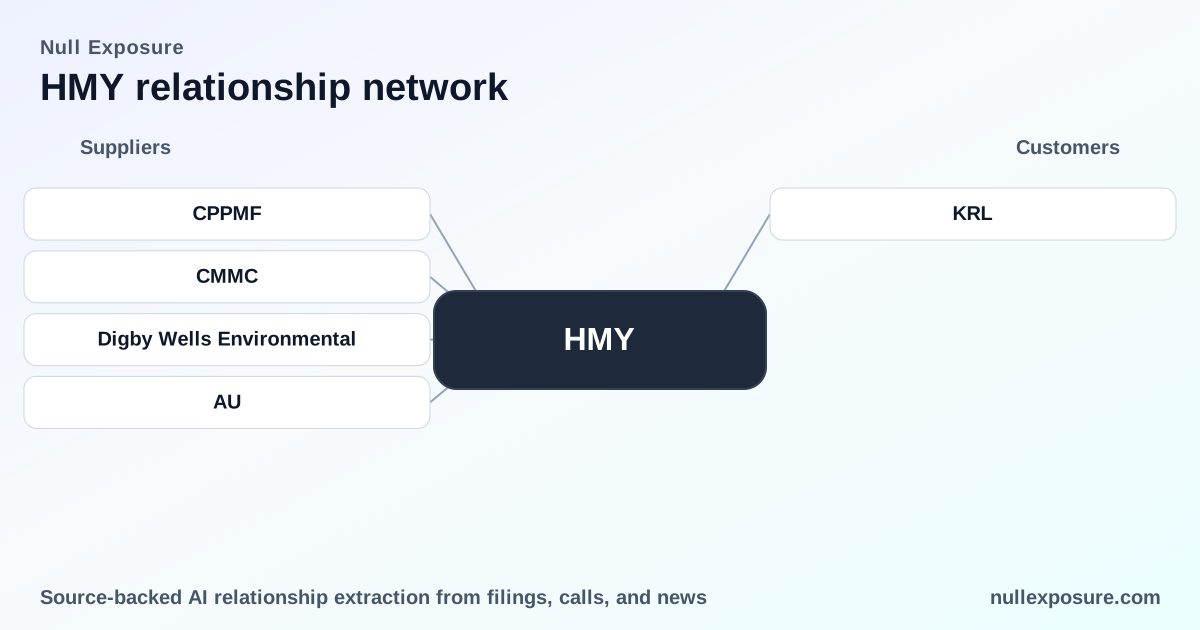
The relationship feed returned two entries tied to the same counterparty and transaction; both must be reported. Each entry is summarized below exactly as captured.
Kainantu Resources Ltd. — acquisition of Kili Teke from Harmony Gold (PNG) Exploration Limited
- Harmony’s wholly-owned subsidiary, Harmony Gold (PNG) Exploration Limited (HGEL), entered into a definitive agreement to sell 100% of the Kili Teke Gold-Copper Project in Papua New Guinea to Kainantu Resources Ltd. The press release records the transaction as an outright acquisition of the project by Kainantu. Source: press release on Junior Mining Network dated 10 March 2026 — https://www.juniorminingnetwork.com/junior-miner-news/press-releases/2886-tsx-venture/krl/118944-kainantu-resources-announces-acquisition-of-kili-teke-copper-gold-project-from-harmony-gold-png-exploration-limited.html
Kainantu Resources Ltd. — duplicate entry of the HGEL sale
- The relationship list includes a second, duplicate mention of the same March 10, 2026 press release documenting the transfer of the Kili Teke project from Harmony’s PNG exploration unit to Kainantu Resources. This duplicate confirms the same counterparty engagement captured twice in the feed. Source: Junior Mining Network press release, 10 March 2026 — https://www.juniorminingnetwork.com/junior-miner-news/press-releases/2886-tsx-venture/krl/118944-kainantu-resources-announces-acquisition-of-kili-teke-copper-gold-project-from-harmony-gold-png-exploration-limited.html
What the Kili Teke disposal reveals about Harmony’s customer relationships
The Kili Teke sale is concrete evidence of Harmony using subsidiary-level transfers to reallocate non-core PNG assets to junior operators, converting exploration-value into cash or strategic consideration. This is a commercially efficient mechanism that reduces non-core exposure and concentrates management attention and capital on core South African operations.
Operationally, the transaction indicates:
- Low customer concentration risk at the buyer level for Harmony, because the counterparty is a junior explorer/operator acquiring a targeted project rather than a major offtake counterparty.
- Transactional maturity: Harmony structures transactions through HGEL, demonstrating an established contracting posture that isolates asset-level liabilities and simplifies disposals.
- Commercial criticality: The disposal reduces Harmony’s PNG exploration footprint, lowering geopolitical and operational complexity without materially altering its core gold production profile.
Company-level constraint signals
NullExposure records contain no explicit contractual constraints associated with Harmony’s customer relationships in this capture. That absence is itself a company-level signal: publicly flagged customer-level contractual concentration, limiting clauses, or contractual criticality were not recorded for this relationship set. Investors should interpret this as an absence of flagged, high-consequence customer-contract risks in the visible transaction feed rather than proof of their nonexistence in Harmony’s overall contractual book.
Practical investment implications
- Portfolio focus: Selling Kili Teke reinforces Harmony’s strategy of concentrating capital on material operations while monetizing smaller, higher-risk assets. This supports free cash flow and de-risks geographic exposure.
- Earnings stability: Given Harmony’s strong operating margin and return metrics, divestitures like Kili Teke are consistent with preserving margin quality and deploying proceeds to pay down costs or return capital.
- Counterparty risk profile: Transactions with junior buyers reduce buyer concentration risk but increase execution complexity (e.g., deal completion, future earn-outs); Harmony’s subsidiary-based structure limits balance sheet contagion.
For deeper, structured visibility into Harmony’s counterparty transactions and customer signals, see NullExposure: https://nullexposure.com/
Key takeaways
- Harmony monetizes through production and strategic disposals; the Kili Teke sale to Kainantu is a concrete example.
- The company uses subsidiary entities to execute asset sales, signaling a disciplined and mature contracting posture.
- No explicit customer-level contractual constraints were recorded in this relationship capture, which is a company-level signal reducing observed customer concentration risk in the public feed.
- Investors should treat disposals as constructive for balance sheet flexibility and operational focus, while monitoring for additional divestments that could further alter geographic risk.
This record is focused on the customer relationship activity captured for HMY; for broader counterparty analytics and chronological transaction history, visit NullExposure: https://nullexposure.com/