HNI Corp: How customer relationships shape revenue, risk, and strategic optionality
HNI designs, manufactures, and sells workplace furnishings and residential building products primarily in North America, monetizing through point-of-sale product revenue, dealer and distributor channels, and a smaller set of contract assets tied to multi-year dealer commitments. Revenue is overwhelmingly transactional and near-term — recognized at a point in time on transfer of control — but HNI supplements this with limited multi-year dealer arrangements and guarantees that create pockets of recurring commercial exposure. For primary coverage and relationship mapping, see NullExposure.
Why the customer map matters for valuation
HNI's operating model is built on high-volume manufacturing and broad distribution. This creates several definable characteristics that matter for investors assessing customer credit and concentration risk:
- Contracting posture: The company’s filings disclose that most customer contracts are short duration — typically less than one year — and HNI routinely elects the practical expedient not to adjust for significant financing components. This confirms a predominantly spot-sales revenue profile with limited embedded financing on customer invoices (company consolidated financial statements, 2024).
- Selective long-term exposure: HNI holds contract assets from funds paid up-front to certain workplace furnishings dealers in exchange for multi-year marketing commitments; these are explicit exceptions to the short-term norm and represent longer-dated distributor commitments (company financial notes).
- Distribution concentration and criticality: The business depends on a national network of independent dealers, wholesalers, office-product distributors and eCommerce resellers; management explicitly warns that the loss of significant dealer relationships would have a material operational and marketing impact (2024 filings). Dealers are therefore strategic intermediaries and single points of commercial leverage.
- Customer concentration: HNI reports that its five largest customers accounted for roughly 15% of consolidated net sales in 2024 and that no single customer exceeded 10% of sales — a clear signal of moderate diversification at the top end of the book (FY2024 disclosure).
- Geographic footprint and exposure: Revenue is concentrated in the United States and Canada, with exports to Latin America and operations in India and Mexico. North America is the dominant market, and international exposure is meaningful but secondary (company MD&A).
- Lifecycle and maturity of relationships: Most order backlogs are short and cancellable; the company describes backlog fulfillment over a few months, indicating low structural customer lock-in outside of dealer commitments (consolidated statements commentary).
- Materiality signals: The filings simultaneously present material risk scenarios (loss of key dealers, macro-induced demand shocks) and immaterial items (no individual customer accounts for ≥10% of sales), forcing a balanced view of systemic vulnerability within a diversified customer base.
Relationships called out in HNI’s public remarks
Below are every customer/partner name returned in the search results, with plain-English summaries and source attributions.
-
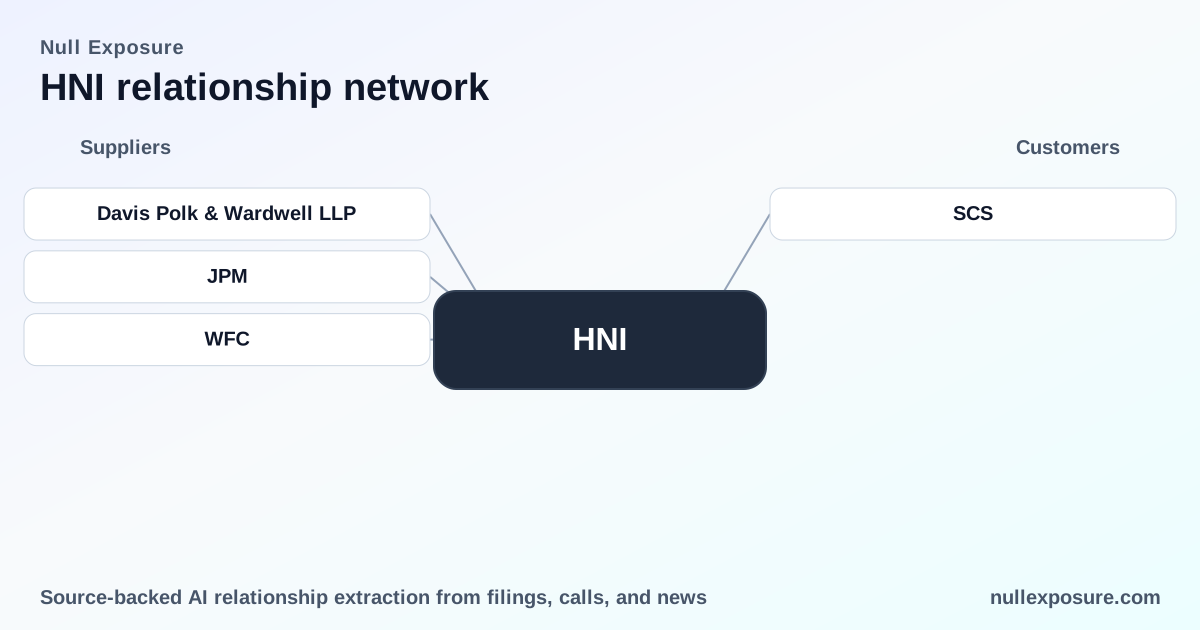
SCS — HNI referenced SCS in its 2025 fourth-quarter earnings remarks in connection with an acquisition activity described late in the year. The mention indicates a corporate action affecting HNI’s competitive footprint and customer relationships. Source: HNI 2025 Q4 earnings call transcript (first seen March 7, 2026).
-
Steelcase — HNI stated in the 2025 Q4 earnings call that it completed the acquisition of Steelcase late in the year; that acquisition transforms HNI’s landscape of customers and competitors by folding an industry peer into its structure. Source: HNI 2025 Q4 earnings call transcript (first seen March 7, 2026).
(Both results derive from the same Q4 2025 earnings call disclosure; the transcript specifically noted completion of the Steelcase transaction.)
How these named relationships change the customer-risk profile
The public acknowledgement of a completed Steelcase acquisition — and the callout of SCS in the same context — is strategically significant. Consolidation through acquisition expands HNI’s direct customer relationships and increases exposure to large enterprise contracts and integrated dealer networks, which shifts parts of the revenue base from pure spot sales to revenues subject to integration and large-account servicing dynamics (earnings call, March 2026). Integration increases bargaining power on both sides: HNI gains scale, while servicing larger accounts raises the potential for concentrated pricing pressure.
Operational constraints that drive commercial dynamics
Use of practical expedients, distribution strategy, and warranty/guarantee practices create predictable commercial behaviors:
- Short contracting cycle reduces financing risk but increases sensitivity to quarter‑to‑quarter demand swings because most revenue is recognized at shipment and backlog clears quickly (company revenue recognition note).
- Multi-year dealer commitments create measurable but limited long-term exposure; these contracts produce contract assets that are amortized over their term and are subject to impairment if dealer relationships deteriorate (financial notes on contract assets).
- Government and large-enterprise sales exist alongside SMB demand, adding complexity: government procurement rules and large-corporate purchasing create both upside (stable, large orders) and downside (restrictive terms, funding variability) (MD&A).
- Manufacturing footprint and ramping initiatives matter: the company is actively optimizing manufacturing, with ramp-up activity in Mexico and production relocation domestically; these steps influence fulfilment capacity and lead-times for customers and therefore commercial service levels (operational commentary).
A discrete corporate-level disclosure also shows the company has roughly $4 million of aggregate guarantees outstanding as of year-end 2024 — a modest contingent exposure relative to total net sales, but a concrete indicator of the company’s role in underwriting dealer credit (notes on guarantees).
Investor implications and tactical takeaways
- Revenue durability is mixed: HNI’s model combines high-frequency transactional sales with a small set of longer dealer commitments; investors should value current revenue predictability as moderate but subject to cyclical softness in commercial construction and housing.
- Consolidation increases scale risk and opportunity: The Steelcase acquisition materially changes customer composition and could increase large-account concentration; integrate this into revenue forecasts and margin models.
- Dealer network is the primary operational lever: Protecting and monitoring dealers’ credit health is central to downside risk management; insolvencies or concentrated dealer losses are a first-order risk.
- Geographic concentration reduces diversification benefits: Performance will track North American commercial and housing cycles, with limited but meaningful export exposure.
Key actions for modelers and operators:
- Stress-test scenarios for dealer insolvency and order cancellations given short contract durations.
- Revisit customer concentration assumptions post-Steelcase integration and re-run top-customer sensitivity analyses.
- Monitor manufacturing ramp metrics (Mexico facility) because lead-times and fulfilment substantially affect near-term revenue recognition.
Conclusion: what investors should watch next
HNI operates a predominantly spot-sales business with targeted dealer commitments that create pockets of longer-term exposure. The company’s reliance on independent dealers, the completed Steelcase acquisition, and concentrated North American end markets are the primary drivers of customer risk and opportunity. For a deeper read on relationship mapping and comparable corporate disclosures, visit NullExposure.