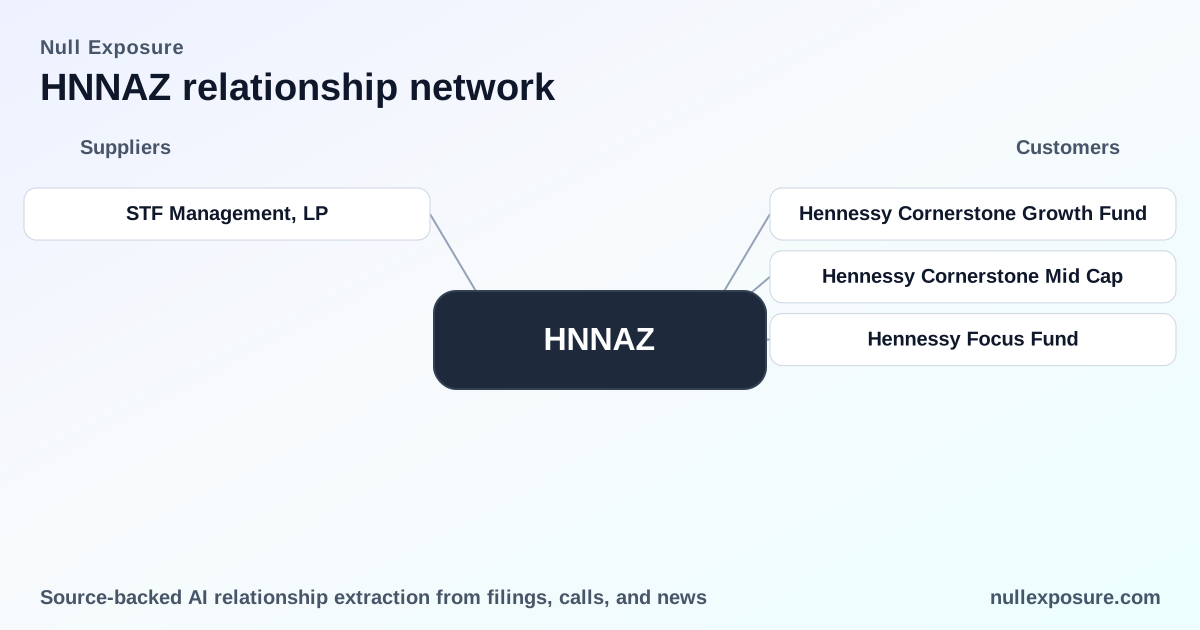
HNNAZ — Customer Relationships That Power Hennessy Advisors’ Fee Engine
Hennessy Advisors operates as a classic fee-for-service asset manager: it provides investment advisory and shareholder services to a family of mutual funds and an ETF and is paid a percentage of average daily net asset value, plus modest shareholder service fees. The company’s revenue model is usage‑based, highly concentrated, and contractually renewable on a short cadence, meaning asset flows drive top‑line volatility and distribution partnerships determine growth. For a consolidated view of customer relationships and implications for noteholders, see https://nullexposure.com/.
How Hennessy gets paid and what that implies for counterparties
Hennessy’s operating model is straightforward: investment advisory fees account for the vast majority of revenue, recognized monthly and calculated daily based on the funds’ NAV. Contracts are structured so that fees scale with assets under management — a classic usage‑based arrangement — while advisory agreements require annual renewal and are terminable on relatively short notice, which creates an ongoing governance checkpoint for fund boards and investors. Company disclosures also show material concentration: a handful of funds historically account for roughly three‑quarters of assets under management and a similar share of revenue, making Hennessy economically dependent on a small number of products.
Key operating characteristics:
- Contracting posture: Fees are usage‑based (percentage of AUM) and contracts are renewed annually or can be terminated on short notice, which compresses long‑term revenue visibility.
- Concentration and criticality: All operating revenues derive from advisory and shareholder service agreements with the Hennessy Funds; revenue and asset concentration across five or six funds is a primary single‑point risk.
- Geography and counterparties: Business is US‑centric and distributed through national and regional financial institutions and advisors, exposing the firm to distributor consolidation.
- Spend and flexibility: Historical fee waivers are modest (roughly $0.18–$0.20 million in recent fiscal years), signaling limited but present pricing flexibility.
For investors evaluating HNNAZ, these are the structural constraints that determine cash‑flow resilience and refinancing risk.
Relationship map: who Hennessy works with and why it matters
Below are the customer and distribution relationships identified in the record, each summarized in plain English with source context.
Oppenheimer & Co. Inc.
Oppenheimer served as the book‑running manager for the notes underwriting, listed among the underwriters that agreed to purchase principal amounts of Hennessy’s Notes under an underwriting agreement disclosed via EDGAR. (Source: Advfn/EDGAR underwriting notice, 2021; referenced in FY2026 reporting: https://br.advfn.com/noticias/EDGAR/2021/artigo/86126516)
Takeaway: Oppenheimer’s role is transactional and distributional for the debt issuance, not an ongoing advisory client relationship.
Janney Montgomery Scott LLC
Janney Montgomery Scott is listed alongside Oppenheimer among the underwriters that committed to purchase the Notes in the same underwriting agreement disclosed on EDGAR. (Source: Advfn/EDGAR underwriting notice, 2021; referenced in FY2026 reporting: https://br.advfn.com/noticias/EDGAR/2021/artigo/86126516)
Takeaway: Janney functions as a distribution counterparty on the capital markets side of Hennessy’s financing activity.
Hennessy Funds Trust
Hennessy Funds Trust is the organized vehicle of mutual funds for which Hennessy Advisors provides investment advisory services under formal agreements covering all classes of the Hennessy Funds. These agreements are the legal basis for the firm’s fee income. (Source: Advfn/EDGAR disclosure regarding investment advisory agreements, 2022; referenced FY2026: https://br.advfn.com/noticias/EDGAR/2022/artigo/88081556)
Takeaway: This is the core customer relationship: the Trust is the contracting counterparty through which virtually all operating revenue is earned.
Hennessy Cornerstone Growth Fund
Hennessy Advisors serves as investment advisor to all classes of the Hennessy Cornerstone Growth Fund, making it a direct revenue source through advisory fees tied to the fund’s assets. (Source: CNBC fund profile and company filings, FY2025: https://www.cnbc.com/quotes/Z3A-FF)
Takeaway: One of the funds that contributes materially to fee income; fund performance and flows directly affect revenue.
Hennessy Cornerstone Mid Cap
Hennessy Advisors acts as investment advisor to the Hennessy Cornerstone Mid Cap Fund, which is among the concentration drivers of the firm’s assets under management. (Source: CNBC fund profile and company filings, FY2025: https://www.cnbc.com/quotes/Z3A-FF)
Takeaway: Historically one of the largest contributors to AUM and revenue, making it a critical product for sustaining fees.
Hennessy Focus Fund
Hennessy Advisors is the investment advisor for the Hennessy Focus Fund across its share classes, providing portfolio management and related services in return for advisory fees. (Source: CNBC fund profile and company filings, FY2025: https://www.cnbc.com/quotes/Z3A-FF)
Takeaway: Another concentrated revenue source; changes in flows here have outsized effects on consolidated revenues.
(For a full customer‑relationship view and analytics, visit https://nullexposure.com/.)
Why these relationships matter to noteholders and investors
- Revenue sensitivity to flows: Because fees are usage‑based, the firm’s cash flows are highly correlated with fund AUM. Historical disclosures show net outflows and monthly redemption increases that materially affected assets under management and operating performance.
- Contractual renewal risk: Annual renewals and short termination rights give fund boards and large distributors leverage to renegotiate or reallocate assets, which creates recurring re‑contracting risk.
- Concentration is a financial lever: With roughly 75% of AUM concentrated in five or six funds, poor performance in one or more of those products would disproportionately reduce fee revenue, amplifying leverage and refinancing sensitivity for near‑term debt.
- Distribution dependency: National broker‑dealers and advisor networks are primary distribution channels; consolidation or product rationalization at those institutions is an operational risk to asset growth.
- Limited pricing flexibility: Fee waivers recorded in the mid‑hundreds of thousands demonstrate the firm can and does adjust economics to retain assets, but the magnitude is small relative to total revenues.
Final read for investors
HNNAZ is underpinned by a concentrated, usage‑based revenue stream tied to a small set of funds; the economics are predictable when flows are stable and volatile when product performance or distribution access changes. The underwriting relationships for the notes (Oppenheimer, Janney) are executional, while the Hennessy Funds Trust and the named funds are the durable revenue source. For credit analysis, focus on AUM trends in the top funds, renewal outcomes for advisory agreements, and distributor appetite — those three levers determine covenant breathing room and refinancing capacity.
For a consolidated portal to customer relationships and primary source references, visit https://nullexposure.com/.