Hallador Energy (HNRG): Customer Map and What It Means for Revenue Risk and Growth
Hallador Energy is a vertically integrated coal miner and independent power producer that monetizes through two linked revenue streams: coal sales from its Sunrise mines and wholesale electricity and accredited capacity sold by Hallador Power. The company earns base coal pricing under multi‑year supply contracts and recognizes delivered energy and capacity revenues under long‑dated PPAs and prepaid forward power sales, while opportunistically selling into the MISO wholesale market to capture spot upside. For a quick primer on how we source and present this relationship intelligence, visit https://nullexposure.com/.
Operational thesis in one line
Hallador converts coal production into predictable cashflow through contracted coal offtake and contracted power sales, supplemented by commodity exposure through MISO spot sales — a business model that delivers near‑term cash certainty while remaining concentrated and contractually leveraged to a small set of large utility customers.
How Hallador’s customer relationships shape the business
- Contracting posture: Hallador runs a mix of long‑term, multi‑year contracts (notably PPAs and priced coal commitments through 2028) alongside short‑term prepaid forward power contracts used to smooth cash flow and service debt. The company also sells a material amount into the spot market via MISO.
- Concentration and criticality: Customer concentration is high; Hallador derived the vast majority of 2024 revenue from a handful of customers and counts multiple customers above the 10% threshold. Loss of a single large counterparty would have material impact on cash generation.
- Maturity and obligations: Hallador has committed coal sales and delivered energy obligations running through 2028 with hundreds of millions of dollars of contracted revenue and remaining performance obligations. These forward commitments underpin near‑term revenue visibility while locking the company into fixed volumes and prices.
- Geography and markets: Operations and most customers sit in MISO Zone 6 / Illinois Basin / Indiana, creating both logistical advantages and regional regulatory exposure. Global events and export market instability are relevant company‑level risk factors but do not drive day‑to‑day customer revenue.
- Spend and scale: Contracts span meaningful spend bands — Hallador reports hundreds of millions in committed coal sales and multiple prepaid power contracts in the $10–$100M range that materially affect liquidity timing.
The combination of long‑dated contracts for base revenue and periodic prepaid/short‑term contracts for liquidity creates a hybrid revenue profile: stable headline cashflow with cyclical commodity and counterparty exposure.
Customers that define 2024 revenue (what the filings say)
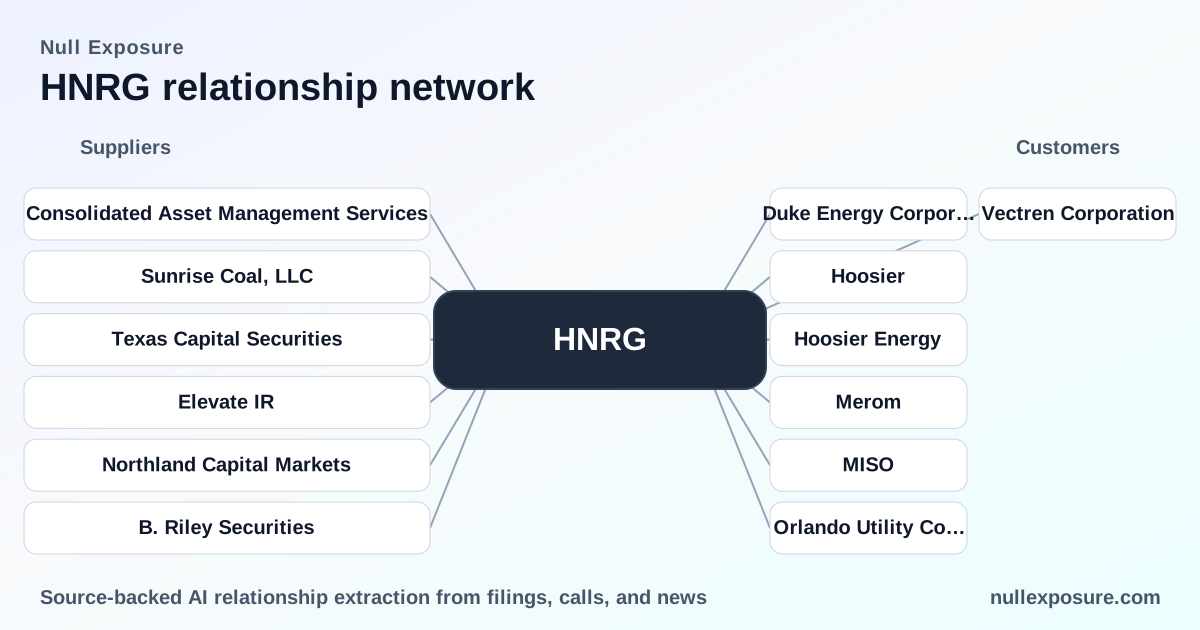
Duke Energy Corporation
Hallador identifies Duke Energy as a significant third‑party customer in FY2024, reflecting coal or power deliveries that contribute materially to third‑party revenue. According to Hallador’s FY2024 Form 10‑K, Duke is listed among the company’s significant customers for 2024 (Hallador 2024 10‑K, FY2024).
Hoosier / Hoosier Energy
Hallador’s Electric Operations generated a material portion of 2024 revenue under a PPA with Hoosier, a PPA entered as part of the Merom acquisition; revenue recognition for delivered energy under this PPA occurs daily and the contract was amended to extend into 2028. The FY2024 10‑K documents Hallador’s PPA and the Hoosier Asset Purchase Agreement that governs deliveries and pricing (Hallador 2024 10‑K, FY2024).
Merom (Merom Generation Station)
Hallador is contractually committed to supply Merom with coal through 2028, with the company explicitly noting a 9.2 million‑ton supply commitment to Merom through 2028. This commitment flows from the Merom acquisition and related supply arrangements (Hallador 2024 10‑K, FY2024).
MISO (Midcontinent Independent System Operator)
Hallador sells a material amount of power in the competitive wholesale market through MISO, alongside long‑term bilateral contracts; the 10‑K highlights that while long‑term contracts insulate some revenue, Hallador also participates in day‑ahead/spot markets via MISO (Hallador 2024 10‑K, FY2024).
Orlando Utility Commission (OUC)
OUC is named as a significant third‑party customer for 2024, indicating Hallador’s energy or coal deliveries to municipal utility buyers contributed materially to that year’s third‑party sales (Hallador 2024 10‑K, FY2024).
Vectren Corporation (a CenterPoint Energy subsidiary)
Hallador lists Vectren Corporation (a subsidiary of CenterPoint Energy) among its significant third‑party customers in 2024, signaling utility counterparty exposure in its contracted sales book (Hallador 2024 10‑K, FY2024).
Notes on sources: each relationship above is recorded by Hallador in its FY2024 Form 10‑K (filed with the SEC) where the company enumerates significant third‑party customers, PPAs, supply commitments, and market participation.
Constraints that matter for investors (company‑level signals, and relationship‑specific facts)
- Long‑term commitments anchor revenue: Hallador reports large long‑term contracts through 2028, including priced coal commitments (8.4–8.5 million tons) and PPAs that lock volumes and prices and are scheduled to generate revenue through 2028 (company 10‑K disclosures).
- Short‑term prepaid contracts provide liquidity but shift cash timing: In 2024 Hallador executed multiple prepaid forward power contracts ($45M for 11 months; $60M for 19 months; and other prepaid arrangements) that advanced cash and created contract liabilities recognized over delivery periods (company 10‑K).
- Spot market exposure remains meaningful: Hallador continues to sell in MISO and the spot market, which introduces commodity price volatility into earnings despite a strong forward book (company 10‑K).
- Concentration risk is high and critical: In 2024, 96% of revenue derived from four customers (5 plants) on a segment basis, and historical receivables are concentrated among a small set of counterparties; this is a structural counterparty risk to cashflows (company 10‑K).
- Material contractual spend: The company discloses hundreds of millions of dollars of remaining performance obligations (coal sales ~$460M and energy/capacity obligations >$200M), indicating high absolute contract spend and the consequential revenue dependence (company 10‑K).
- Regional footprint and regulation exposure: Operations focus on the Illinois Basin and MISO Zone 6, making Hallador sensitive to regional retirements, transportation costs, and evolving emissions/CCR regulations that could change demand dynamics (company 10‑K).
Investment takeaway and next steps
- Primary investment view: Hallador’s revenue base is highly visible in the near term thanks to multi‑year coal and power contracts and sizeable prepaid power sales, but customer concentration and commodity/market exposure leave upside and downside tied to a small set of large utilities and MISO market moves.
- Key risks: concentrated counterparty credit, regulatory pressure on coal demand, and reliance on prepaid contracting to smooth liquidity. Key strengths: long‑dated contracted volumes, localized logistics advantage in the Illinois Basin, and demonstrated ability to secure prepaid forward sales that support debt servicing.
For a deeper read on the customer‑level contract obligations and how Hallador is positioning forward sales into 2025 and 2026, visit https://nullexposure.com/ for structured signals and filings.