Honest Company (HNST) — Retail Relationships, Revenue Drivers, and Commercial Risks
Honest Company sells cleanly‑formulated baby, beauty and personal care products through a two‑pronged monetization model: direct‑to‑consumer subscriptions and one‑off sales (Honest.com) plus wholesale distribution to large retail and third‑party ecommerce customers. Revenue is generated from product sales, subscription churn and recurring orders, and trade promotion programs negotiated with major retailers — a model that converts brand equity into largely transactional retail revenue and working‑capital exposure. For a deeper dataset and ongoing tracking of counterparties, visit NullExposure.
How Honest’s commercial model works in practice
Honest operates as an omnichannel branded consumer goods company that is increasingly retail‑first. The firm records finished‑goods sales to retail and ecommerce partners under standard vendor agreements, and continues to offer a subscription product set direct to consumers. Payment terms are typically short — 30 to 45 days — and vendor contracts are predominantly purchase‑order driven, giving retailers and Honest transactional flexibility but also creating revenue volatility tied to shelf placement, inventory cadence and promotional cycles. The 2024 Form 10‑K shows Honest’s strategic shift to favor retail distribution and optimize fulfillment economics while gradually de‑emphasizing DTC as a fulfillment channel.
Retail counterparties: what investors need to know
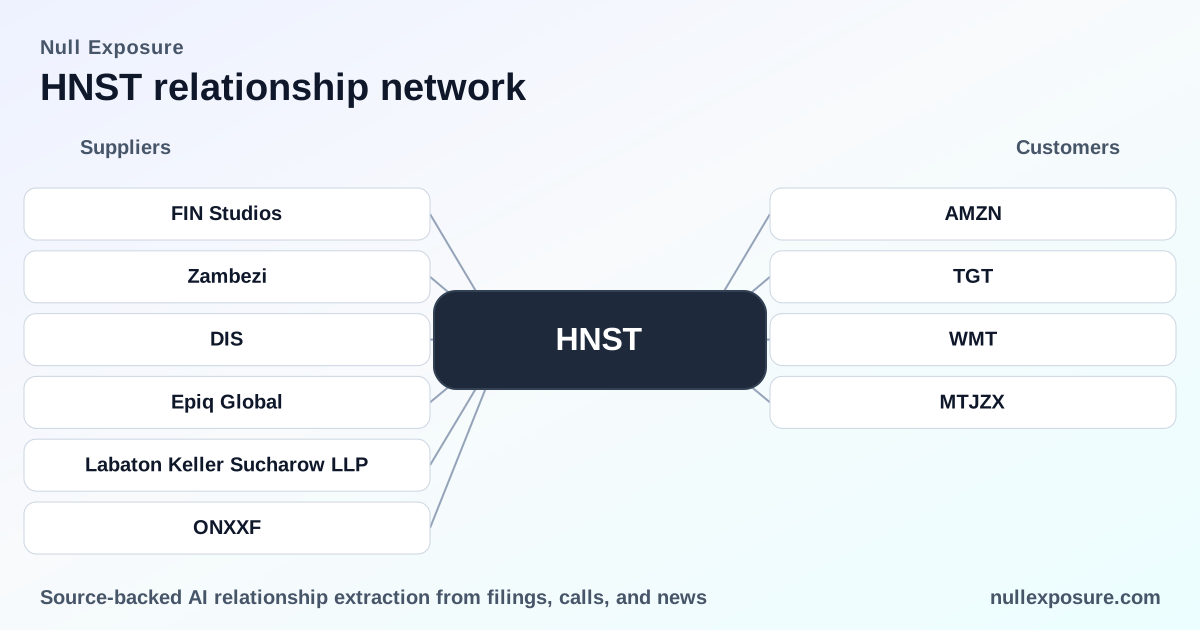
The underlying data set identifies multiple retailer relationships through press releases and the company’s own 10‑K. Below are concise, plain‑English summaries for every relationship recorded in the public results, with source citations.
Amazon (AMZN)
Honest lists Amazon as a national ecommerce channel for its Hydrorich Cream and sanitizing wipes; Amazon is one of the company's three largest retail/ecommerce customers and accounted for a large share of revenue in 2024. According to the company’s 2024 Form 10‑K and multiple February–March 2026 press releases, Honest products are available on Amazon’s storefront and Amazon is a major distribution partner (Form 10‑K 2024; GlobeNewswire and Finviz coverage, Feb–Mar 2026).
Target / Target.com (TGT)
Target represented a significant retail partner in 2024 — the 10‑K reports Target accounted for roughly 30% of Honest’s retail sales — and Honest’s product launches (Hydrorich Cream, scented sanitizing wipes) are promoted for availability on Target.com as well as in stores. Company reporting and press releases in early 2026 confirm ongoing assortment at Target and online placement on Target.com (Form 10‑K 2024; GlobeNewswire and Finviz, Feb–Mar 2026).
Walmart / Walmart.com (WMT)
Walmart is an active retail channel for Honest products and represented approximately 9% of retail sales in 2024, with recent product rollouts promoted for Walmart.com as availability expands. Press and the 2024 Form 10‑K record Honest’s national distribution through Walmart and continuing efforts to broaden online availability (Form 10‑K 2024; GlobeNewswire, Feb–Mar 2026).
MTJZX (symbol shown in filing metadata)
MTJZX appears in the company filing metadata as an identifier linked to Target disclosures in the 2024 Form 10‑K, reflecting how the company reports customer concentration in its SEC filing; treat MTJZX as an internal/information‑system identifier rather than a separate commercial counterparty. This identifier is present in the 10‑K customer concentration table (hnst 2024 Form 10‑K).
Commercial and contractual constraints that shape risk/reward
Investors should price Honest’s revenue and working‑capital profile against a short, spotty contract posture and high retailer concentration:
-
Contracting posture: largely spot and short‑term. Honest’s vendor agreements with Amazon, Walmart and Target are purchase‑order oriented, with explicit short‑notice termination windows for some partners (Amazon: 60 days; Walmart: 30 days); Target’s vendor agreement cited in the filing does not include termination provisions. That structure prioritizes flexibility but exposes Honest to abrupt assortment or allocation changes (company 2024 Form 10‑K).
-
Payment and working capital cadence: short specialist terms. Payment terms are generally 30–45 days, and the company routinely accrues trade promotion and sales incentive liabilities for retail and ecommerce customers, which creates timing and margin pressure around promotional periods (Form 10‑K 2024).
-
Concentration: concentrated retail exposure. In 2024 Honest’s three largest retailers — Target, Amazon and Walmart — accounted for approximately 30%, 34% and 9% of total revenue, respectively, making retail decisions at those customers a material determinant of Honest’s cash flow and inventory turns (Form 10‑K 2024).
-
Channel shift and maturity: DTC being de‑emphasized. Honest is strategically shifting away from lower‑margin DTC fulfillment and reallocating spend to retail marketing and scalable distribution; the company will transition Honest.com away from shipping and fulfillment beyond 2025 and retain it primarily as a marketing and subscription hub (Form 10‑K 2024).
-
Geography: concentrated in North America. Substantially all long‑lived assets and revenue are U.S.‑based, increasing sensitivity to U.S. consumer spending cycles, state tax and privacy law changes, and domestic retail dynamics (Form 10‑K 2024).
-
Critical operational dependencies. Honest’s DTC technology, fulfillment centers and distribution network are operationally critical; disruptions to these systems or to retail fulfillment can materially reduce sales and damage brand equity (Form 10‑K 2024).
Tactical risk vectors investors should monitor
- Retail assortment and SKU allocation at Target, Amazon and Walmart, given the high concentration of revenue in those customers.
- Trade promotion accrual accuracy and the impact of off‑invoice discounts and allowances on reported gross margins.
- Inventory and fulfillment alignment during the transition from DTC fulfillment back to retail and third‑party logistics partners.
- Regulatory and labeling risk for claims on product ingredients (past consumer actions and FDA/FTC scrutiny create downside risk to brand positioning). A mid‑cycle operational shock at any major retailer will have outsized effects on cash flow and working capital given the company’s concentration and short contractual horizons (Form 10‑K 2024; press releases Feb–Mar 2026).
Investment takeaways
- Revenue is retail‑driven and concentrated. Honest monetizes through retail and ecommerce sell‑in and smaller DTC subscription revenue; three retailers accounted for the bulk of 2024 sales, which concentrates execution risk.
- Contracts are transactional rather than long‑term. Purchase‑order style vendor agreements and standard retailer terms create flexibility for buyers and revenue volatility for Honest.
- Operational execution is the gating factor. Inventory, fulfillment and promotion execution determine quarter‑to‑quarter performance more than product innovation alone.
- Valuation should price in concentration and working‑capital risk. Given short payment cycles and promotional liabilities, profitability swings are tied to retailer behavior and promotional cadence.
For investors evaluating counterparties or tracking changes in Honest’s retail footprint, NullExposure provides ongoing counterparty mapping and alerts — see NullExposure homepage for access and subscription options.
Bold decisions about exposure to HNST require conviction in Honest’s ability to stabilize retail placements and compress promotional leakage. The next material signals will be changes in SKU counts and shelf placement at Target, Amazon buy‑box positioning, and Walmart assortment decisions reported in quarterly results and retailer resets (Form 10‑K 2024; press releases Feb–Mar 2026).