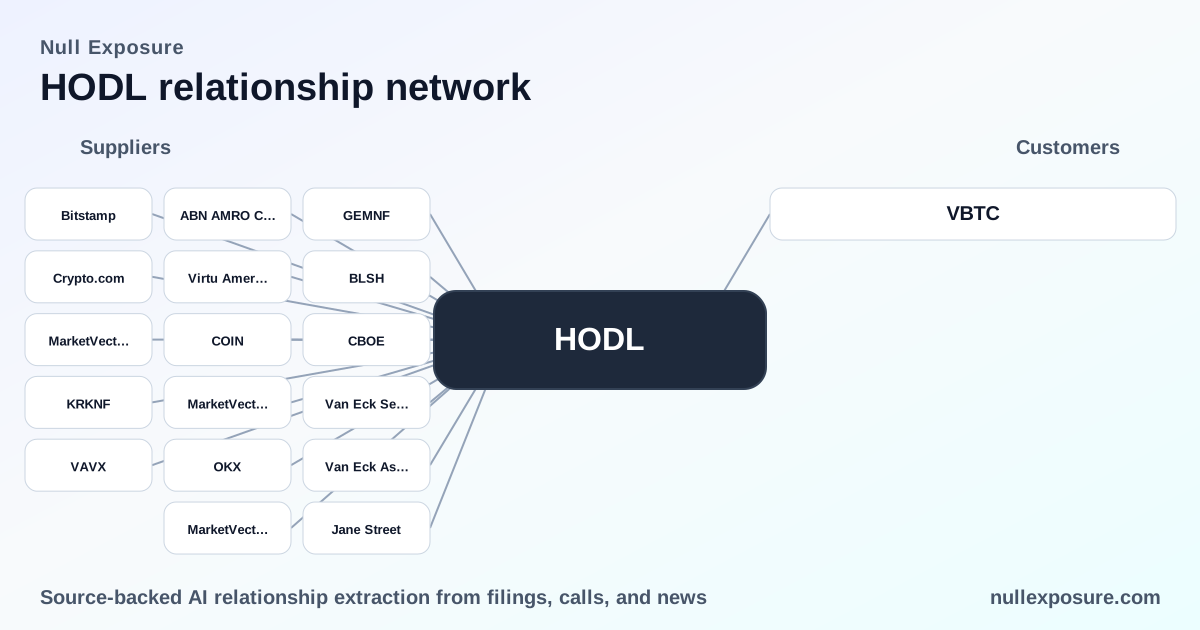
HODL customer relationships: who buys the VanEck Bitcoin Trust and how that shapes risk
Thesis — VanEck’s Bitcoin Trust (ticker HODL) is a passive, sponsor-fee monetized vehicle that generates revenue through asset-based Sponsor Fees while depending on a small set of market intermediaries to create and redeem large Baskets of shares in cash. The Trust does not hold retail customer contracts; it sells liquidity and bitcoin exposure through institutional Authorized Participants and secondary-market investors, and its economics and operational risk profile are determined by the cash-only creation/redemption model, the role of Liquidity Providers, and regulatory exposure in North America and global digital-asset markets. For a concise business-sentiment view and relationship signals, visit https://nullexposure.com/.
How HODL monetizes and how that matters to investors
HODL is a passive exchange-traded trust that tracks bitcoin by taking custody exposure to bitcoin and issuing shares traded on exchanges; the Sponsor collects recurring fees on assets under management rather than charging transactional fees to retail holders. Creation and redemption occur in large blocks (“Baskets”) and are currently conducted solely in cash, which forces reliance on third-party Liquidity Providers to supply or absorb bitcoin during settlement. That cash-only posture concentrates operational and counterparty risk into the Authorized Participant / Liquidity Provider channel and into the Trust’s custodial/cash arrangements, making market-making behavior and AP participation a critical determinant of secondary-market liquidity and tracking performance.
- Key commercial driver: ongoing AUM (fee base) and secondary-market trading spreads, not direct retail billing.
- Operational leverage: the Sponsor’s ability to attract and retain APs and Liquidity Providers controls tradability and NAV arbitrage.
For deal teams and research groups who want forward-looking monitoring, NullExposure maintains relationship-level signals and source references at https://nullexposure.com/.
Relationship snapshots: every result in the record
VanEck Bitcoin ETF (ASX: VBTC) — InvestingNews (Mar 10, 2026)
The ASX-listed VanEck Bitcoin ETF (VBTC) is structured as a feeder fund that invests in the U.S.-listed VanEck Bitcoin Trust (BATS: HODL) rather than holding bitcoin directly, routing Australian investor flows into HODL’s liquidity and fee base. According to InvestingNews (March 10, 2026), VBTC’s ETF structure creates indirect exposure to HODL’s underlying holdings and tracking characteristics.
VBTC (duplicate mention) — InvestingNews (Mar 10, 2026)
The same InvestingNews piece reiterates that VBTC’s ASX product sources its bitcoin exposure through HODL, effectively making HODL the operational counterparty for Australian feeder demand and cross-border AUM inflows. InvestingNews (March 10, 2026) frames VBTC as a vehicle that leverages HODL’s U.S. listing and custody arrangements to serve ASX investors.
Basic Capital distribution tie — Bitget / Basic Capital announcement (May 3, 2026)
Basic Capital, a fintech platform for employer-sponsored retirement plans, will offer a selection of VanEck’s digital asset ETPs through its 401(k)-focused product; the press release mentions HODL among VanEck’s best-known products. A Basic Capital distribution arrangement reported via Bitget (May 3, 2026) signals potential institutional and retirement-plan inflows routed to HODL via intermediary platforms, expanding the Trust’s investor base beyond active traders.
VanEck Bitcoin ETF (VBTC) — The Block (May 3, 2026)
The Block reported that VBTC operates explicitly as a feeder fund into the U.S.-listed VanEck Bitcoin Trust (HODL), confirming that foreign-listed ETF variants are structurally dependent on HODL’s share creation/redemption and custodial mechanics for actual bitcoin exposure. The Block (May 3, 2026) emphasizes that this feeder relationship transfers the Trust’s tracking and operational characteristics to regional distribution products.
Operating-model constraints and what they signal for partners and investors
The Trust’s regulatory filings and public commentary surface several company-level constraints that shape commercial relationships and risk allocation:
- Contracting posture — cash-only subscription model. The Trust conducts creations and redemptions solely in cash; Authorized Participants deposit or receive cash rather than in-kind bitcoin. This is a structural commercial choice that shifts settlement and market-impact risk onto Liquidity Providers and APs rather than the Trust holding in-kind liquidity buffers.
- Spot-market mechanics without in-kind capability. Unlike many commodity ETPs that use in-kind transfers, HODL does not permit in-kind creations or redemptions for bitcoin, increasing transaction friction and potential slippage for APs.
- Framework agreements allocate transaction costs outward. The Authorized Participant Agreement makes APs responsible for transaction costs and slippage on creations/redemptions, which incentivizes APs to internalize funding and execution risk or demand wider fees.
- Counterparty mix skews to individuals and institutional APs. Prospectus language highlights individual U.S. shareholders, retirement plan accounts, and institutional Authorized Participants as principal holders or counterparties, creating a two-tiered investor base: retail secondary-market holders plus concentrated APs who control primary liquidity.
- Geography and regulatory profile: U.S.-centric with global market exposure. Tax, AML, and regulatory clauses center on U.S. law, while price reference and bitcoin execution are exposed to global market prices and operational events.
- Materiality and concentration: trading mechanics are critical. The Trust warns that inability to attract APs or Liquidity Providers will materially impair the arbitrage mechanism and could force premiums/discounts to NAV; AP participation is therefore a critical operational dependency, not a marginal one.
- Commercial maturity and stage signals. The Trust’s model is active in market operation (regular creations/redemptions), while broader merchant adoption of bitcoin payments is still ramping — those macro trends are not direct revenue drivers but affect bitcoin’s market liquidity and volatility.
- Spend and remediation signals. Related industry settlements cited in the record indicate large-dollar exposures in the ecosystem, signaling that counterparty remediation and legacy claims in crypto can drive sizable cash flows across the sector, though not directly a revenue line for HODL.
Investment implications: concise checklist for analysts
- Revenue is predictable but AUM-sensitive. Sponsor Fees scale with assets, so distribution deals (e.g., feeder funds and 401(k) platforms) are directly accretive to fee income.
- Concentrated operational counterparty risk. The Trust’s dependence on APs and Liquidity Providers for cash creations/redemptions is a single point of failure for liquidity; monitor AP participation metrics and market-maker behavior.
- Tracking risk through benchmark and execution. The use of a benchmark rate and cash settlement exposes the Trust to slippage between the benchmark and executable market prices, which can erode investor confidence and AUM.
- Regulatory tail risk is asymmetric. U.S.-centric compliance obligations and global crypto policy changes can materially affect tradability and custody operations.
- Distribution partnerships expand AUM but import platform risk. Feeder funds such as ASX VBTC and retirement-platform distribution through Basic Capital bring incremental fee revenue while routing new complexity into cross-jurisdiction settlement.
Bottom line
HODL’s commercial value is its ability to attract and retain large-scale APs, Liquidity Providers, and feeder distribution partners; its cash-only creation model concentrates operational risk into those relationships. Investors should prioritize monitoring AP participation, Liquidity Provider capacity, and feeder-fund flows (e.g., VBTC and retirement-plan platforms) as leading indicators of fee growth and liquidity resilience.
Explore deeper relationship analytics and up-to-date monitoring at https://nullexposure.com/.