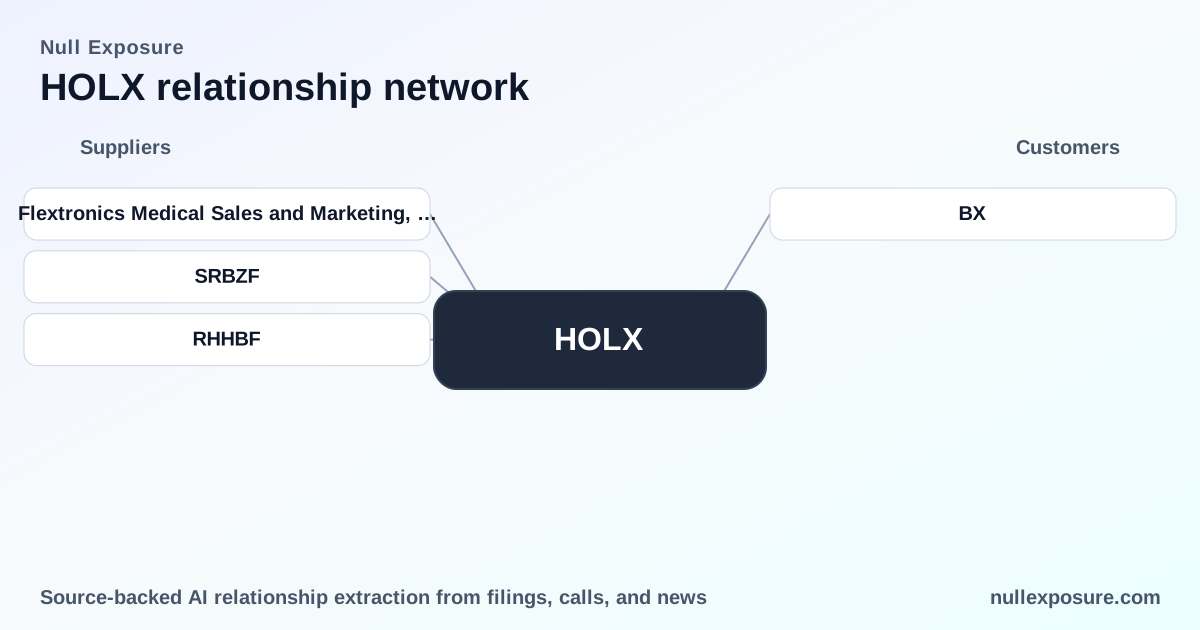
Hologic (HOLX) — customer map and what it means for investors
Hologic monetizes a platform of capital equipment, high-margin disposables (assays, handpieces) and recurring services by placing instruments at customer sites under a mix of usage agreements and service contracts, then recovering economic value through consumables and maintenance revenue. The company’s commercial model combines direct sales, distributor channels and lab services to convert installed bases into predictable service-and-consumables streams—an important structural advantage for investors seeking recurring revenue exposure in medical technology. For deeper signals on counterparty exposures and contract posture, visit https://nullexposure.com/ for proprietary relationship analytics.
Why the customer map matters now
Hologic’s revenue mix reflects a deliberate product-to-consumable playbook: hardware drives high-margin consumables and long-term services. The company frequently places instrumentation at customer sites while retaining title and recognizes related revenue over time as disposables are consumed. That contracting posture yields recurring revenues but also concentrates economic value in attach rates and testing volumes rather than in one-off equipment sales.
Several company-level signals derived from public filings and commentary temper that thesis:
- Contracting mix is skewed toward short-term and usage-based arrangements. The filings note one- to three‑year service contracts and extensive placement of equipment under customer usage agreements, where instrument revenue is recognized over the life of consumable sales rather than at delivery.
- Geography is concentrated in the U.S. Approximately 72–75% of revenues originate in North America, with EMEA and APAC as secondary markets—meaning reimbursement and procurement policy shifts in the U.S. will disproportionately affect results.
- Revenue concentration shows both diversification and vulnerability. No single customer exceeded 10% of consolidated revenue in FY2023–FY2025 (an immateriality signal), yet Diagnostics depends on a relatively small set of large labs—loss of a major lab customer would be meaningful (a materiality signal).
- Relationship roles are multi-modal. Hologic is primarily a seller and manufacturer, but it also serves as a service provider and licensor where embedded leases and service obligations exist; international distribution networks remain important in markets where Hologic sells via third parties.
- Lifecycle dynamics matter. Some product lines are being wound down (for example, the Fluoroscan Insight FD systems were discontinued effective FY2026) while other offerings (Genius, Panther/Panther Fusion) are ramping, suggesting revenues will reallocate across segments rather than grow uniformly.
These signals frame both the upside (recurring consumable economics, software/AI-enabled differentiation) and the primary operational risks (reimbursement, regulatory approvals, attach-rate variability, and cybersecurity demands).
Named relationships flagged in coverage — what investors should know
-
Quest Diagnostics (DGX): Coverage noted that Quest deployed the Hologic Genius Digital Diagnostic System across multiple sites as part of lab automation and digital pathology initiatives, indicating commercial traction for Hologic’s AI-enabled cytology platform (TradingView summary of a Zacks note, May 2, 2026; https://www.tradingview.com/news/zacks:1a2dcb29f094b:0-here-s-how-quest-diagnostics-is-placed-ahead-of-q1-earnings/).
-
Blackstone Inc. (BX): Private markets activity drove a strategic ownership change—Blackstone closed a privatization of Hologic for roughly $18 billion, a transformational event that shifts Hologic’s capital and governance posture and will influence customer strategy and investment cadence under private ownership (InsiderMonkey transcript of Blackstone earnings commentary, FY2026, March 10, 2026; https://www.insidermonkey.com/blog/blackstone-inc-nysebx-q4-2025-earnings-call-transcript-1685221/).
-
VolitionRx Limited (VNRX): VolitionRx announced a co-marketing service agreement with Hologic as part of its human licensing strategy, signaling collaborative go-to-market activity between VolitionRx’s biomarker tests and Hologic’s distribution/commercial channels (InsiderMonkey transcript of VolitionRx earnings commentary, FY2026, May 4, 2026; https://www.insidermonkey.com/blog/volitionrx-limited-amexvnrx-q4-2025-earnings-call-transcript-2-1731678/).
What those relationships imply for revenue quality and strategy
The Quest deployment is the clearest commercial validation of Hologic’s strategy to sell AI-enabled diagnostic platforms that create recurring image- and assay-related revenue, which supports higher long-term margins if adoption scales. The VolitionRx co-marketing agreement demonstrates Hologic’s openness to third-party assay and biomarker partnerships, extending the consumable economy beyond proprietary tests. Blackstone’s acquisition is a governance and capital structure event: privatization typically leads to a sharper focus on margin optimization, installed-base monetization, and potential product rationalization or bolt-on M&A.
Together these relationships underscore a dual path to growth: expand instrument footprint via direct placements (driving consumables) while selectively partnering to broaden assay menus and software services.
Operational constraints and investor risk checklist
Investors should treat the following company-wide constraints as ongoing monitoring items rather than relationship-specific facts:
- Short-term/usage-based contracting dominates revenue recognition. Equipment placements plus embedded operating leases convert upfront capital into downstream recurring revenue; this is a strength for revenue durability but a sensitivity for volumes and attach rates.
- Regulatory and reimbursement exposure is concentrated geographically. The heavy U.S. revenue mix amplifies policy and payor risk; EMEA and APAC provide diversification but require ongoing regulatory compliance (CE Mark, country-specific approvals).
- Materiality is nuanced. Public filings stress that no single customer exceeded 10% of consolidated revenue (supporting diversification), but Diagnostics still depends on a small set of large lab customers—losing one would be meaningful.
- Lifecycle actions introduce transition risk. Product discontinuations and manufacturing consolidations (e.g., closure of Manchester operations) indicate portfolio pruning that produces one-time charges and supply-chain consequences.
- Cybersecurity, compliance and clinical acceptance remain constant headwinds. Evolving laws around data and medical practice can drive incremental costs or change the addressable market.
Key monitoring triggers for the next 12–24 months
- Track Genius adoption metrics and Panther attach rates; these determine the monetization of instrument placements.
- Watch consumable volumes and price realization across Diagnostics and GYN Surgical—these drive gross margins.
- Monitor post-privatization strategy under Blackstone for capex, M&A cadence and any shift from growth to margin optimization.
- Follow co-marketing and licensing deals (like VolitionRx) as potential accelerators of assay menu expansion.
- Keep an eye on reimbursement decisions and regulatory approvals in the U.S. and EMEA that can materially affect demand.
For investors and operators who want a systematic breakdown of counterparties, contract types, geography exposures and a forward-looking watchlist built from filings and news flow, see the full relationship analytics at https://nullexposure.com/.
Bold takeaway: Hologic’s business converts installed instruments into recurring consumable and service revenue—this structure supports predictable cash flow but requires execution on attach rates, regulatory approvals, and strategic alignment under new ownership.