Home BancShares (HOMB): Customer Relationships and the Operating Signals Investors Should Price
Home BancShares operates as a regional bank holding company through Centennial Bank and related subsidiaries, monetizing primarily through net interest income on a large loan book, recurring service and trust fees, and secondary-market mortgage sales; growth comes from a blend of organic originations and acquisitions that expand deposit and loan balances. For investors evaluating customer dynamics, the key lens is how Home balances short‑term funding needs and transactional revenue with a concentrated, real‑estate‑heavy loan portfolio that drives credit cyclicality and capital sensitivity. Learn more at https://nullexposure.com/.
High‑level thesis: revenue drivers and customer economics in one line
Home BancShares earns predictable spread income from a diversified set of loan products while supplementing margins with fee income from deposit services, trust operations, and mortgage/interchange activity; the business is acquisition‑led and regionally concentrated, which amplifies margin upside in normal cycles and downside in localized real‑estate stress.
How the company’s operating model shapes customer relationships
Home’s disclosed customer and contract signals define a mixed contracting posture. Short‑term elements—loan modifications, time deposits maturing within months, repurchase agreements, and transaction fees—create near‑term cashflow visibility and liquidity sensitivity. Long‑term commitments—commercial mortgages amortized over 15–30 years with multi‑year balloons and contractual commercial loan terms—anchor the bank’s interest‑earning assets and credit exposure.
Customer composition is dominated by individuals, small businesses, and municipalities, with public funds forming a material portion of deposits. Geographic concentration in Arkansas, Florida, Texas, Alabama and New York concentrates both collateral risk and deposit stability. Credit and accounting practices are central to operations: allowance for credit losses, loan servicing and the valuation of core deposit intangibles are among the company’s most critical accounting areas. Overall the relationship portfolio is largely active, with non‑performing and restructured loan pools being monitored and gradually wound down.
Direct customer relationships disclosed in filings and commentary
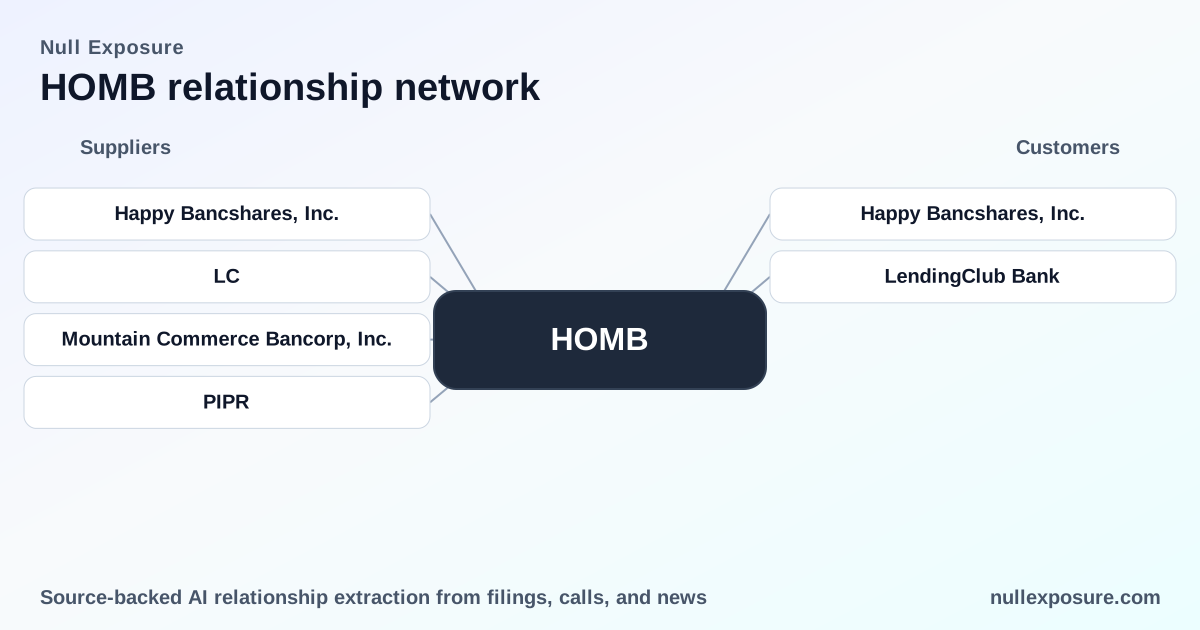
The filings and market commentary explicitly reference three named relationships and recent portfolio actions; each is summarized below with the cited source.
Happy Bancshares, Inc.
Home completed the acquisition of Happy Bancshares on April 1, 2022 and merged Happy State Bank into Centennial Bank, bringing a substantial deposit and loan footprint into Home’s franchise. According to the FY2024 10‑K, the purchased business contributed material assets and deposits at acquisition and the core deposit intangible recorded reflects the acquired customer relationships. (Source: Home BancShares 2024 10‑K, acquisition disclosure and core deposit intangible discussion — FY2024)
LendingClub Bank
Home completed the purchase of the performing marine loan portfolio from Utah‑based LendingClub Bank on February 4, 2022, which expanded the company’s SPF (shore/boat financing) footprint and consumer loan mix. The FY2024 10‑K documents the transaction as a targeted portfolio purchase to bolster specialty consumer loan production. (Source: Home BancShares 2024 10‑K, portfolio purchase disclosure — FY2024)
Mountain Commerce
Management referenced Mountain Commerce in public remarks as an acquired franchise whose employees, customers and shareholders have been integrated to grow Home’s Tennessee presence; the comment was made during the Q1‑2026 earnings call. This is an integration‑oriented relationship intended to expand local lending and deposit coverage. (Source: Q1‑2026 earnings call transcript published on InsiderMonkey — FY2026)
Operating constraints and what they imply for customer economics
Below are company‑level signals from public disclosures that materially affect how Home serves and is paid by its customers.
-
Contracting posture (mixed maturity): Home runs a hybrid model—short‑term liquidity and transactional revenue (monthly account fees, interchange rules, repurchase agreements) coexist with multi‑year lending commitments (commercial loan terms, mortgage amortizations). This structure supports cross‑selling but increases sensitivity to rate cycles and deposit runoff timing.
-
Revenue model composition: Net interest income is the principal earnings engine, supplemented by recurring non‑interest income (service charges, trust fees, mortgage lending income and interchange revenue). Usage‑based fees and portioned management fees create recurring but variable income streams.
-
Concentration risk: Commercial real estate is material (roughly 57% of loans per the 2024 disclosures), translating into concentrated collateral exposure that can produce outsized loan‑loss volatility in local downturns. Geographic concentration in a handful of states intensifies this effect.
-
Counterparty mix and criticality: Retail consumers, small and mid‑market businesses, and public entities form the deposit base and loan demand; public funds are material and deposits are the primary funding source, making deposit flight or uninsured deposit concentration a strategic risk.
-
Accounting and operational maturity: Loan‑loss methodology and allowance for credit losses are treated as critical accounting judgments; servicing of acquired portfolios (SPF, CFG franchises) and integration of acquisitions are operational priorities, with active monitoring through Key Risk Indicators.
-
Relationship stage and asset quality: The portfolio is predominantly active, with pockets of restructured and non‑performing loans that are being managed or wound down; Home discloses periodic charge‑offs and restructurings, including a focused asset cleanup in recent periods.
-
Spend and ticket‑size signals: The company discloses multiple exposure bands—from large borrower concentrations well into the hundreds of millions to mid‑size and small commercial exposures—indicating the bank services a full spectrum of client sizes and retains meaningful large credits on the balance sheet.
Investment takeaways for operators and research users
- Growth through acquisition is a central strategy: acquisitions (Happy, Mountain Commerce, portfolio purchases like LendingClub Bank’s marine loans) materially shift scale, deposit composition and fee income; investors must track integration success and core deposit retention metrics.
- Credit concentration is the principal risk lever: with commercial real estate representing a majority of loan balances, downside scenarios for regional CRE will transmit to earnings and capital more quickly than diversified lenders.
- Fee diversification cushions margin pressure: service charges, trust fees, mortgage and interchange income provide useful offset when net interest margins compress, but many of these are usage‑sensitive and regulated.
- Operational governance matters: allowance estimation, KRI monitoring and branch/market integration execution are critical value drivers; these are explicitly called out as material and critical in the company’s filings.
For a structured view across Home’s customer relationships and how they interact with these operating constraints, visit NullExposure’s homepage to explore deeper signal reporting: https://nullexposure.com/.
Bottom line: Home BancShares is a regional, acquisition‑driven bank with significant CRE concentration, a mixed contract profile that supports both stable and transactional income, and several active integration projects that will determine near‑term credit and deposit outcomes. Investors should underwrite both the upside from deposit‑based funding and cost synergies and the downside from localized real‑estate stress and deposit volatility.