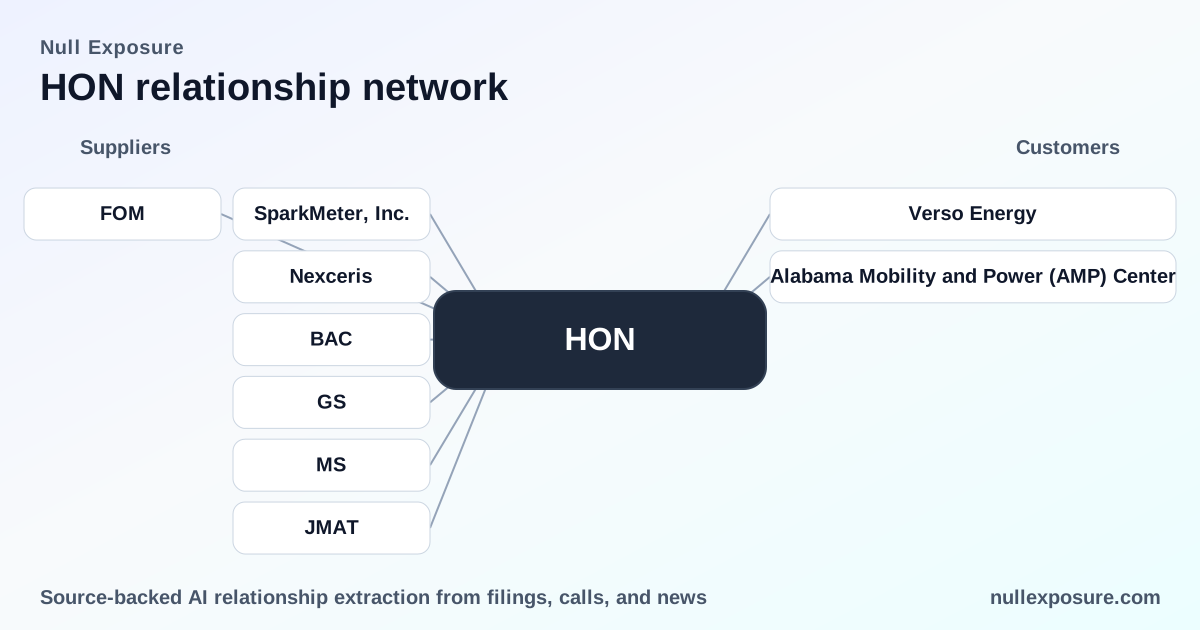
Honeywell (HON): Customer Map and What It Means for Investors
Honeywell is a diversified industrial conglomerate that monetizes through a mix of product sales, long-term engineering contracts, recurring services and software subscriptions, and licensing across aerospace, building automation, industrial automation and energy solutions. The company’s go-to-market blends capital equipment deliveries with multi-year service agreements and software-enabled upsells, generating high-margin aftermarket revenue and predictable backlog. For quick access to our research tools, visit https://nullexposure.com/.
How Honeywell’s customer relationships drive cash flow and risk
Honeywell’s commercial posture skews toward long-term, contract-backed engagements with a substantial services component; the company recognizes revenue both at a point in time for product sales and over time for long-duration performance obligations. The business model is globally distributed and materially dependent on recurring service footprints, government and prime-contractor channels in aerospace, and licensing/IP transactions that convert legacy product lines into third‑party revenue streams. Key model characteristics for investors:
- Contracting posture: Predominantly long-term contracts with milestone and progress billing; roughly half of performance obligations extend beyond one year, producing durable revenue visibility.
- Concentration and criticality: Aerospace and defense prime customers (including U.S. government channels) and major energy project contractors create strategic dependency and elevated contractual scrutiny; these relationships are critical to backlog and aftermarket earnings.
- Revenue mix and margin profile: A deliberate tilt toward services and software increases margin stability over product cycles; services account for a meaningful portion of sales and are recognized over time, supporting recurring cash flow.
- Maturity and portfolio actions: Honeywell continues portfolio simplification via divestitures and licensing (PPE, footwear, PSS, Warehouse & Workflow), signaling a shift toward higher-margin, software-enabled industrial automation and aerospace services.
Customer relationships — concise catalog (by sector)
Below is a compact, investor-ready rundown of every customer/partner mention in the set of sources we reviewed. Each entry is one or two sentences with the source noted.
Aerospace & eVTOL partners
- Archer (ACHR): Archer is partnering with established aerospace suppliers such as Honeywell to lower capital and certification risk on eVTOL programs. A 2025 review in 247wallst highlighted Honeywell’s supplier role in Archer’s development program (article, Apr 2025).
- Vertical Aerospace (EVTL): Vertical’s Valo eVTOL integrates Honeywell fly‑by‑wire and other systems, positioning Honeywell as a systems supplier on new urban air mobility platforms. Needham and company releases cited Honeywell as a core partner in 2025–2026 product integration (Finviz/VerticalMag, 2025–2026).
- Lilium / HONIV (HONIV): Honeywell supplies avionics and electric propulsion components for advanced air taxi mockups, showing continued OEM avionics placement. Aviation press described Honeywell’s avionics role at EBACE 2023 (Aviation News, 2023).
- Regal Rexnord (RRX): Regal Rexnord developed electromechanical actuators for eVTOLs through a partnership with Honeywell, reflecting Honeywell’s role as a platform integrator for OEM partners. Management commentary on product partnerships noted this cooperation (InsiderMonkey transcript, 2026).
Aftermarket, MRO and distribution partners
- Innovative Solutions & Support (ISSC): ISSC purchased asset lines and licensed Honeywell avionics and generator product lines, reporting meaningful revenue contributions from those Honeywell-origin assets. Company filings and press coverage documented $30m in asset deals and the contribution to FY2025–FY2026 results (TradingView/SimpleWall/press, 2025–2026).
- VSE Corporation (VSEC / VSE): VSE expanded its license and distribution relationship with Honeywell, securing aviation distribution agreements and growing aftermarket throughput. Press reporting on VSE cited expanded Honeywell license activity and aviation contract wins (SimplyWall/TikR/press, 2026).
- ScanSource (SCSC): ScanSource launched dedicated support programs to bolster channels selling Honeywell products, demonstrating Honeywell’s reliance on third‑party distribution channels in select markets (TradersUnion press, 2026).
- Genuine Parts Company (GPC): GPC is an early adopter in Australia of Honeywell Voice for Manhattan Active, indicating Honeywell’s channel-led deployment of warehouse voice solutions (PR Newswire, 2026).
Energy, LNG and industrial project customers
- NextDecade (NEXT) / Rio Grande LNG: Honeywell will supply LNG process technology and equipment for Rio Grande LNG units under an arrangement with Bechtel, with revenue converting as projects hit FID and execution milestones in 2026. Financial coverage and Honeywell comments tied NextDecade/Rio Grande to 2026 revenue schedules (Yahoo Finance/TikR, Apr–May 2026).
- Commonwealth LNG: Honeywell signed integrated LNG pretreatment and liquefaction technology agreements for Commonwealth LNG in Louisiana, executed with Bechtel as engineering contractor. Management highlighted these wins on the Q1 2026 earnings call transcript (InsiderMonkey, May 2026).
- Bechtel / Bechtel Energy Inc: Bechtel is the engineering partner on major LNG projects where Honeywell supplies process technology, underscoring Honeywell’s role as technology vendor to EPC contractors. The Q1 2026 earnings call referenced the Bechtel relationship (InsiderMonkey, May 2026).
- Qatar Energy LNG: Honeywell secured rebuild and expansion project work with Qatar Energy LNG, reinforcing high‑margin services and software opportunities in large-scale energy customers (Earnings call transcript coverage, May 2026).
- Dangote Petroleum Refinery and Petrochemicals: Dangote selected Honeywell for advanced technology services and proprietary catalysts to expand refinery capacity, establishing Honeywell as a technology and licensing supplier in major downstream projects (Earnings call transcript, May 2026).
- Weatherford (WFRD): Weatherford signed an MOU with Honeywell to deploy advanced emissions management and integrated SCADA solutions, reflecting ties in decarbonization services (WorldOil, Dec 2023).
- Verso Energy: Verso’s selection of UOP eFining technology (a Honeywell UOP offering) increases clean fuel output capacity and signals continued UOP market traction (TikR coverage, Feb 2026).
Licensing, IP transfers and divestitures
- Innovative Aerosystems: Innovative Aerosystems acquired an exclusive perpetual license from Honeywell for aircraft power generating systems, illustrating Honeywell’s strategy of monetizing IP through perpetual licenses (SimplyWall.St report, May 2026).
- HEI‑A (HEICO): HEICO acquired Honeywell ELT product line rights via licensing transactions, showing Honeywell’s use of licensing to transition mature product lines (SEC filing, 2026).
- AstroNova (ALOT): AstroNova’s Aero segment reported royalties to Honeywell that will expire under acquisition-era contractual terms, indicating legacy royalty streams are phasing out (AstroNova 10‑K commentary, FY25).
- VSE (again): VSE’s expanded license relationship and distribution agreements with Honeywell were reported as material operational developments (SimplyWall/TikR, 2026).
Corporate buyers of divested businesses
- Rocky Brands (RCKY): Rocky Brands acquired Honeywell’s performance and lifestyle footwear business (Muck Boot, XTRATUF, Servus) for $230m in 2021, representing Honeywell’s historical non-core consumer divestitures (press releases and filings, 2021).
- Brady Corporation (BRC): Honeywell agreed to sell its Productivity Solutions and Services business to Brady for $1.4bn in cash, part of a broader portfolio simplification push (press coverage and company announcements, May 2026).
- American Industrial Partners: Honeywell agreed to sell its Warehouse & Workflow Solutions business to American Industrial Partners in an all-cash transaction to sharpen focus on core automation businesses (FacilitiesDive/ConstructionOwners coverage, May 2026).
Other strategic and government relationships
- Boeing (BA): Honeywell maintains exposure to aerospace primes like Boeing, reinforcing its strategic position in commercial and defense supply chains (earnings and industry reports, 2026).
- TAI (Turkish Aerospace Industries): Media reported that Honeywell provided engines for TAI’s light utility helicopters via a Rolls‑Royce joint arrangement, evidencing international OEM partnerships (CAAT/press commentary, 2024–2026).
- Alabama Mobility and Power (AMP) Center: Honeywell equipment was delivered to AMP as part of battery manufacturing transformation projects, consistent with Honeywell’s involvement in advanced manufacturing initiatives (Ritzau announcement, 2026).
- Redwire (RDW): Redwire leveraged Honeywell’s optical payload terminal for QKDSat, showing Honeywell’s components role in space communications and secure satellite payloads (CyprusShippingNews, Apr 2026).
- Eni (E): Eni’s Ecofining technology was developed with Honeywell UOP, reflecting long-term co-development and licensing in biofuels (regional press on biorefinery projects, 2026).
- Duke Energy (DUKB): Honeywell tested energy storage hardware at Duke Energy’s microgrid test bed, indicating collaboration on energy storage and grid solutions (UtilityDive, 2021).
Investment implications and closing takeaways
- Durable revenue: Honeywell’s mix of long-term contracts, installed base services and licensing yields recurring, higher-margin revenue streams and backlog that supports medium-term guidance.
- Portfolio focus: Recent divestitures and licensing deals demonstrate active portfolio simplification, reallocating capital toward software, aerospace services, and industrial automation.
- Concentration & execution risk: Dependence on large energy projects, aerospace primes and government channels concentrates execution risk but also raises barriers to entry and margin defensibility.
- Actionable point: For investors evaluating Honeywell’s customer relationships, prioritize exposure to aerospace aftermarket contracts, large EPC energy wins (LNG/UOP), and the cadence of divestiture proceeds that can fund buybacks or reinvestment.
For a more detailed relationships crawl and ongoing signals on HON customers, explore our platform at https://nullexposure.com/.
Bold takeaways above summarize the commercial levers that will determine Honeywell’s near‑term cash conversion and strategic optionality.