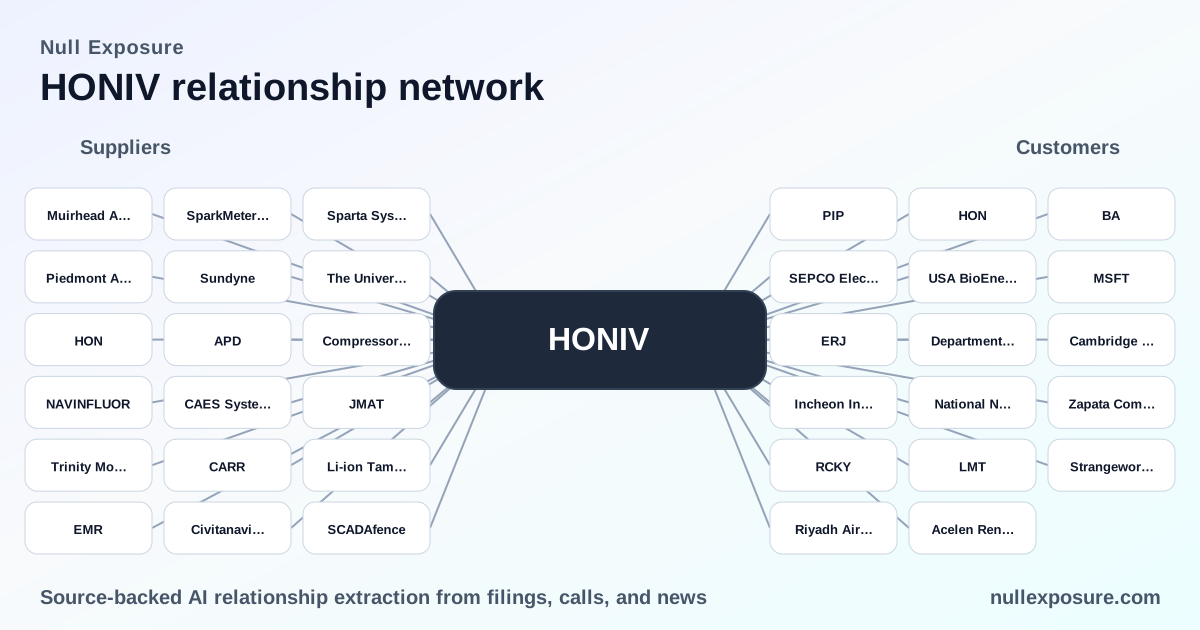
Honeywell (HONIV) — Customer Map and Commercial Implications
Honeywell operates across aerospace, industrial automation, building controls and energy technologies and monetizes through equipment sales, software and licensing, long-term services and government-management contracts. Revenue mixes include high-margin software and licensing, recurring aftermarket maintenance and large upfront engineering contracts, creating steady cash flow from a diversified customer base while preserving exposure to project timing and capital cycles. Learn more about how we track counterparty relationships at https://nullexposure.com/.
Why these customer links matter to investors
Honeywell’s go-to-market couples capital-intensive equipment sales with recurring software and services, producing durable margins when installed bases and long-term contracts are intact. That structure drives three investor-relevant characteristics: contracting posture, concentration and criticality. Below I summarize those company-level signals before cataloguing the customer relationships investors should watch.
- Contracting posture: Honeywell wins a mix of fixed-price engineering contracts, licensing deals and long-term operations contracts (including government management). This mix supports predictable recurring revenue from services while leaving project timing exposure in engineering and construction work.
- Concentration: Broad end-market coverage (aerospace, defense, airports, energy, industrial) reduces single-counterparty concentration, but several large, strategic contracts—government labs and major refineries/airports—create single-name operational leverage.
- Criticality: Systems sold frequently deliver mission-critical outcomes (defense platforms, nuclear lab operations, refinery process control, airport operations), which strengthens switching costs and aftermarket revenue potential.
- Maturity and recurring economics: Established industrial product lines plus software/platform partnerships create a mix of mature hardware cash flows and growing recurring software/license revenue.
If you want a focused view of how individual counterparties feed these company-level signals, see the relationship map below — or explore our broader coverage at https://nullexposure.com/.
Customer relationships: names, commercial roles, and source notes
-
Protective Industrial Products (PIP) — Honeywell sold its Personal Protective Equipment business to Protective Industrial Products in May 2025, transferring an entire product line that reduces Honeywell’s exposure in PPE while consolidating PIP’s market position. (PR Newswire, transaction notice — https://www.prnewswire.com/news-releases/honeywell-acquires-sparkmeters-data-platform-and-software-technologies-to-strengthen-its-portfolio-of-utility-solutions-302534611.html)
-
PIP (duplicate entry) — The same PR Newswire item reiterates the May 2025 completion of the PPE sale to PIP; investors should treat the PIP relationship as a completed divestiture rather than an ongoing customer contract. (PR Newswire — https://www.prnewswire.com/news-releases/honeywell-acquires-sparkmeters-data-platform-and-software-technologies-to-strengthen-its-portfolio-of-utility-solutions-302534611.html)
-
Embraer (ERJ) — Honeywell holds OEM and aftermarket relationships with Embraer; a 2022 press item shows Honeywell (via Muirhead Avionics) supporting Embraer ERJ cockpit control displays through an exclusive global repair agreement, reinforcing Honeywell’s positioning in aviation MRO. (Skies Magazine press release, FY2022 — https://skiesmag.com/press-releases/muirhead-avionics-signs-exclusive-global-repair-agreement-with-honeywell-for-erj-cockpit-control-displays/)
-
ERJ (duplicate entry) — The Embraer/ERJ mention repeats the same global repair agreement context; treat as confirmation of Honeywell’s repair-and-support revenue channel for regional jets. (Skies Magazine — https://skiesmag.com/press-releases/muirhead-avionics-signs-exclusive-global-repair-agreement-with-honeywell-for-erj-cockpit-control-displays/)
-
Lanaz Company / HON — Honeywell’s UOP supplied licensing, basic engineering design and modular units to Lanaz in Erbil for refinery modernization, underscoring Honeywell’s role as licensor and engineering partner in international refinery projects. (Euro-Petrole, FY2022 — https://www.euro-petrole.com/lanaz-to-use-honeywell-technology-to-modernize-iraqi-refinery-to-produce-cleaner-burning-fuels-n-i-23257)
-
SEPCO Electric Power Construction Corporation (SEPCO) — Honeywell secured a major systems contract with SEPCO to supply control, telecoms, safety and security systems for Aramco’s King Salman shipyard project, illustrating Honeywell’s large-scale industrial systems business in energy and infrastructure. (Energy Industry Review, FY2021 — https://energyindustryreview.com/construction/honeywells-systems-selected-for-one-of-the-worlds-largest-shipyards/)
-
RCKY / Rocky Brands Inc. — In a mid‑March transaction, Rocky Brands purchased a Honeywell footwear portfolio for $230 million, showing Honeywell’s strategic divestiture of non-core consumer assets and Rocky’s expansion via acquisition. (WWD footwear news, FY2021 — https://wwd.com/footwear-news/shoe-industry-news/rocky-brands-jason-brooks-honeywell-deal-details-1237701766/)
-
Rocky Brands Inc. (duplicate) — The Rocky Brands entry repeats the transaction detail; investors should note the $230 million sale as a concrete example of portfolio pruning. (WWD — https://wwd.com/footwear-news/shoe-industry-news/rocky-brands-jason-brooks-honeywell-deal-details-1237701766/)
-
Riyadh Airports Company — Honeywell signed an MoU with Riyadh Airports to co‑develop integration and automation solutions at King Khalid International Airport, highlighting Honeywell’s strategic airport systems engagements in the Middle East. (ACI Asia-Pacific press release, FY2021 — https://www.aci-asiapac.aero/media-centre/news/honeywell-and-riyadh-airports-sign-memorandum-of-understanding-to-explore-the-use-of-integration-and-automation-technology-at-king-khalid-international-airport)
-
Incheon International Airport — Incheon implemented Honeywell’s NAVITAS platform as an integrated airport system, a reference customer case that demonstrates Honeywell’s commercial footprint in airport operations software. (Airport Industry News, FY2021 — https://airportindustry-news.com/honeywell-expands-navitas-software-suite-to-enhance-airport-operations/)
-
USA BioEnergy — Honeywell will supply Experion PKS distributed control and safety systems for USA BioEnergy’s new Texas advanced biorefinery to produce sustainable aviation fuel, reinforcing Honeywell’s role in renewable fuels process control and automation. (Honeywell press release, 2024/2026 context — https://www.honeywell.com/us/en/press/2024/09/honeywell-and-usa-bioenergy-to-partner-on-automation)
-
LMT / Sikorsky / Boeing (DEFENSE PROGRAM) — Honeywell is selected as engine supplier for the Sikorsky‑Boeing DEFIANT X (a future long-range assault aircraft), reflecting strategic defense supply relationships with prime contractors and OEMs. (The Defense Post, FY2022 — https://thedefensepost.com/2022/02/17/sikorsky-boeing-honeywell-engine-defiantx/)
-
Boeing (BA) — The DEFIANT X program citation also names Boeing as prime partner where Honeywell supplies propulsion systems, underlining aerospace OEM revenue channels. (The Defense Post, FY2022 — https://thedefensepost.com/2022/02/17/sikorsky-boeing-honeywell-engine-defiantx/)
-
Sikorsky (duplicate LMT context) — Sikorsky’s role in the DEFIANT X program ties directly to Honeywell engine supply and demonstrates platform-level integration with prime aerospace manufacturers. (The Defense Post, FY2022 — https://thedefensepost.com/2022/02/17/sikorsky-boeing-honeywell-engine-defiantx/)
-
National Nuclear Security Administration (NNSA) — An extended NNSA award keeps Honeywell’s National Technology and Engineering Solutions of Sandia managing Sandia National Laboratories, highlighting long-term government operations revenue and high barrier-to-entry services. (ExecutiveBiz reporting on DOE contract awards, FY2022 — https://www.executivebiz.com/articles/honeywell-subsidiary-to-continue-management-operation-of-sandia-lab)
-
Department of Energy — DOE-confirmed contract extensions keep Honeywell‑affiliated entities operating Sandia through April 30, 2027, emphasizing multi‑year government contract exposure and associated revenue visibility. (ExecutiveBiz / DOE notice, FY2022 — https://www.executivebiz.com/articles/honeywell-subsidiary-to-continue-management-operation-of-sandia-lab)
-
Acelen Renewables — Acelen’s selection of Honeywell’s Ecofining licensing for SAF and renewable diesel marks the 50th site to license Honeywell renewable fuels technology, indicating scale in Honeywell’s refinery licensing business. (Honeywell news, FY2024 — https://www.honeywell.com/us/en/news/2024/01/renewable-fuels-milestone-50-facilities-to-power-the-future-of-fuels)
-
Microsoft (MSFT) / Cambridge Quantum / Zapata / Strangeworks — Honeywell’s quantum systems are accessible through Microsoft Azure Quantum and other partner platforms (Cambridge Quantum, Zapata, Strangeworks), situating Honeywell within a broader software and cloud ecosystem for high-end computing customers. (Honeywell press release on quantum performance, FY2021 — https://www.honeywell.com/us/en/news/2021/07/honeywell-sets-another-record-for-quantum-computing-performance)
-
MSFT (duplicate) — The Microsoft platform reference is reiterated in Honeywell communications about quantum accessibility, reinforcing the commercial channel for Honeywell’s advanced-computing offerings. (Honeywell, FY2021 — https://www.honeywell.com/us/en/news/2021/07/honeywell-sets-another-record-for-quantum-computing-performance)
-
Cambridge Quantum Computing / Zapata Computing / Strangeworks (individual entries) — Each partner is listed as an integration point for Honeywell’s quantum systems, evidencing Honeywell’s go-to-market via ecosystem partners for software and compute access. (Honeywell press release, FY2021 — https://www.honeywell.com/us/en/news/2021/07/honeywell-sets-another-record-for-quantum-computing-performance)
Investment implications and final takeaways
- Honeywell’s commercial mix reduces revenue cyclicality through recurring service contracts and licensing while retaining project timing exposure in engineering and construction scopes.
- Strategic government contracts (Sandia/NNSA, DOE) and large infrastructure projects (Aramco shipyard, airports, refineries) create durable revenue lines with high switching costs.
- Divestitures (PPE, footwear portfolio) show active portfolio management and a tilt toward higher-margin industrial and software businesses.
For institutional-grade counterparty mapping and to monitor changes in real time, review our platform at https://nullexposure.com/ — we track contract-level signals and public transactional notices that feed this type of analysis.