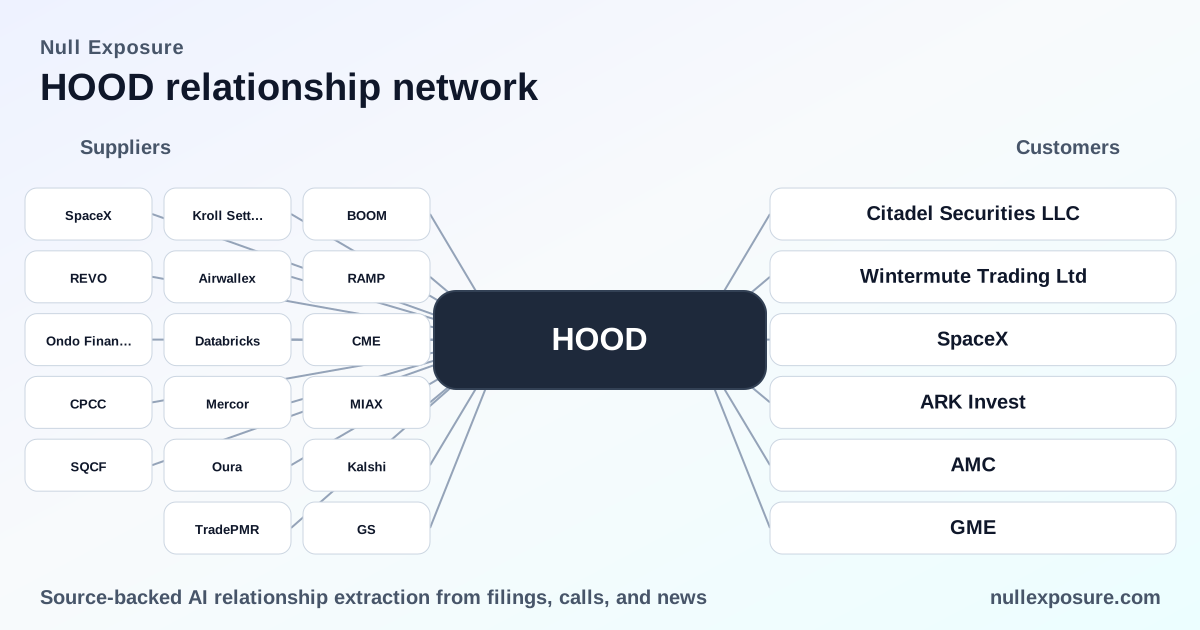
Robinhood’s customer map: who pays, who partners, and why investors should care
Robinhood Markets monetizes a high-frequency, low-margin retail brokerage engine: transaction-based fees from market makers, net interest spread on customer cash and margin, and subscription revenue (Robinhood Gold), supplemented by payments and credit products and crypto custody services. The business mixes short‑term, usage‑based cash flows (per‑trade rebates collected monthly) with recurring subscription revenue, creating strong revenue leverage to active retail volumes but also concentrated counterparty exposure and regulatory sensitivity. Learn more about how we surface these customer relationships at https://nullexposure.com/.
How Robinhood gets paid — a concise operating thesis
Robinhood’s core monetization is straightforward and predictable in structure: orders placed by individual customers are routed to market makers; Robinhood collects per‑trade consideration (transaction rebates) that settle short term and are billed in arrears, while Gold subscribers pay a flat recurring fee recognized ratably. Net interest and lending products (margin, securities lending, Cash Sweep) create a second leg of earnings that scales with balances and interest rates. The company’s contracting posture is therefore a mix of short‑term operational receivables (market maker rebates), subscription agreements with explicit renewal mechanics, and usage‑based clearing/settlement activity. That mix makes revenue highly sensitive to customer activity, counterparty concentration, and regulatory change.
Customer counterparties that matter now
Below I walk through every relationship surfaced in the public record. Each entry includes a plain‑English take and a concise source note.
Wintermute Trading Ltd (FY2024)
Wintermute is identified in Robinhood’s customer concentration disclosures as a market maker that accounted for a meaningful share of transaction‑based revenue in 2024. Wintermute rose to a near‑double‑digit contributor to transaction revenue in the most recent reporting period. According to Robinhood’s 2024 Form 10‑K, Wintermute is listed in the customer concentration schedule for FY2024.
Citadel Securities LLC (FY2024)
Citadel Securities is a long‑standing market‑making counterparty and, per Robinhood’s filings, consistently accounted for roughly double‑digit percentages of transaction‑based revenue (about 12% in 2024). Investors should treat Citadel as a core revenue hinge in the PFOF/transaction‑rebates model. Source: Robinhood 2024 Form 10‑K customer concentration disclosures.
ZONE / CleanCore Solutions (FY2025) — partnership on crypto treasury
CleanCore Solutions (ZONE) announced a partnership positioning Robinhood as its institutional custodian for a Dogecoin treasury and associated liquidity arrangements, highlighting Robinhood’s role as a custody and settlement partner for corporate crypto treasuries. See the Globe and Mail and AccessWire reports from March 2026 describing the CleanCore–Robinhood arrangement: https://www.theglobeandmail.com/... and https://www.accessnewswire.com/....
SpaceX (FY2026) — IPO distribution role under consideration
Media reporting indicates Robinhood is pursuing a lead retail distribution role should SpaceX pursue a public offering, which would put Robinhood in a strategic placement role for a very large retail allocation. Source: Sahm Capital analysis (Feb–Mar 2026) discussing Robinhood’s potential SpaceX distribution role.
BNY Mellon (BK) (FY2026) — infrastructure and trustee collaboration
A transcript of a BNY Mellon earnings call notes that BNY will manage national program infrastructure and collaborate with Robinhood, which will provide brokerage and initial trustee services—a sign that Robinhood is anchoring parts of issuer/retail programs where custody and distribution are required. Source: BNY Mellon Q1 2026 call transcript on Investing.com (May 2026).
Opendoor (OPEN) (FY2026) — shareholder participation via Robinhood’s Say platform
Opendoor directed investors to participate in its Q1 2026 shareholder activity through Robinhood’s Say Technologies platform, signaling that companies are using Robinhood channels to reach and engage retail holders. Source: Opendoor press release on GlobeNewswire (Apr 2026).
HODU (FY2026) — leveraged ETF using swaps exposure to Robinhood stock
A Globe and Mail note describes HODU as a leveraged ETF that obtains exposure to Robinhood’s equity via total return swaps, making Robinhood both the underlying and an indirect counterparty in derivative‑based retail products. Source: Globe and Mail press coverage (Mar 2026).
ARK Invest (FY2026) — large institutional investor flows
Market commentary (TradingView posts) highlights expectations that ARK Invest and similar active funds (Cathie Wood) have been building positions in HOOD, a factor that can amplify retail momentum when institutions add to positions. Source: TradingView idea thread (Mar 2026).
GameStop (GME), AMC (FY2026) — retail trading extremes on the platform
Trading commentary notes that meme‑style trading in names like GameStop and AMC has been highly active on Robinhood, illustrating the platform’s role as the retail epicenter of episodic volume spikes that drive both revenue and operational strain. Source: TradingView commentary (Mar 2026).
Operational constraints and what they signal to investors
-
Short‑term receivables and settlement risk: Robinhood’s market‑maker revenues are usage‑based and settled monthly, and the company discloses unsecured intraday receivables tied to crypto and market‑maker counterparties. That creates a day‑to‑day liquidity dependency on clearing partners. This is a company‑level signal drawn from the 10‑K language about short‑term receivables and settlement cadence.
-
Subscription stability vs. volume sensitivity: Gold subscription revenue is recurring and recognized ratably, providing stabilizing cash‑flow, but it is still a smaller portion of total revenue versus transaction‑based income; growth in Gold subscribers (up materially in 2024) moderates—but does not eliminate—activity exposure.
-
Concentration and regulatory criticality: The 10‑K explicitly lists Citadel and Wintermute as individually meaningful market makers, which is a concentration risk; the company also flags PFOF and transaction‑rebate practices as high‑regulatory‑scrutiny items, a critical operating constraint.
-
Geographic posture: Substantially all revenue remains U.S.‑centric, but Robinhood is expanding in the U.K., EU, and globally (Robinhood Wallet in 150+ countries), which increases jurisdictional regulatory complexity.
-
Counterparty mix: The customer base is overwhelmingly individual retail investors, which amplifies the sensitivity of revenue to consumer sentiment and market volatility; large enterprise relationships exist but are secondary to the retail base.
Bottom line for investors
- Key positive: Robinhood’s product mix scales with activity—when retail trading surges, transaction‑based revenues and securities‑lending flows can expand rapidly, delivering outsized near‑term growth.
- Key risks: counterparty concentration (Citadel, Wintermute), regulatory scrutiny of PFOF/transaction rebates, and short‑term settlement exposures are the primary operational hazards. These are company‑level constraints reflected in the 2024 Form 10‑K and subsequent reporting.
- Monitor: changes to execution disclosure rules, market‑maker revenue splits, and inflows/outflows tied to meme‑stock episodes; also track the growth and stickiness of Gold subscribers as a stabilizing metric.
If you want a structured, investor‑grade view of Robinhood’s counterparty map and risk exposures, visit https://nullexposure.com/ for our methodology and deeper dashboards.