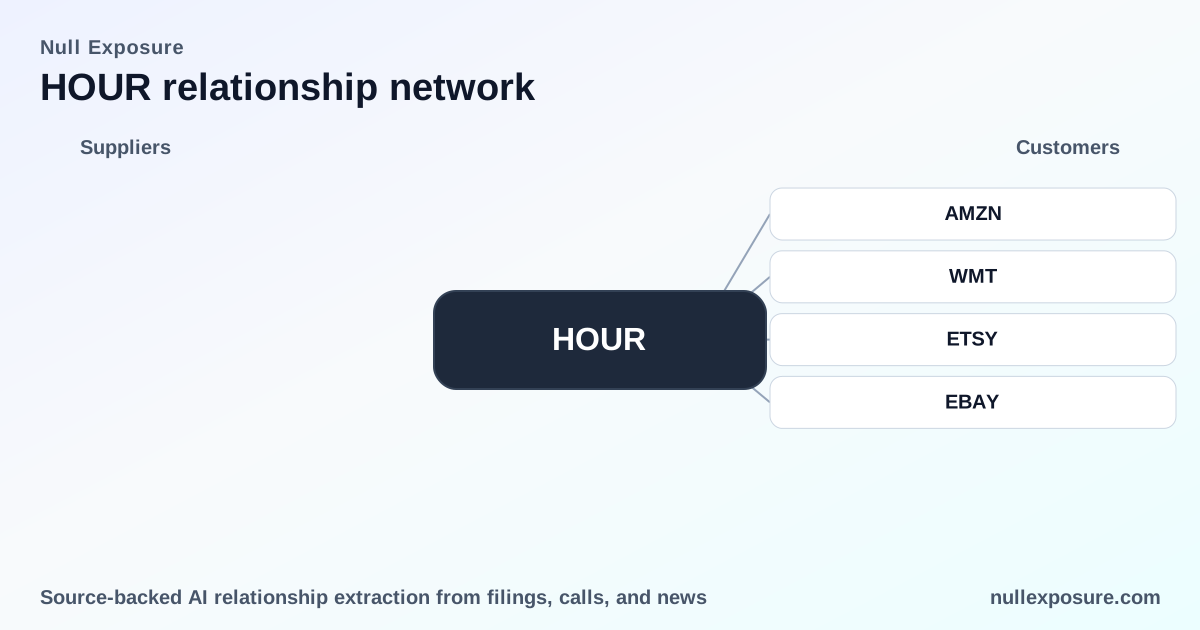
Hour Loop’s customer footprint: a concentrated seller that is slowly diversifying
Hour Loop is a U.S.-based online retailer that buys wholesale inventory and resells it across third‑party marketplaces, generating the bulk of revenue from platform sales and booking revenue at the point of sale. The company monetizes through retail margin on merchandise, marketplace reimbursements (notably Amazon reimbursements for lost/damaged items), and incremental scale effects from order volume; Amazon is the primary channel driving cash flow and profits. For strategic diligence, see more at https://nullexposure.com/.
Why the customer map matters to investors
Hour Loop’s operating leverage is directly tied to channel distribution and contract posture. Short collection cycles and point‑in‑time revenue recognition support working capital, but heavy dependence on a single marketplace creates asymmetric downside if platform economics change. The company’s 2024 revenue base and order growth underpin the business, yet concentration is the defining risk factor.
Operating model constraints that shape the relationships
- Contracting posture — short-term, point sales: The company treats customer order confirmations as contracts executed at order placement, with revenue recognized at a point in time and typical collection periods reported as less than seven days. This makes the customer relationship operationally transactional rather than long‑term contractual. (Company 10‑K, FY2024)
- Spot economics dominate: Order-level confirmations and point-in-time recognition imply a spot, transaction-led revenue model, not subscription or recurring contract revenue.
- Customer type and geography: Hour Loop sells directly to individual consumers in the U.S. market (its stated TAM is U.S. internet users), though it reports a small but growing international revenue line. North America is the commercial focus; international sales are currently immaterial to core revenue.
- Materiality profile: At the corporate level, several disclosures mark channel concentration as critical — the company generated 99% of net revenue through Amazon in 2023–2024, making that relationship functionally critical to Hour Loop’s results. Other operational risks (returns, inventory forecasting, data security) are material to margins and reputation but are company‑level exposures rather than tied to a single counterparty.
- Relationship stage and role: The company’s relationships are active and mature with Amazon (since 2013); other channels are in either early ramp or minimal contribution stages as Hour Loop pursues multi‑channel expansion.
Channel relationships — concise, sourced takeaways
Below are the customer/channel relationships reflected in public reporting and market coverage. Each entry is a plain‑English summary with a source.
-
Amazon / AMZN / Amazon.com
Hour Loop has generated virtually all of its revenue through Amazon, with filings and coverage stating roughly 98–99% of sales flow via the Amazon Marketplace; this dependence drives both cash‑flow visibility and concentrated platform risk. According to the company’s FY2024 disclosures and subsequent investor coverage, Amazon reimbursements for lost/damaged merchandise are an important profit component. (Company Form 10‑K, FY2024; Zacks coverage reported via ShareWise, Dec 2025; GlobeNewswire Q3 2025 release) -
Amazon Canada
Hour Loop has expanded listings into Amazon’s Canadian marketplace as part of a multi‑channel growth push, helping the firm capture additional demand outside the U.S. domestic storefront. (CEO commentary and press release coverage in 2026 noting expansion to Amazon Canada; The Globe and Mail / company press releases, FY2026) -
Amazon Mexico
Management cited Mexico as a targeted channel in multi‑market expansion, contributing to the company’s broadened customer reach outside the U.S. core. (Company commentary reported via The Globe and Mail and press releases, FY2026) -
Walmart / WMT
Walmart is a currently negligible revenue channel, with the company reporting minimal sales via Walmart and noting Walmart operations are in early stages of contribution relative to Amazon. (Company SEC filings summarized in TradingView and ShareWise reporting, FY2025) -
eBay / EBAY
Hour Loop lists products on eBay as part of its multi‑channel strategy; eBay contributes only a small share of revenue relative to Amazon but is cited as a growth channel in 2025–2026 reporting. (Company press releases and market coverage via GlobeNewswire and Bitget, FY2025–FY2026) -
Etsy / ETSY
The company added listings on Etsy during its channel expansion, though disclosures and reports indicate Etsy sales remain minor versus Amazon. (Company press releases and coverage cited in Bitget and QuiverQuant reporting, FY2025–FY2026)
What the constraint signals imply for investors
- Commercial concentration is the dominant risk/return driver. The explicit disclosure that 99% of revenue flowed through Amazon in 2023–2024 is a corporate‑level signal of dependency and the primary source of operational leverage. Where Amazon terms change (fees, buy box dynamics, or reimbursement policy), Hour Loop’s margin profile will move materially.
- Short collection and point-of-sale recognition improve cash conversion. The company’s reported collection period of under seven days gives Hour Loop a cash advantage in inventory turns, supporting a wholesale/resale model that cycles capital rapidly.
- Customer base is retail‑individual centric and U.S.‑centric. The firm’s go‑to‑market is individual consumers in North America; international lines exist but are small. That positioning makes the business sensitive to consumer discretionary cycles and U.S. sales tax/regulatory developments.
- Maturity of the Amazon relationship is long standing; alternate channels are nascent. Amazon is a mature, high‑importance channel (operating since 2013) while Walmart/eBay/Etsy expansions are incremental — improving diversification but not yet reducing concentration materially.
Investment implications and headline risks
- Positive: High order volume, short working‑capital cycles, and a wholesale margin model produce predictable near‑term cash flows when platform economics are stable; recent order growth supported revenue increases in 2024. (Company reported revenues and order metrics, FY2024)
- Negative: Platform concentration is existential risk — a shift in Amazon’s policies, referral fees, reimbursement practice, or buy‑box mechanics would directly compress profitability. Diversification into Walmart, eBay, Etsy and foreign Amazon marketplaces reduces single‑point exposure over time but currently remains insufficient to offset the Amazon dependency.
- Operational: Inventory forecasting, returns and data security are material operational risks that affect margins and reputation; Amazon’s handling of reimbursements is explicitly called out as a substantial portion of profits in filings.
- Governance and liquidity context: Hour Loop’s market metrics (public market capitalization, thin institutional float and high insider ownership) imply limited public liquidity and concentrated shareholder control — factors investors should weigh alongside operational concentration.
For a focused look at channel concentrations, risk factors and the company’s filings, investors can review the company reports and press coverage summarized here. For a company‑level view and further relationship analytics, visit https://nullexposure.com/.
Bold takeaway: Hour Loop is a high‑conviction, platform‑dependent reseller — attractive for its cash conversion and order scale, but carrying pronounced single‑channel concentration risk until multi‑channel revenue becomes material.