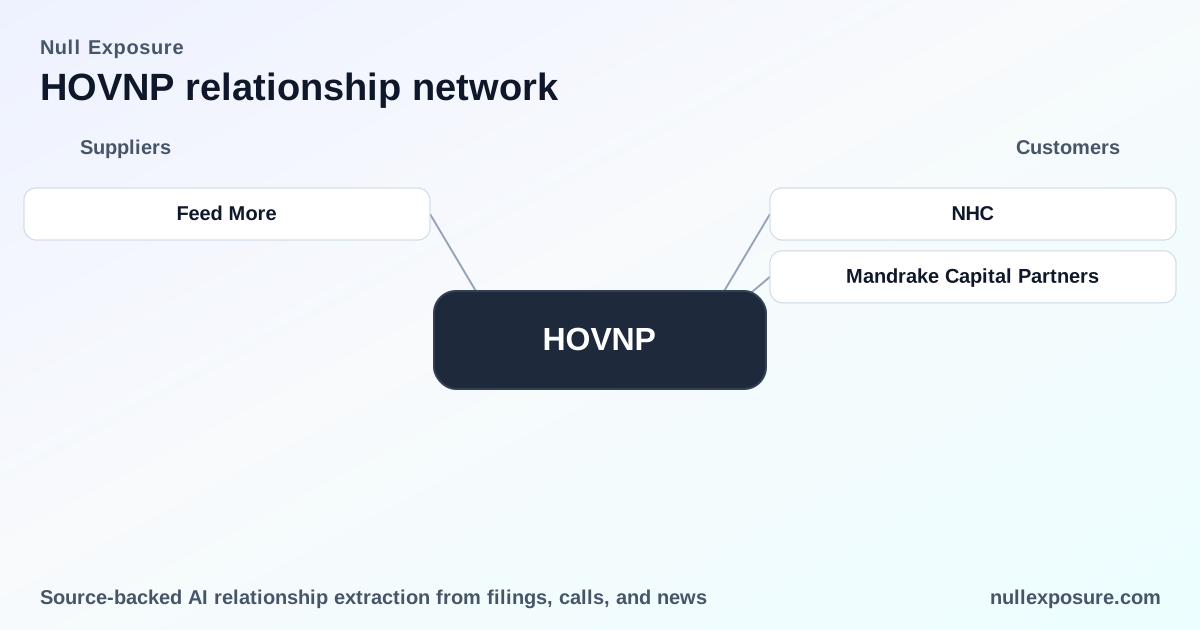
HOVNP: Customer Relationships Drive a Core Homebuilding Franchise with Financial Services Upside
Hovnanian Enterprises operates a vertically integrated homebuilding business that designs, builds, markets and sells single‑ and multi‑family homes across the United States, and monetizes through direct home sales, ancillary land sales and a financial‑services arm that originates and quickly sells mortgage loans and provides title services. Homebuilding accounts for roughly 97% of consolidated revenues, while the financial services segment acts as both a customer convenience and a short‑duration funding channel that accelerates sales and reduces time in inventory. For investors evaluating customer relationships, the combination of high revenue concentration in home sales, short project cycles and active mortgage pipeline defines both the growth lever and the primary risk vector for HOVNP. Visit https://nullexposure.com/ for additional coverage and intelligence on corporate counterparties.
Why this matters: Hovnanian’s customer footprint is dominated by individual homebuyers and localized market exposure across 13 states, but commercial and government relationships—along with strategic international tie‑ups—introduce diversification and execution complexity that investors must price into valuation and credit analysis.
How Hovnanian’s customer model actually works
Hovnanian sells completed and quick‑move‑in homes directly to retail buyers through on‑site sales offices and digital channels, collects deposits and executes construction on contracts that are typically completed within 6–9 months. The company’s mortgage subsidiary funds loan originations and then sells those mortgages into the secondary market within weeks, limiting on‑balance‑sheet interest rate exposure but leaving limited repurchase and warranty liabilities. Hovnanian supplements for‑sale activity with Build‑For‑Rent arrangements and land‑banking structures to manage working capital and inventory turnover. These operational characteristics produce a cash conversion profile tied tightly to local housing demand and mortgage availability.
Constraints that shape partner exposure and commercial posture
- Contract posture: short‑term dominant. Contracts with buyers and mortgage arrangements are structured for rapid conversion; loan commitments and mortgage sales are executed within short windows (commonly 60 days or less) and home construction cycles are under 12 months. This enforces a cadence of frequent transactions rather than long‑dated recurring revenue streams.
- Longer‑dated financing exists but isn’t the customer relationship paradigm. Hovnanian issues long‑term notes and accesses institutional capital (for example, senior notes due 2031 and 2033), but those instruments are financing tools rather than customer contracts.
- Counterparty concentration toward individuals. The bulk of commercial interaction is with individual homebuyers—Hovnanian’s backlog and delivery volumes confirm a retail‑centric revenue base—making demand sensitivity to mortgage rates and local economics the primary exposure.
- Government and large enterprise touchpoints are secondary but meaningful. Letters of credit, performance bonds and municipal receivables connect Hovnanian to local governments for infrastructure obligations; institutional counterparties appear on the mortgage resale side as investors and forward purchasers.
- Geographic concentration within the U.S. defines execution risk. Operations span 13 states and 27 markets with material exposure to Arizona, California, Texas, New Jersey, Florida and other state ecosystems; regional shocks to employment, insurance costs or taxing regimes translate directly into sales momentum and margin pressure.
- Materiality: homebuilding is critical. With approximately 97% of consolidated revenue derived from homebuilding, any disruption to buyer demand or construction capacity is directly material to earnings and liquidity.
- Spend scale is large. The financial services pipeline was reported at $404.4 million in process as of October 31, 2025, and the company operates with debt facilities and note issuances in the hundreds of millions, indicating counterparty engagements that range from retail deposits to institutional investors.
These constraints together describe a business that is transactional, regionally concentrated, retail‑driven and materially sensitive to interest rates and local policy—a profile investors must weigh when assessing partner exposures and long‑term resilience. For more detailed corporate relationship intelligence, see https://nullexposure.com/.
Active counterparties and what they mean for investors
This section inventories the customer relationships surfaced in recent coverage and explains their strategic implications.
NHC — strategic partnership in Saudi projects
Hovnanian’s K. Hovnanian M.E. signed a memorandum of understanding to deepen cooperation with Saudi Arabia’s National Housing Company (NHC), creating joint working groups to pursue NHC projects in support of Vision 2030 and community development initiatives. This arrangement signals an extension of Hovnanian’s geographical reach into large‑scale government projects through a local partner and positions the firm to participate in institutional housing programs. (GlobeNewswire press release, May 15, 2025: https://www.globenewswire.com/news-release/2025/05/15/3082589/12793/en/Hovnanian-Enterprises-Announces-Strategic-Partnership-Between-K-Hovnanian-M-E-and-Saudi-Arabia-s-NHC.html)
Mandrake Capital Partners — build‑and‑sell for rental conversion
Local reporting describes a transaction in which Hovnanian will construct housing units and then sell those units to Mandrake Capital Partners, which will operate them as rental properties. This illustrates the company’s increasing use of institutional sale channels such as build‑for‑rent and third‑party landlords to convert inventory and accelerate cash realization—an operational lever that reduces exposure to retail demand volatility while creating counterparty concentration risk with institutional buyers. (Richmond BizSense, May 6, 2025: https://richmondbizsense.com/2025/05/06/developer-drops-13m-for-former-feed-more-hq-near-the-diamond/)
Operational implications and investment risks
Hovnanian’s model creates several investor‑level headlines: rapid inventory turnover and short mortgage hold periods reduce interest‑rate duration but transfer liquidity and repurchase risk to the mortgage resale market; the heavy tilt toward individual buyers makes revenue volatile with mortgage rate cycles; and regional concentrations concentrate downside in specific states. Institutional transactions such as the Mandrake sale or the NHC MOU provide diversification of exit channels and geographic expansion, but they also require execution capabilities outside the core domestic retail model.
Key risk drivers to monitor in ongoing diligence:
- Mortgage sales and repurchase exposure—track forward commitments and investor makeup.
- Backlog quality and geographic mix—the company reported a backlog of 1,517 homes totaling roughly $0.9 billion (Oct. 31, 2025) and expects most to close within six‑nine months.
- Warranty, buyback and legal contingencies—limited representations on loan sales and construction warranty costs are recorded at close and can be material.
- Local policy and insurance cost shifts—changes to tax deductibility or insurance premiums materially affect affordability in key markets.
Bottom line and what to watch next
Hovnanian is a core homebuilder that leverages a financial‑services arm to speed sales and manage funding; its customer relationships are densely retail but strategically supplemented by institutional and government partners. The NHC MOU represents selective geographic expansion via partnership, while the Mandrake transaction signals continued use of institutional buyers to manage inventory. For investors, the next material inflection points are mortgage market access, regional demand trends across the 13‑state footprint, and the cadence of institutional sale programs that alter margin and cash conversion dynamics.
For deeper counterparty mapping and ongoing updates on HOVNP counterparties, visit https://nullexposure.com/ for detailed publisher reports and relationship intelligence.