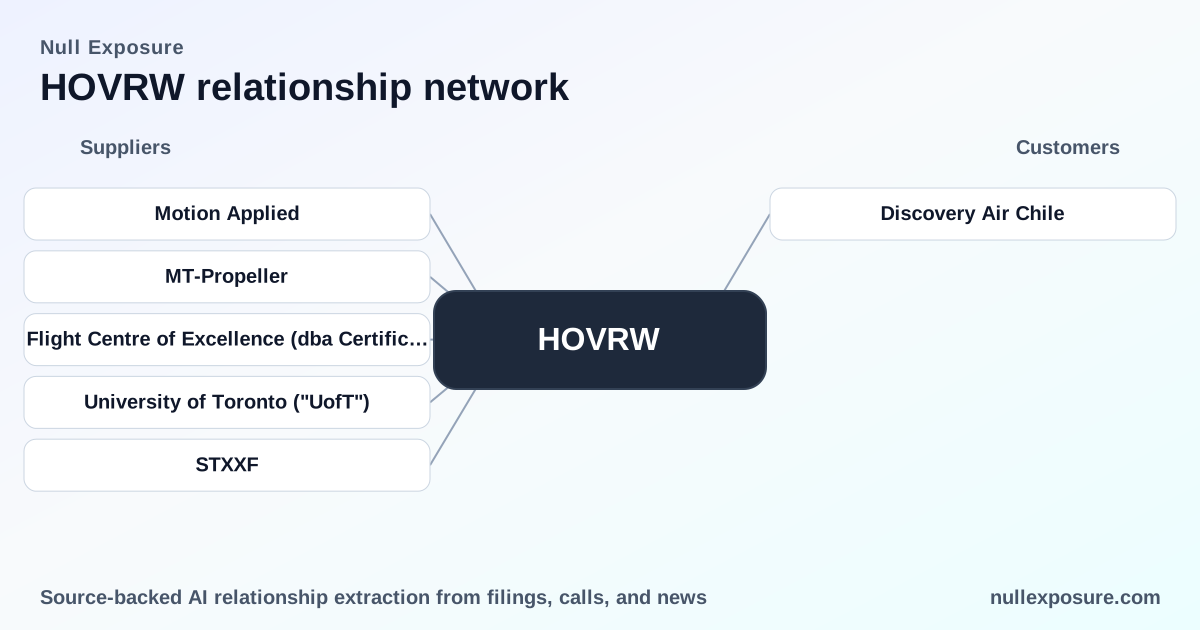
New Horizon Aircraft (HOVRW): customer map and commercial implications
New Horizon Aircraft builds and intends to monetize the Cavorite X7 through direct aircraft sales, leasing/operating agreements, and licensing of its patented fan‑in‑wing technology, supplemented by government research and development contracts and service offerings tied to Regional Air Mobility (RAM). The company is pre‑revenue on aircraft deliveries, is advancing certification and prototype programs, and is positioning licensing and leasing as near‑term monetization routes while production and type certification remain years away. For a concise view of HOVRW customer signals and contractual posture, see the NullExposure homepage: [https://nullexposure.com/].
What the customer ledger currently shows
HOVRW’s public customer footprint is slim but directional: one reported commercial LOI with an air operator/lessor and multiple corporate disclosures that establish commercial pathways (sales, licensing, subscription financing, and government R&D receipts). The transactions on record reflect a company that is transitioning from R&D into commercial prospecting and pre‑sales commitments rather than a mature fleet operator.
Discovery Air Chile — a lease letter of intent
Horizon Aircraft signed a letter of intent with Discovery Air Chile to lease five Cavorite X7 hybrid eVTOL aircraft, with delivery anticipated by 2028. This arrangement is framed as a lease commitment rather than a firm purchase, positioning Discovery Air Chile as an early operator/lessor customer in Latin America. (Source: Airport‑Technology, March 10, 2026.)
All customer and counterparty signals investors should parse
Below is a concise, company‑level synthesis of every customer‑facing relationship signal disclosed in filings and media; these are operational signals, not isolated metrics.
- Licensing and IP monetization — The company plans to manufacture aircraft and license its patented fan‑in‑wing technology to OEMs, establishing a non‑equity monetization channel for intellectual property that could scale independently of manufacturing output. Evidence: company disclosure describing licensing of core innovations.
- Subscription and private placements — HOVRW executed subscription agreements in December 2024 that issued Class A ordinary shares and Series A preferred shares, and amended those agreements in January 2025; these financing contracts are part of the company’s capital strategy to fund development. Evidence: Form 8‑K filings (Dec 18, 2024; Jan 10, 2025).
- Framework sales capacity — The company filed an S‑3 shelf in March 2025 and established a Capital on Demand™ Sales Agreement, giving HOVRW a ready pathway to raise up to $6.25 million through at‑the‑market sales. Evidence: Form S‑3 and related prospectus (March 2025).
- Government counterparty exposure — HOVRW explicitly targets both civilian and military markets and receives payments from government entities for R&D deliverables, indicating the government channel is a deliberate revenue source. Evidence: company filings describing NATO and other government customers and R&D payment flows.
- End‑customer mix — The company signals a multi‑channel go‑to‑market: third‑party air carriers, lessors, individual consumers and NATO military customers are all positioned as potential buyers or lessees of the Cavorite X7. This creates diversified commercial targets but also raises go‑to‑market complexity. Evidence: public filings describing intended buyer categories.
- Geographic scope — HOVRW positions its product for North America, Europe and global markets, with explicit certification routes through Transport Canada (TCCA) followed by FAA and EASA processes for U.S. and EU commercialization. Evidence: filings on certification strategy and regulatory engagement.
- Relationship maturity and staging — Company disclosures reflect multiple stages: prospect (industry outreach and expressions of interest), active (ongoing market research agreements and a small shelf sale program), pilot (test and prototype phases), and at least one terminated financing arrangement (Forward Purchase Agreement mutually terminated Nov 1, 2024). Evidence: contract and financial notes in filings.
- Product and channel segmentation — The business is centered on hardware (the Cavorite X7) and manufacturing, with services and licensing expected to complement aircraft sales; initial use cases cited include medevac, firefighting and disaster relief. Evidence: product and segment disclosures.
- Spend and scale signals — For at least one market research contract, the fixed fee fund was modest (USD 366 approved; USD 235 received as of May 31, 2025), indicating early‑stage, low‑ticket government or partnership pilots rather than large, high‑value procurement today. Evidence: Market Research Investment Agreement financials.
How the constraints translate into an operating profile
These disclosed constraints create a consistent operating model: early‑stage, asset‑heavy hardware development with diversified monetization channels but limited near‑term revenue from aircraft deliveries. Practical implications:
- Contracting posture: a mix of licensing agreements, subscription financing and framework sales arrangements suggests HOVRW is balancing non‑dilutive IP monetization with equity financing and at‑the‑market liquidity.
- Concentration and counterparty risk: pre‑revenue status removes immediate concentration risk, but the company’s future exposure will depend on a relatively small set of airline/lessor customers and government contracts once deliveries begin.
- Criticality: RAM market development is critical to HOVRW’s ability to generate aircraft sales; the company itself discloses that failure of the RAM market to develop would significantly impair growth prospects.
- Maturity: the relationship mix (prospects, pilots, a small number of active research contracts and a lease LOI) positions HOVRW in a commercialization incubation phase rather than revenue maturity.
Investment implications — opportunities and risks
HOVRW is a classic pre‑revenue aerospace investment: high optionality, high execution risk.
- Opportunities: licensing of unique HOVR fan‑in‑wing IP and early leasing commitments (Discovery Air Chile LOI) create multiple potential revenue streams ahead of mass production.
- Risks: delivery and certification timelines (TCCA→FAA→EASA), substantial negative operating results (EBITDA reported at -$22,442,000), and the need for ongoing financing dilute near‑term upside; the company’s beta is elevated (3.62) and float indicates concentrated retail‑oriented ownership dynamics (shares float ~32.4M).
- Operational execution: manufacturing scale‑up, certification, and customer acceptance are the gating factors; failure to certify or to deliver on cost targets would materially impair margins and demand.
Key takeaways for operators and investors:
- Discovery Air Chile LOI validates commercial demand pathway for leasing, not direct sales, and sets a 2028 delivery horizon. (Airport‑Technology, March 10, 2026.)
- Licensing and government R&D receipts provide near‑term non‑delivery revenues while the aircraft remains in certification. (Company filings: subscription agreements Dec 2024, S‑3 shelf March 2025, market research agreement Jan 2022.)
- Certification and manufacturing scale are the principal execution risks; the company expects no material sales before TCCA type certification is issued. (Company risk disclosures.)
If you want a consolidated, transaction‑level feed and continuous monitoring of HOVRW customer activity, NullExposure tracks these developments and historic filings in one place: [https://nullexposure.com/].