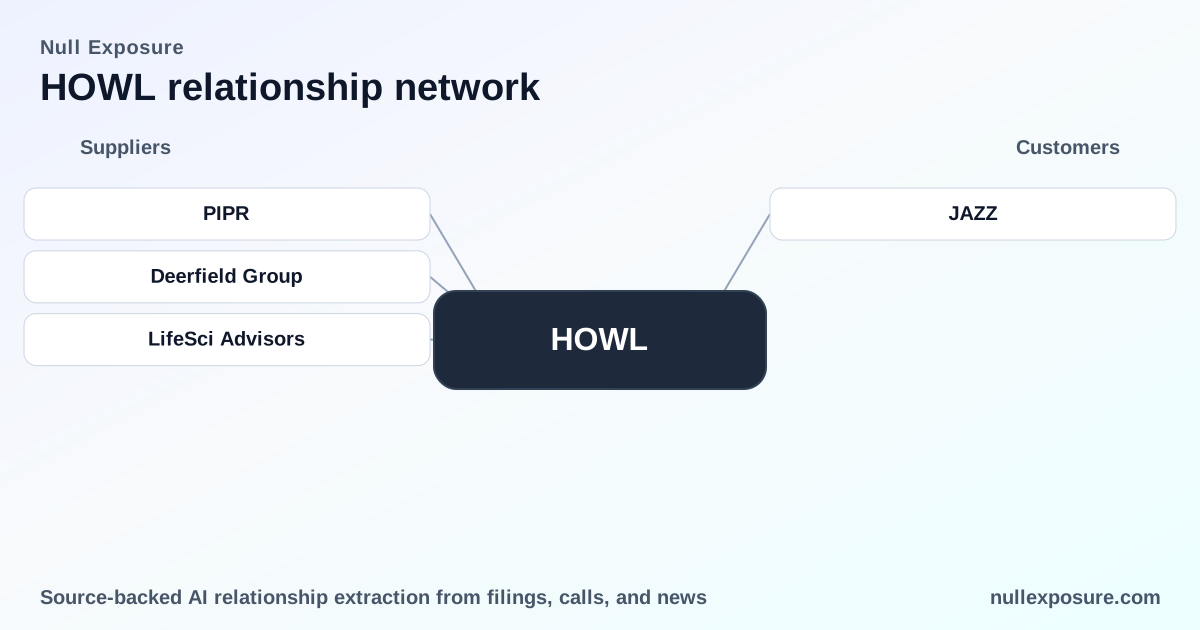
Werewolf Therapeutics (HOWL): customer relationships, revenue mechanics, and what investors should watch
Werewolf Therapeutics develops conditionally activated immunotherapies and monetizes through a mix of collaborations, licensing deals with upfront payments and milestone/royalty upside, and the prospect of future product sales and royalties once approvals are achieved. Current cash receipts include upfront collaboration consideration and modest sublease income; material commercial revenue is not yet present, so the company’s valuation depends on successful clinical progress, partner monetization events, and third‑party reimbursement dynamics.
Explore an at‑a‑glance view of partner economics and contract mechanics at https://nullexposure.com/ for investors who model deal-driven biotech value creation.
What the public record says about HOWL’s customers and partners
-
Jazz / JAZZ — According to MedCity News (April 2022), Dublin‑based Jazz Pharmaceuticals paid a $15.0 million upfront fee to obtain global rights to Werewolf’s WTX‑613 program, representing a classic licensing-style collaboration that provided immediate non‑dilutive cash to Werewolf. (MedCity News, April 2022)
-
Jazz Pharmaceuticals — The same MedCity News coverage confirms the $15.0 million upfront for global rights to WTX‑613, recorded in FY2022 disclosure of the transaction terms and reflected in subsequent collaboration revenue recognition. (MedCity News, April 2022)
Both relationship entries in the public results reference the same licensing transaction; the repeated listings reflect the same customer counterparty described under two naming variants. The MedCity News article is the primary external coverage cited for these entries.
How the company structures and recognizes deal economics
Company disclosures make the contracting posture clear: licensing arrangements are the dominant form of partner engagement, and Werewolf treats license + associated research services as a combined performance obligation when necessary. Upfront fees have been recorded as deferred revenue and recognized over time using an input‑based (cost‑to‑cost) method tied to research service delivery. The public filing language also states that sales‑based royalties and milestone receipts are recognized when the related sales occur or when specific performance obligations are satisfied, which preserves upside for product commercialization while deferring revenue recognition until measurable events occur. (Company filings; revenue recognition language and deferred revenue recorded as of December 31, 2024)
Company‑level constraints that shape customer economics
These are company‑level signals derived from regulatory and financial disclosures rather than attributes of any single partner.
-
Contract type — Licensing dominates. Multiple excerpts describe exclusive and non‑exclusive licenses combined with R&D services, and the accounting treatment treats those combinations as single performance obligations when the license is not distinct from service delivery.
-
Payment timing — Shorter financing horizon for some arrangements. The company does not treat contracts as having a significant financing component when customer payment and delivery are within one year, which supports near‑term revenue recognition patterns in many service elements.
-
Counterparty mix — Government and individual stakeholders matter. Filings emphasize government payors (Medicare/Medicaid) and individual patients/physicians as critical parties for future commercialization and reimbursement, signaling that reimbursement policy and payer behavior are core risk drivers.
-
Geography — North America and EMEA are the principal markets. Regulatory approvals and pricing regimes in the U.S. and EU are repeatedly cited; the company expects to pursue approvals and to face region‑specific pricing and HTA requirements.
-
Materiality — Current commercial revenue is immaterial, but commercialization outcomes are critical. The company reports no product sales to date and recognizes prior collaboration deferred revenue as completed in 2024, yet filings also stress that payor coverage and pricing will be critical to future product value.
-
Roles and segments — Werewolf acts as seller, licensor and R&D service provider while retaining manufacturing and commercialization exposure. Disclosures show the company recognizing collaboration revenue, performing research services, and accounting for manufacturing costs in its reporting.
-
Relationship lifecycle — Mix of terminated and prospective relationships. Some arrangements (notably a lease/sublease and a collaboration transfer) are recorded as terminated or completed, while core product‑commercialization relationships remain at prospect or active stages depending on regulatory progress.
-
Spend bands — Deals range from sub‑million to multi‑tens of millions. Public excerpts reference upfronts in the $10m–$100m band (the $15.0M Jazz upfront) and sublease cash flows in the $100k–$1M band, which provides context for near‑term cash receipts versus longer‑term upside.
Financial and operational implications for investors
-
Revenue profile: Werewolf currently reports zero product revenue and recognized collaboration revenue that declined sharply year‑over‑year (e.g., $19.9M in 2023 vs. $1.9M in 2024 for one collaboration line), reflecting the front‑loaded nature of licensing receipts and subsequent recognition patterns tied to service delivery. (Company consolidated revenue notes)
-
Cash flow drivers: Upfront licensing payments and milestone structures provide short‑term cash; long‑term value depends on achieving regulatory approvals, capturing favorable coverage and adequate reimbursement, and converting royalty streams into recurring revenue.
-
Regulatory and payer risk: Filings emphasize the significance of Medicare drug price negotiation programs, inflation‑linked rebates, and state pricing laws as potential downward pressure on eventual product pricing and margins. Payer policy is a core determinant of realized commercial value.
-
Concentration and criticality: While no single customer dominates current revenue (historical collaboration revenue has been limited), the company’s value is highly concentrated in the success of a small number of lead programs (WTX‑124, WTX‑330 and others), so partner decisions around licensing and development materially influence valuation.
Operational monitoring checklist for the next 12–24 months
- Track additional milestone receipts or licensing transactions and the accounting treatment (deferred vs. recognized).
- Monitor clinical readouts and regulatory timelines for lead programs that unlock royalties and product sales.
- Watch U.S. and EU payer policy developments (Medicare negotiations, HTA implementation) that will determine pricing ceilings.
- Observe any new collaborations that shift risk — whether Werewolf retains commercialization rights or transfers them to partners, which changes revenue mix from royalties to upfronts/fees.
Midway summary and resource: for a structured, investor‑grade view of partner economics and to follow new disclosures from Werewolf, see https://nullexposure.com/.
Bottom line for investors
Werewolf’s near‑term value is transaction‑driven and binary: upfront licensing and milestone economics provide limited cash runway, while long‑term upside depends on regulatory success and payor coverage for a narrow set of lead programs. The Jazz licensing event (documented in industry coverage) is a concrete example of how the company converts program value into cash, but investors must price in clinical execution risk and increasingly aggressive government payer interventions when modeling future revenues.
Key watchpoints: upcoming clinical milestones, new licensing transactions, deferred revenue movement in quarterly filings, and U.S./EU reimbursement policy changes.