Helport AI (HPAI): Customer relationships that reveal a tightly controlled, early‑stage commercial play
Helport AI sells AI software and deployment services into logistics and adjacent verticals, monetizing through platform access, productized deployments (including AI‑enabled support teams) and transactional or subscription contracts tied to integrations and training. Revenue is already meaningful for a sub-$50m market cap company — $34.9m TTM with positive net margin — but ownership concentration and customer mix reflect an early commercial posture that investors must parse carefully. For a deeper audit of partner exposures and investor‑facing relationships visit https://nullexposure.com/.
Why customer relationships matter for HPAI equity investors
Helport is positioning its software as an operational lever: clients obtain platform access, APIs and training, while Helport supplements that with bespoke support teams for product rollouts. The company reports $34.86m revenue TTM, a 5.3% profit margin, and 22.4% quarterly revenue growth (YOY), signaling commercial traction but still thin operating margins (1.93% operating margin TTM). Ownership is heavily insider‑tilted (about 79% insiders, 0.5% institutions), which increases governance and liquidity considerations for public investors.
The customer relationships (each result in the record)
Below I list every relationship record surfaced in the results and summarize its relevance in plain English, with source context.
-
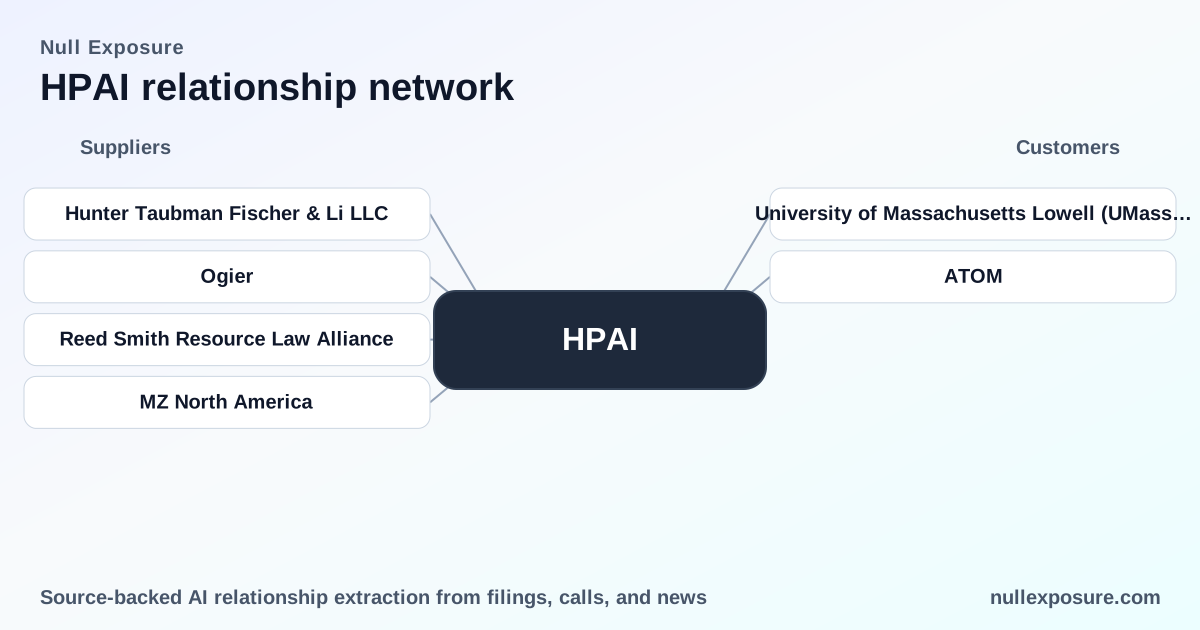
University of Massachusetts Lowell (UMass Lowell) — Helport provided platform access and training to students as part of a competition with Manning School of Business. This engagement supplied students with hands‑on exposure to Helport’s software, APIs and workshops, positioning the company as an industry partner for talent development and academic validation. According to a Yahoo Finance press release dated March 10, 2026, Helport co‑hosted the initiative and provided technical resources and tailored training.
-
Fulberto Limited — Fulberto, a British Virgin Islands entity, purchased 250,000 ordinary shares from Helport in a Regulation S private placement for $1,000,000. This transaction reflects a private capital relationship rather than a traditional customer sale, and it increases shareholder base liquidity while diluting existing equity slightly. The subscription agreement is disclosed in SEC filing coverage summarized by Investing.com (report published May 3, 2026, describing transactions executed in FY2025).
-
Youth Spring Limited — Youth Spring, incorporated in Samoa, subscribed for 125,000 shares for $500,000 under a FY2025 subscription agreement. As with Fulberto, this is a private placement purchaser and therefore functions as a financing counterparty rather than a software customer. Investing.com’s SEC‑filing summary (May 3, 2026) records the October 2, 2025 subscription.
-
ATOM (Atome — regional press variant) — Helport deployed AI‑enabled support teams for two of Atome’s financial products, with the partnership beginning May 19, 2025; this is an operational deployment rather than a simple software license, indicating higher integration and service intensity. A Yahoo Finance Canada article dated March 10, 2026 reported the May 2025 deployment and the operational nature of the engagement.
-
Atome (U.S. Yahoo variant) — The same deployment to Atome’s financial product lines is also reported on the U.S. Yahoo Finance feed, reinforcing that the Atome engagement was publicized across outlets on March 10, 2026 and that Helport’s offering includes dedicated support teams for client product operations.
-
Atome (duplicate feed entry) — An additional Yahoo Finance distribution of the Atome story shows consistent messaging across outlets: Helport delivers staffed, AI‑enabled support as part of client product rollouts, underlining their hybrid product+services model in the field (news visibility March 10, 2026).
-
ATOM (another distribution) — A further instance of the Atome coverage appears in the results, repeating the point that Helport is active in the fintech support product space and has scaled at least one client deployment into production since May 2025 (reported March 10, 2026).
(Notes: multiple identical Atome/ATOM entries reflect repeated press distribution rather than distinct, separate customers. All Atome entries describe the May 19, 2025 deployment reported in March 2026.)
What these relationships collectively disclose about Helport’s operating model
- Contracting posture — product + service hybrid. Helport sells software access and APIs, but its engagements (Atome) include staffed deployments and training, indicating revenue mixes of recurring platform fees plus higher‑margin professional services during onboarding and scaling.
- Customer concentration and criticality. Publicly disclosed commercial deployments are modest in number but operational in scope; the Atome relationship is functionally critical for that client’s product lines because Helport supplies support teams rather than only a back‑end license.
- Commercial maturity. Financials point to an early growth company: revenue of $34.9m and positive EBITDA (EV/EBITDA ~8.3), yet operating margins remain thin and quarterly EPS growth was negative year‑over‑year. The company is scaling business lines but is not yet a low‑risk, mature software incumbent.
- Capital posture and ownership concentration. High insider ownership (~79%) and near‑zero institutional participation (~0.5%) are material governance signals; recent private placements (Fulberto, Youth Spring) show Helport uses private share sales as a financing channel alongside public capital.
Investment implications: risks and upside
- Upside: Helport’s combination of platform, APIs and staffed deployments creates a differentiated go‑to‑market where early clients translate into recurring revenue and cross‑sell opportunities. Positive TTM revenue and improving top‑line growth support a growth narrative that justifies multiple expansion if margins scale.
- Risks: Concentrated ownership limits float and increases volatility; customer disclosures show selective, operational deployments rather than a diversified base; financials indicate low operating leverage today. Private placements dilute insiders modestly but also highlight capital needs during scale‑up.
- Catalysts to watch: new disclosed enterprise deployments, expansion of Atome engagement across product lines, reduction in insider share percentage as institutional interest grows, and evidence of margin expansion from productizing professional services.
How investors should monitor upcoming disclosures
- Track press releases and SEC filings for additional enterprise contracts or scaling updates to the Atome relationship. Watch for more institutional investors participating in rounds: a shift from private placements to institutional buys would materially change liquidity dynamics.
- Monitor quarterly results for margin progression: moving from 1.9% operating margin to a sustainably higher level will validate the software‑plus‑services model.
For a tactical audit of Helport’s partner exposures and to compare similar small‑cap AI infrastructure plays, visit https://nullexposure.com/ for deeper partner mapping and filing synthesis.
Bottom line
Helport AI is a focused, early‑stage software infrastructure company that monetizes through platform access plus hands‑on deployments; its disclosed customer relationships — academic engagement and an operational fintech deployment — validate the model but also expose concentration and governance quirks. Investors should reward proof of repeatable, scalable enterprise rollouts and lower insider concentration; until then, the stock behaves like a small, strategically positioned growth play with material idiosyncratic risk.