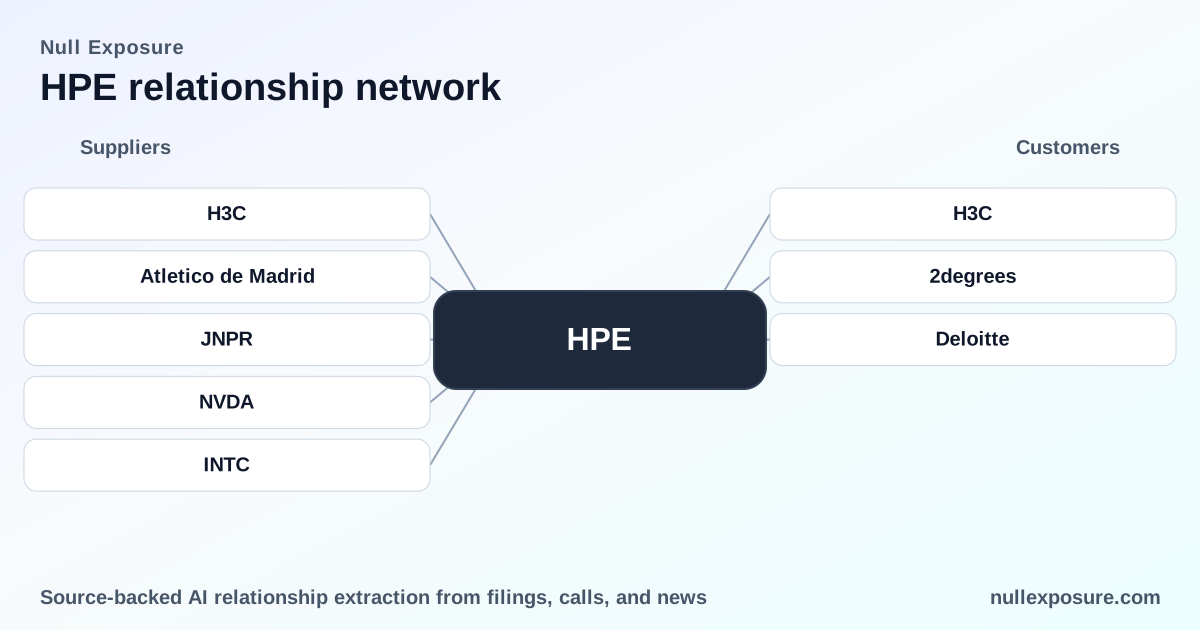
HPE’s customer footprint: where revenue, partners and as‑a‑service economics converge
Thesis: Hewlett Packard Enterprise monetizes through a mix of hardware sales, software licenses, professional services, financing and consumption-based offerings (HPE GreenLake), with an explicit strategy to shift revenue toward recurring, usage- and subscription-based models that increase lifetime customer value. For investors, the critical read is how that mix changes counterparty risk, revenue visibility and margin profile across government, large enterprise, mid‑market and channel partners.
Discover more HPE customer intelligence at https://nullexposure.com/.
The operating model investors need to understand
HPE runs a hybrid monetization engine: high‑value hardware and integrated systems provide upfront sales and gross margin, while GreenLake, SaaS and managed/private cloud products convert customers into recurring revenue streams. The company uses financing and leasing (HPE Financial Services) to smooth adoption and capture customers that prefer consumption economics.
Key company-level signals:
- Contract mix: HPE operates across short‑term and multi‑year relationships — from one‑year commercial contracts to multi‑year government and lease arrangements — and explicitly capitalizes costs of multi‑year customer contracts (source: HPE FY2025 10‑K).
- Consumption focus: GreenLake is described as pay‑per‑use and is a deliberate lever to grow ARR and recurring revenue (source: HPE FY2025 10‑K).
- Concentration & materiality: No single customer exceeds 10% of financing receivables, but distribution channels and a few large customers are notable revenue drivers (one distributor represented ~10% of accounts receivable in FY2025).
- Global footprint and counterparty mix: Approximately 61% of 2025 revenue is outside the U.S., and customers span governments, very large enterprises, mid‑market and SMBs (source: HPE FY2025 10‑K).
These characteristics imply greater revenue durability when GreenLake and subscription growth accelerate, but also different working capital and credit risk dynamics because longer recognition windows and financing arrangements increase receivable exposure.
Who is buying HPE today — concise relationship rundown
Below are the relationships surfaced in public filings and media; each entry is a plain‑English snapshot with its source.
H3C
HPE bought and sold product to H3C, recording approximately $175 million in sales to H3C in FY2025 (with purchases from H3C as well), and H3C has been the subject of share‑sale and put/call arrangements disclosed in HPE’s filings. Source: HPE FY2025 10‑K (Item: commercial arrangements and equity interests).
Bell Food Group AG
Bell Food Group is listed as a user of HPE ProLiant servers in production, signalling HPE’s penetration into industrial/processing operations. Source: SiliconANGLE article (April 30, 2026).
SLNH (Soluna / SLNH)
Soluna’s AI cloud deployment is powered by HPE GreenLake infrastructure with NVIDIA H100 GPUs, demonstrating GreenLake’s role in third‑party AI cloud capacity provisioning. Source: DataCenterDynamics (March 10, 2026).
XRX (Xerox)
Xerox management referenced migration to consumption models such as HPE GreenLake during its earnings call, indicating HPE’s role as a provider of consumption IT for established enterprise customers. Source: XRX Q4 2025 earnings call transcript.
AMD
AMD noted HPE’s December announcement of Helios Racks with HPE Juniper switches and optimized software for scale‑up networking — a product tie with implications for AI‑scale deployments. Source: AMD Q4 2025 earnings call.
DLR‑P‑K (Digital Realty)
Digital Realty signed up for HPE Private Cloud Business Edition to manage data‑center operations, illustrating HPE’s private cloud positioning with hyperscale infrastructure operators. Source: DataCenterDynamics (March 2026).
CieloVision
CieloVision uses ProLiant servers in production, reflecting HPE’s footprint in spatial intelligence and edge compute use cases. Source: SiliconANGLE (April 30, 2026).
RaceTrac Inc.
RaceTrac, a convenience store operator, runs HPE ProLiant servers in production, showing HPE’s reach into retail and edge compute deployments. Source: SiliconANGLE (April 30, 2026).
Robert Bosch GmbH
Bosch is named among global engineering customers using ProLiant servers in production, supporting HPE’s industrial and enterprise installed base claims. Source: SiliconANGLE (April 30, 2026).
EQIX / Equinix
Equinix partnered with HPE to deploy an AI factory at‑scale solution (HPE infrastructure plus NVIDIA and software stacks) in Hong Kong, positioning HPE as a cloud‑adjacent infrastructure supplier inside colocation and interconnection hubs. Source: TelecomTV (May 2026).
CHT (Chunghwa Telecom)
Chunghwa Telecom and HPE collaborated to build a disaster recovery centre using HPE Cyber Resilience Vault, signalling HPE’s role in critical telecom resiliency services. Source: TelecomTV coverage (March 2026).
IPM (Intelligent Protection Management Corp)
IPM was selected as an accredited partner for HPE’s Private Cloud AI solution, underscoring HPE’s partner certification strategy for private AI deployments. Source: The Globe and Mail / company press release coverage (2025–2026).
BLIN
BLIN referenced Hewlett Packard as a partner in a virtual summit and partner roster, indicating HPE’s channel/partner engagement in search and commerce ecosystems. Source: BLIN Q3 2025 earnings call.
2degrees
New Zealand telco 2degrees deployed HPE’s turnkey AI factory, suggesting HPE’s regional reach for on‑premise AI solutions and data sovereignty positioning. Source: FinViz / InsiderMonkey coverage of analyst commentary (March 2026).
Deloitte
HPE is the infrastructure platform for Deloitte’s CFO Insights (an AI solution running on HPE Private Cloud AI), demonstrating HPE’s enterprise software‑plus‑infrastructure go‑to‑market in professional services. Source: CFO.com coverage and Deloitte partnership mentions (March 2026).
CDW
CDW’s HPE practice manager publicly engaged around HPE workforce transitions, reflecting the distributor/reseller ecosystem and HPE’s reliance on large solution providers to sustain enterprise sales. Source: CRN (March 2026).
ULBI (Ultralife Corporation)
Ultralife used HPE servers in an initial design for ruggedized communication and control solutions, indicating HPE’s presence in specialized rugged/defense‑adjacent applications. Source: InsiderMonkey coverage of Ultralife earnings call (2025).
What this customer map means for investors
- Revenue durability is improving as HPE converts more product sales into GreenLake consumption and subscription revenue; that increases ARR but shifts recognition timing (source: HPE FY2025 10‑K).
- Counterparty mix is diversified across governments, hyperscalers, large enterprises and SMBs, reducing single‑customer dependency but increasing exposure to global macro and regulatory risks (source: HPE FY2025 10‑K).
- Channel and distributor health matter: one distributor accounted for ~10% of accounts receivable in FY2025, so partner credit stress would have outsized cash‑flow effects (source: HPE FY2025 10‑K).
- AI and private cloud use cases create higher‑value engagements, but they also require longer implementation cycles and specialized financing/leasing solutions — expanding HPE Financial Services’ relevance and credit exposure.
Bold takeaway: HPE is executing a deliberate shift from one‑time hardware revenue toward recurring, consumption‑oriented contracts; the strategy increases lifetime value and gross margin potential, but it also concentrates new forms of receivable, implementation and partner‑credit risk.
If you monitor HPE for portfolio allocation or vendor risk analysis, track GreenLake ARR, financing receivables trends, and distributor exposure in upcoming quarterly filings. For deeper customer‑level exposure and ongoing signals, visit NullExposure for continuous coverage: https://nullexposure.com/.