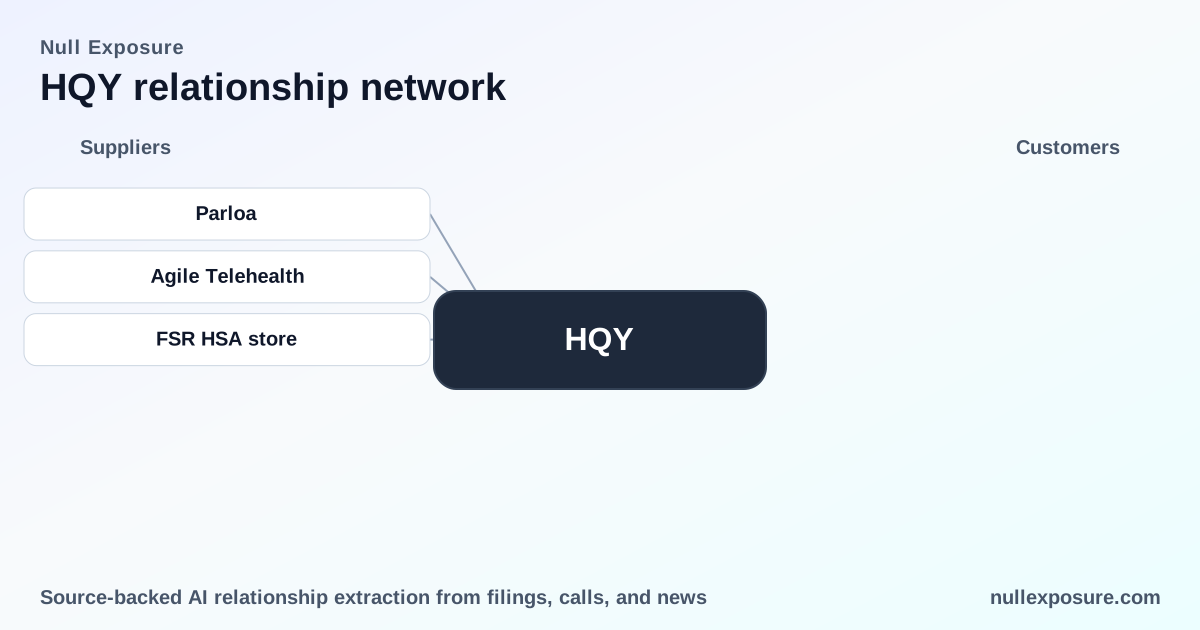
HealthEquity (HQY): Customer Relationships and What They Mean for Investors
HealthEquity operates a cloud-native, service-led platform that administers Health Savings Accounts (HSAs) and complementary consumer-directed benefits (CDBs) for employers, government programs, and individual members across the United States. The company monetizes through a three-part revenue mix — recurring service fees for administration, custodial revenue on client-held deposits and HSA assets, and usage-based interchange fees from card transactions — supplemented by asset-based advisory fees on invested HSA balances. For investors, the combination of long-lived customer relationships and transaction-driven revenue offers a blend of stability and growth optionality tied to consumer healthcare spending and platform engagement. Learn more about the coverage here: NullExposure homepage.
One-line investor thesis
HealthEquity is a service-first, custodial growth business: scale and margin expansion are driven by HSA account growth, higher assets under custody, and increased card usage — while regulatory custodial requirements and platform availability are the principal operational risks.
The single documented customer relationship: Sanford Health — why it matters
Sanford Health generated $123,923 in revenue for HealthEquity in the fiscal year ended January 31, 2026, and the relationship is expected to produce in excess of $120,000 in the current fiscal year. This is a small but identifiable enterprise client-level revenue item that highlights HealthEquity’s client mix of employers and health systems. Source: a press release covered by The Globe and Mail (May 3, 2026): https://www.theglobeandmail.com/investing/markets/stocks/HQY/pressreleases/1077704/healthequity-adds-sanford-health-ceo-bill-gassen-to-board/
What the filing signals tell investors about HQY’s operating model
HealthEquity’s public disclosures and excerpts present a coherent set of company-level signals about how customer relationships are structured and how the business behaves operationally:
- Contracting posture — long-term + portfolio accounting: HealthEquity treats customer relationships as long-lived assets for commission amortization, using portfolio averages and estimating HSA relationship lives (for example, 15 years for HSAs and 7 years for other CDBs). This signals durable contracts and embedded customer lifetime value assumptions.
- Revenue mix blends recurring subscription and usage-based economics: The company recognizes recurring monthly service fees and asset-based advisory fees alongside interchange revenue recognized at the point of card use, creating revenue that is both predictable and cyclical with consumer spending.
- Primary counterparty is the individual member, with enterprise distribution: The business model depends on millions of individual HSA holders reached through employer Clients and Network Partners; federal programs are a separate, smaller counterparty channel.
- Geography concentrated in the U.S.: All material operations and revenues are domestic, focusing investor exposure to U.S. healthcare policy and employer benefit trends.
- Platform criticality and materiality: Platform availability and custodial capacity are critical — HealthEquity derives substantially all of its revenue from HSAs and CDBs, and outages or custodial noncompliance generate material operational and financial risk.
- Company acts as service provider and seller: The firm is both an administrator (service provider / non-bank custodian) and a seller of payment and advisory services, with regulatory responsibilities (IRS non-bank custodian, HIPAA/GLBA constraints, and SEC rules for its advisory subsidiary).
- Maturity and staging: The business shows a mix of mature and ramping relationships — a large installed base (millions of accounts and tens of billions in assets) combined with ongoing account growth and technology modernization programs.
These signals should be read together: long amortization periods and custody designations underline a high customer lifetime value model, while interchange and advisory fees create near-term revenue sensitivity to consumer transaction activity.
Revenue mix and structural numbers investors should keep in mind
HealthEquity reports three primary revenue streams that reflect how customer relationships convert to cash flow:
- Service revenue (administration fees, monthly recognition),
- Custodial revenue (interest and custodial fees on client-held funds and HSA assets),
- Interchange revenue (transaction-level fees when members use payment cards).
The company disclosed fiscal-year figures showing service, custodial, and interchange contributions to total revenue, reflecting a business that combines stable recurring cash flows with growth tied to account and transaction volume.
Strategic and risk implications for investors evaluating HQY’s customer relationships
- Scale and stickiness are real strengths. HealthEquity’s designation as an IRS non-bank custodian and its large HSA base (millions of accounts; billions in assets) provide competitive moats and predictable custodial flows that support valuation multiples for fintech-enabled service businesses.
- Revenue downside is tied to consumer behavior and regulation. A reduction in HSA adoption, disruption to consumer spending, or adverse tax/regulatory changes would have an outsized effect because substantially all revenue is tied to tax-advantaged healthcare accounts.
- Operational risk is concentrated in platform availability and compliance. Cybersecurity, fraud mitigation, and maintaining required net-worth custodial thresholds are principal operational exposures that could lead to material consequences.
- Mix dynamics matter to the stock story. Improvement in interchange volume and growth in HSA assets (which produce custodial and asset-based fees) will accelerate top-line growth and operating leverage; conversely, slower card usage or lower investment adoption compresses near-term growth.
How Sanford Health fits the pattern for analysts and operators
The Sanford Health account is an example of the employer / health system client segment that routes individuals onto HealthEquity’s platform. While the reported ~$124k annual revenue is small relative to enterprise totals, it illustrates the unit economics: corporate relationships scale primarily by member adoption and ongoing transaction use, not by one-time licensing fees. Source: The Globe and Mail press release on May 3, 2026 (https://www.theglobeandmail.com/investing/markets/stocks/HQY/pressreleases/1077704/healthequity-adds-sanford-health-ceo-bill-gassen-to-board/).
Explore the broader set of HealthEquity customer relationships and constraints at NullExposure: https://nullexposure.com/.
Bottom line for investors
- HealthEquity’s customer model combines durable, long-tenor relationships with transactional revenue upside. That mix supports predictable cash flow and multiple expansion when asset growth and card usage accelerate.
- Key monitoring items for investors are HSA account growth, HSA Assets under custody, interchange volume trends, regulatory custodial thresholds, and platform security/performance metrics. These operational KPIs map directly to revenue sensitivity and risk exposure.
For analysts building scenarios, treat HealthEquity as a custody-led services business where growth is a function of distribution (employers and Network Partners), member engagement (card and investment adoption), and regulatory compliance — and where a single customer like Sanford Health is informative about unit-level economics rather than concentrated counterparty risk.