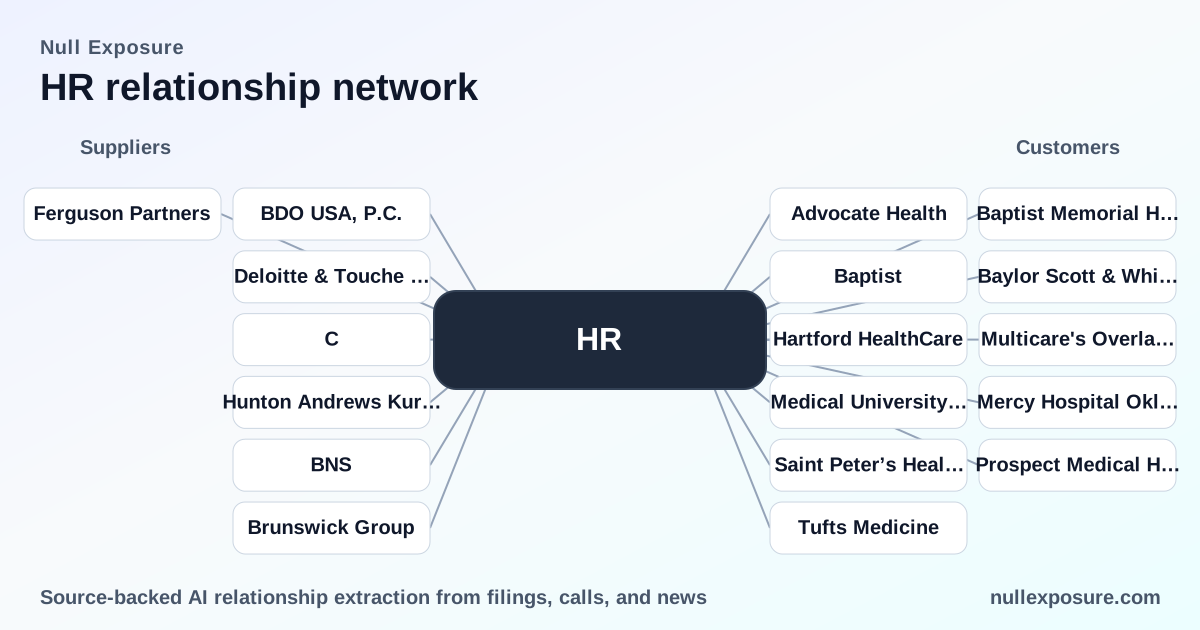
Healthcare Realty (HR): Tenant relationships that underwrite the REIT’s outpatient platform
Healthcare Realty Trust operates and monetizes by owning, leasing, managing, financing and developing outpatient medical office buildings and adjacent healthcare properties across the United States; its revenue is overwhelmingly rental income generated from long-term, non‑cancelable leases with hospital systems and health operators, supplemented by management fees and occasional seller‑financing on dispositions. For investors, the company’s earnings volatility is driven less by occupancy swings than by lease expirations, tenant credit at large health systems, and capital recycling executed through asset sales and selective financing.
Explore HR coverage and relationship intelligence at https://nullexposure.com/ (visit for the full feed).
Portfolio posture and what it means for risk and return
Healthcare Realty’s operating model is asset-driven, contract-based and concentrated on large health-system counterparties. Leases generally run across multi-year terms with a reported weighted average lease term and remaining lease tenor that reflect an institutional, long-duration cashflow profile. The company executes active property management, development and selective seller-financing; disposals are used to recycle capital and temper portfolio risk.
Key commercial characteristics that shape investment risk and optionality:
- Contracting posture: predominantly long‑term fixed operating leases with annual escalators and CPI linkages; variable elements (management fees, parking) contribute modest usage‑based revenue.
- Counterparty profile: large health systems and specialty operators form the core tenant base, introducing credit concentration risk even though no single customer accounted for 10%+ of revenue in recent years.
- Criticality and maturity: many properties are on hospital campuses or configured for specialized outpatient care — high tenant dependency and longer leasing cycles if a tenant vacates.
- Geography and concentration: portfolio exposure is national but with measurable concentrations (Dallas, Houston, Seattle among larger market weights).
These signals come directly from HR’s financial filings and recent earnings narratives (Company filings FY2024–FY2026; Q4 2025 earnings call, Mar 2026).
Deal-by-deal: the customers Healthcare Realty cited in recent filings and calls
Below are the named counterparties referenced in HR’s Q4 2025 and Q1 2026 commentary and related releases; each entry gives a plain‑English description and the cited source.
-
Advocate Health — Healthcare Realty executed multiple renewals and extensions totaling roughly 142k–154k sq ft across Charlotte, with multi‑year terms extending occupancy on campus buildings. Source: Q4 2025 earnings call and Q1 2026 results (Healthcare Realty, Mar–Apr 2026).
-
Saint Peter’s Health / Trinity Health St. Peter’s Hospital — HR signed a ~64k sq ft lease (clinic + ASC) in Upstate New York as part of a redevelopment, adding density to an Albany project. Source: Q4 2025 earnings call and GlobeNewswire Q1 2026 release (Mar–Apr 2026).
-
Baptist / Baptist Memorial Health — The company recorded substantive renewals in Memphis (c.166k–170k sq ft) across on‑campus MOBs, sustaining 100% occupancy across several buildings. Source: Q4 2025 earnings call and GlobeNewswire releases (Oct 2025; Feb 2026).
-
Hartford HealthCare (Hartford Health) — HR executed ~65k sq ft of leases in Connecticut, backfilling space formerly occupied by Prospect and improving tenant credit in the market. Source: Q4 2025 earnings call and 10‑K/press release (Mar 2026; Feb 2026).
-
Tufts Medicine — HR completed a 154k sq ft, eight‑year renewal in Boston and is investing in a $25 million modernization project at a fully leased Tufts asset. Source: Q4 2025 earnings call and GlobeNewswire Q1 2026 release (Mar 2026; Apr 2026).
-
Medical University of South Carolina / MUSC Health — HR recorded renewals aggregating ~39k–55k sq ft in Charleston, maintaining full occupancy across multiple buildings. Source: Q4 2025 earnings call, InsiderMonkey and GlobeNewswire Q1 2026 release (Mar–May 2026).
-
Mercy Hospital Oklahoma City Inc. — County records show Mercy purchased a property from HR Acquisition I Corp. for ~$106.5 million in FY2020, reflecting HR’s occasional disposition of assets to operating partners. Source: The Oklahoman report (Oct 17, 2020).
-
Baylor Scott & White Health — HR executed new leasing in Fort Worth and renewals in Austin totaling mid‑tens of thousands of square feet, supporting recently delivered developments on hospital campuses. Source: GlobeNewswire Q3 2025 release (Oct 30, 2025) and Q4/Q1 filings (Feb–Apr 2026).
-
Multicare / Overlake Medical Center — HR achieved a 25k sq ft renewal in Bellevue with a ~22% cash leasing spread, demonstrating rental rate re‑pricing on a fully occupied on‑campus asset. Source: GlobeNewswire Q3 2025 release (Oct 30, 2025).
-
White Plains Hospital (Montefiore subsidiary) — HR highlighted project leasing and tenant generation in White Plains as an example of successful on‑campus redevelopment activity. Source: Q4 2025 earnings call transcript (InsiderMonkey, Mar 2026).
-
Wellstar Health System / Wellstar — HR executed ~176k sq ft of new and renewal leases in Atlanta across six on‑campus MOBs, including a large cancer center lease, maintaining >90% occupancy. Source: Q1 2026 results release (Apr 30, 2026) and Q1 2026 transcript (InsiderMonkey, May 2026).
-
MUSC Health (duplicate reference) — See Medical University of South Carolina entry; HR reported multiple renewals preserving 100% occupancy in Charleston. Source: InsiderMonkey Q1 2026 transcript (May 2026).
-
Prospect Medical Holdings — Prospect’s bankruptcy materially affected HR operations, as Prospect was a notable tenant and its failure required re‑letting and credit remediation. Source: SEC/10‑K discussion and TradingView reporting on HR’s 10‑K (Mar 2026).
-
Steward Health — Steward rejected leases totaling ~349k sq ft in Florida and Massachusetts, with the rejected space representing roughly $13 million of annual rent, and HR recorded the operational and leasing consequences. Source: 10‑K and related filings (FY2024–FY2025 disclosures, cited Mar 2026).
-
State Street Corp., The Charles Schwab Corp., BlackRock, Inc., JPMorgan Chase & Co., The Vanguard Group, Inc. — Institutional holders and fund sponsors appear in public ETF/fund listings holding HR shares; these entries reflect institutional ownership and passive fund exposure to HR equity, not tenant relationships. Source: TradingView ETF listings and market data (FY2026 snapshots, May 2026).
-
White Plains Hospital — (See above; HR referenced White Plains as a leasing success with Montefiore affiliation). Source: Q4 2025 earnings commentary (Mar 2026).
-
Additional market and investor references (e.g., The Globe and Mail / Motley Fool transcripts) document the same tenant activities and reaffirm the leasing metrics referenced above. Source: Media transcripts and press releases (Mar–May 2026).
Constraints that shape HR’s customer economics
These are company-level signals extracted from HR’s filings and public commentary that define how tenant relationships translate into financial outcomes:
-
Long‑term lease backbone: The portfolio is dominated by long-duration, non‑cancelable operating leases with a weighted average lease term measured in years, producing stable straight‑line rental income and inflation linkage through fixed or CPI escalators. (Company filings, FY2024–2026).
-
Revenue composition and criticality: Rental income is the primary revenue line; management fees and parking are secondary, usage‑based streams. Tenant operating performance is material and sometimes critical to cashflow because many assets are specialized outpatient facilities requiring tenant continuity.
-
Concentration nuance: No single customer exceeded 10% of revenues in recent years—revenue diversification exists at the corporate level—but localized market concentrations and health system dependencies create pockets of material exposure at the property level.
-
Maturity and capital strategy: The REIT actively recycles capital through sales, mezzanine financing and seller financing; spend bands on receivables and loans range from sub‑$10m to >$100m, indicating willingness to use financing tools in transactions.
Bottom line for investors
Healthcare Realty’s tenant relationships are the business: long leases with hospital systems deliver predictable cashflow, but credit events (Prospect, Steward) and campus‑level concentration create re‑letting and valuation risk at the property level. The company’s demonstrated ability to secure renewals with strong systems—Advocate, Tufts, Baptist, Wellstar, MUSC, Hartford—supports the core thesis of stable rent rolls, while active asset recycling and selective financing clarify management’s path to preserving yield and funding growth. For a deeper relationship signal feed and modelable tenant exposure, visit https://nullexposure.com/.